




Not too long ago, Prime Minister Narendra Modi’s every word and action would be the lead story in the Hindi and English news media, up North.
Today, he still takes the lead in the headlines here and there but not everywhere. He has challengers: the Cockroach Janta Party and the youth, for starters.
Thus, it came to pass that the top story in the venerable daily newspaper The Hindu on 2 August, Delhi edition, was: “Top court quashes FIRs against Gen Z protesters.”
Turn to The Indian Express and once again, it’s CJP at the No. 1 position, admittedly with a puzzling headline: “CJP condition, Govt request: SC quashes student protest FIRs.”
This when the Prime Minister made important remarks on weeding out terrorism from its roots at the Shanghai Cooperation Organisation (SCO) summit in Kyrgyzstan on 1 August. That was given second place in both newspapers.
The PM would be happy, however, that the English newspapers with the highest circulation in Delhi, The Times of India gave his speech pride of place at the top of the front page — although he had to share the headline with Pakistan: ‘Pak takes SCO chair, Modi slams use of terror as strategic asset’ read TOI’s heading.
The Hindi newspapers were divided between giving the PM’s speech top billing, bringing good news to some of their Delhi readers and bad news for the samosa in Mumbai.
Amar Ujala and Navbharat Times’ Delhi editions headlined free solar heating panels for 2.30 lakh homes in Delhi, followed by the SC’s decision to quash FIRs against protesters on Page 1.
And the Mumbai Navbharat Times highlighted the Maharashtra government’s decision to replace “oily snacks” with a “healthy menu” for official meetings. Goodbye samosa and kachoris….
All the newspapers carried the PM’s call to combat terrorism in straightforward reports. The Indian Express and the Hindi Hindustan went further – they wrote editorials stressing the importance of the SCO summit.
Ho-hum.
Also read: English news channels have Rahul Gandhi. Hindi media has onions, schools and swine flu
Pleasing sight on TV
The Prime Minister would have been pleased with Indian television news.
News channels frequently went ‘live’ for coverage of Modi at the Bishkek summit. They also discussed everything from India’s soft power (as he watched a yoga and classical dance performance staged exclusively in his honour) to India as a superpower.
However, the PM might have been less overjoyed by the way most of them reduced his presence at the SCO summit and his interactions with leaders from other countries to photo ops, ‘a double handshake’ or a podium placement. That robbed his meetings of the seriousness they deserved.
When the PM met Russian President Vladimir Putin, the news channels singled out two notable outcomes: first, the leaders shook hands twice, said TV9 Bharatvarsh.
India Today noticed more—“a firm, warm handshake.”
“Historic handshake,” summed up NDTV 24X7.
Second, they travelled together in the same car to witness the VI World Nomad Games. They have done so on other occasions too–for instance, at the previous SCO summit in Tianjin, last year.
Still, NDTV thought it signalled a ‘New chapter in Modi-Putin ties’.
Also read: What TV media and newspapers saw in PM Modi’s Dimagi Naxal remark
Handshake and cropped image
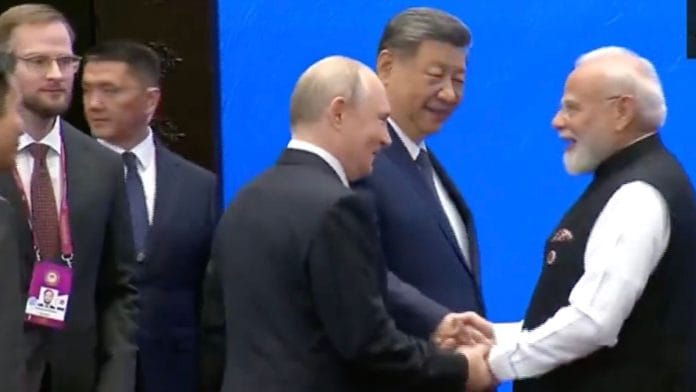
The next moment that caught the eye of TV news cameras was Modi’s encounter with President Putin and Chinese President Xi Jingping. As Putin and Xi approached Modi, he extended his arms and shook hands with both of them.
‘PM’s double handshake is a highlight of the SCO meeting,” said the India Today anchor.
“The hall is filled with the NaMo mantra,” said Times Now Navbharat. “See how he wanted to give a message to the world…”
The video clip of this haath milan played out throughout Tuesday across news channels as a key takeaway of the summit for India.
Onto the photo of all the leaders on the podium. “3 Superpowers 1 stage,” wrote Republic.
The anchor on CNN News 18 was looking elsewhere. Speaking to her reporter, she remarked, “You see the distance between Sharif (Pakistan’s prime minister) and the PM…”
In fact, five leaders stood between Modi and Shehbaz Sharif. The Pakistani PM was standing next to President Putin whereas PM Modi was at the other side of the line-up.
This photo led to an afternoon of fuss and anger. Republic, CNN News 18 noticed that Pakistan published an edited version of the photograph on its official site. “Shameless,” it commented. “Pakistan crops out PM Modi’s image.”
Other channels were equally annoyed and ran this story continuously until late Tuesday afternoon, when they noted Pakistan’s ‘damage control’—the original photo of all the leaders on the podium had been published by Pakistan, replacing the edited one.
On Wednesday, several Hindi newspapers also reported on Pakistan’s ‘shameless’ act — Punjab Kesri and Navbharat Times, for example.
Also read: TV news showed the CJP protest live. Then it rewrote the story on primetime
Global media on Modi-SCO
Away from the single and double handshakes and cropped photographs, a few international newspapers reported on Modi at the SCO in a geopolitical context.
The New York Times analysed the summit from the point of view of China leveraging its power in the region –‘Summit With Russia, India and Iran Shows Leverage Wars Have Given Xi of China’.
The South China Morning Post in, “Aloof but engaged: what India’s SCO comeback reveals” wrote, “Analysts say New Delhi’s revived engagement with the 10-member bloc reflects both its hedging against an evermore unpredictable United States and its desire to counterbalance China’s influence at the SCO…”
And from Iran, the Tehran Times notes Iran’s President Pezeshkian’s “talks with Indian Prime Minister Narendra Modi were particularly significant against the backdrop of sanctions and regional tensions.
“The Iranian president emphasized the extensive potential for cooperation between Tehran and New Delhi in economic, political, scientific and cultural fields, arguing that closer bilateral ties could help mitigate the effects of sanctions.”
These goals may be less eye-catching than handshakes but surely more important?
The author tweets @shailajabajpai. Views are personal.
(Edited by Prashant Dixit)
Three superpowers??!!
China – Yes.
Russia- Broken!
India- Long way to go get basics for the people!!
Hyperbole…