






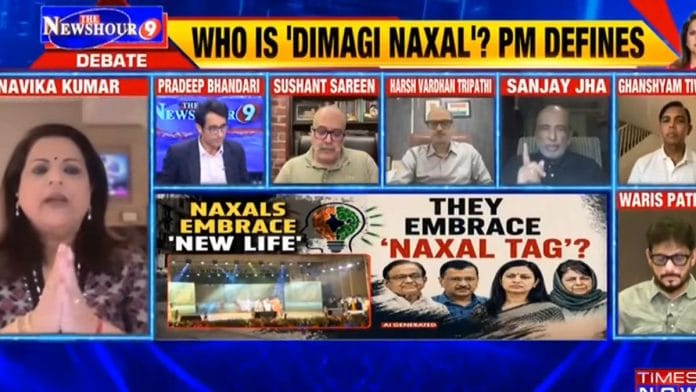


Dimagi Naxals were on everybody’s mind after Prime Minister Narendra Modi spoke of them in his Independence Day speech from Delhi’s Red Fort.
No wonder it made news throughout the weekend and into Monday alongside the controversy over Congress leader Sonia Gandhi’s alleged attempt to “stop” the singing of Vande Mataram in its entirety during the flag-hoisting at Congress headquarters on 15 August.
What followed in the news media was a tussle between the BJP and Congress to promote their conflicting narratives. Television news witnessed the seesaw battle: one moment, the Congress attacked the BJP on ‘Modi’s dimag mein keeda’ (bug in the head), the next, the BJP was on the offensive about Sonia’s Vande Mataram moment.
Before we knew it, a Dimagi Naxal Party had sprung up on social media and was duly recognised by newspapers such as The Economic Times. The paper found it had close to five lakh members on Instagram.
By the way, the episode also inspired a song overnight.
A profound confusion
Much of the debate on TV news channels concerned the identity of the ‘Dimagi Naxal’.
“Who exactly is a Dimagi Naxal?” asked anchor Navika Kumar on Times Now.
Youtuber Ravish Kumar was equally confused. On his channel, he arrived with a plastic model of the brain. He said a ‘neuro expert’ was needed to explain where the ‘Urban Naxal’ resided in the human brain, and where the domain of the Dimagi Naxal fell.
CNN News 18 India anchor Rahul Shivshankar read the prime minister’s mind and between his lines, saying Modi didn’t mention “who he was directing his phrase towards. It’s a coinage.” So, Shivshankar acted as the interpreter of Dimagi Naxal maladies and identified those he thought fit the phrase: “idealogues” in Jammu and Kashmir and the Urban Naxals.
Opposition leaders rushed to identify themselves as Dimagi Naxals. P Chidambaram, Arvind Kejriwal, and Mahua Moitra were among the first to join the ranks.
BJP’s Assam chief minister Himanta Biswa Sarma characterised Congress leader Chidambaram as a “Naxal”, pure and simple. (Times Now)
The Opposition claimed the PM was wagging his finger at Gen Z and the Cockroach Janta Party-led protests in Delhi during July. Such was the backlash on social media and TV news that Union minister Kiren Rijiju was forced to define the term.
This debate over Dimagi Naxals raged “fast and furious”, in Navika Kumar’s words, across TV news channels. So much so that the discourse elbowed out PM Modi’s “saptdhara” (seven streams) mission for youth and the future of the country, which was at the heart of his Independence Day speech.
Also read: Indian politicians need to learn to take a joke
What papers made of ‘Dimagi Naxals’
Several English newspapers made up for TV’s indifference to Modi’s “seven streams” of development:
‘7 pillars, 1 goal: PM lays out blueprint for “Viksit Bharat”’ (Hindustan Times, 16 August, Page 1 lead)
‘Youth will power our journey to Viksit Bharat 2024, say PM’ (The Indian Express, 16 August, Page 1 lead)
The second page 1 story in both newspapers dwelt on India’s ‘Dimagi Naxal’ problem as identified by PM Modi. However, The Times of India was bolder:
‘Armed Naxal gone, now identify and isolate “Dimagi Naxals”: PM on I-Day’ (The Times of India, 16 August, Page 1 lead)
All of these stories faithfully quoted the prime minister’s speech and then offered rebuttals by the Opposition parties. However, in their editorials, The Indian Express and The Hindu were more worried by the PM’s reference.
“Mr Modi sought to offer hope, inspiration and purpose on the one hand, while on the other, build a new phantom labelled ‘Dimagi Naxals’,” The Hindu wrote in ‘United and free’ on 17 August.
The article ended with the statement that the PM “sees… an enemy in every critic… perhaps he could consider new ideas, including those from his critics, instead of amplifying divisive ones”.
The Indian Express outlined the PM’s “reform vision”.
“But the speech had a sharp edge… (PM said) there is need to remain wary of the danger posed by ‘Dimagi Naxals’,” it wrote on 17 August.
The newspaper found this “troubling”.
“There is no place for isolating or targeting anyone on the basis of their ideas – their ‘dimag’,” the paper added.
Other newspapers were kinder to PM Modi or simply bypassed the ‘dimag’. Hindustan Times’ editorial on the Red Fort speech, ‘A road map for progress’, didn’t mention Dimagi Naxals at all.
The Telegraph (Kolkata) found the debate tiresome.
“The controversy was a bit like the proverbial storm in a teacup. Mr Modi’s reference to the ideological supporters of Naxalism in a speech meant to outline India’s route to progress was surprising; was it essential? The reaction of his opponents was puerile. A better alternative would have been a sharp, constructive criticism of the prime minister’s larger vision on national growth,” the paper said in its editorial, ‘Facile debate’.
Since the ruling party and the Opposition found it more rewarding to discuss Dimagi Naxals, this advice went unheeded. The debate subsided only when the Congress and the singing of Vande Mataram became the next topic of contention.
Also read: India’s states announce policies but don’t make documents public. It’s bad for business
Satyaki Savarkar’s baseless claims
As a postscript, I have to mention the curious case of VD Savarkar’s grand-nephew Satyaki Savarkar. He had filed a defamation case against Rahul Gandhi for the Congress leader’s alleged remarks on the Hindutva ideologue.
In the course of a Pune court hearing this week, Satyaki claimed that Nathuram Godse was an active RSS member when he assassinated MK Gandhi.
For some unknown reason, Times Now decided to interview him. He repeated his claims. He also said that after Godse shot Gandhi, the latter lay on the ground for 20 minutes unattended and was left to die instead of being taken to a hospital.
There is no historical basis for this claim, and Times Now ought to have established this immediately. Better still, it ought to have resisted the temptation to air Satyaki Savarkar.
What ‘dimagi soch’ was behind this?
The author tweets @shailajabajpai. Views are personal.
(Edited by Prasanna Bachchhav)