




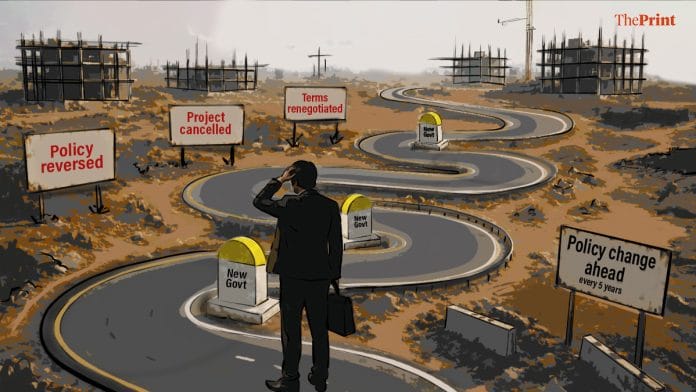

India’s states are the primary drivers of the country’s economic growth, yet they have vastly different, and often opaque, methods of publishing the policies and legislation that investors, businesses and the public depend on. Legislation passes, schemes and programmes are announced, and administrative orders are issued, but the underlying documents frequently never reach the public domain.
This is not for lack of ambition. The central government’s push to digitise citizen services and ease business requirements has been substantial. But at the state level, where growth is actually won or lost, the gap remains wide and costly.
For over 10 years, the Washington DC-based Center for Strategic and International Studies (CSIS) has been tracking policymaking at the state level. In 2023, we also began tracking what happens after states announce policies—do primary-source documents needed to support implementation actually enter the public domain?
Since then, our tracker has recorded 438 policies announced by numerous states without the policy documents being published on government websites. Of these, 24 primary-source documents were published much later, but the remaining 414 announced policies (94.5 per cent) still lack a primary-source document to this day.
Policy transparency matters in a number of ways. Investors and businesses need predictability and stability to make long-term capital commitments. Businesses can plan supply chains, hiring and expansion when regulatory timelines and criteria are clear and publicly available. Compliance costs are reduced when businesses can access policies without navigating complex government websites. Publishing policies in a timely manner helps build trust and confidence.
To illustrate, Delhi approved a Start-up and Incubation Policy in early July 2026, but the document available on the Delhi Department of Industries website is the draft policy from 2025. Neither the Industries Department nor Delhi’s Udyog Mitra (Business Partner) Portal reflects the updated policy. In fact, under the Policies and Notifications drop-down menu on Udyog Mitra, a user clicking on the Industrial Policy is directed to Delhi’s Industrial Policy approved in 2010, under then Congress Chief Minister Sheila Dikshit.
Also Read: Modi govt’s ambitious policies lack a key element—processes
Where policies go missing most
The sourcing gap is not evenly distributed. The bulk of the missing policy documents come from a cluster of 10 states that account for 241 of the 414 missing policies (58 per cent). Of these, Uttar Pradesh, Haryana, Tamil Nadu and Gujarat showed the greatest gaps, with a 100 per cent missing rate— not a single missing policy tracked by CSIS over the last three years was found to have its primary document updated in the public domain.
After these four, Andhra Pradesh was the next worst performer with a 97 per cent missing rate, followed by Delhi and Odisha, both with a 96 per cent missing rate.
The categories most affected are precisely those most relevant to investors: infrastructure and governance-related policies account for 113 missing entries, and industrial policy and business regulation-related policies for 94. Together, they also represent nearly half of our entire backlog.
Our data points to two problems. The first is straightforward: policies exist but are not published online. The second is harder to fix: roughly 30 per cent of the backlog comprises administrative actions, such as a state “approving” or “issuing guidelines”. These “executive actions”, often taken in cabinet meetings or by the chief minister, should have corresponding orders published to support implementation, but they are not always shared online.
State gazettes, for example, tend to publish legislation and do not always include policies outside the legislative domain. This is a structural problem, not merely a research gap.
Also Read: When ‘delayed’ becomes ‘ongoing’, the growing transparency gap in India’s infrastructure
Make policies findable, trackable & timely
Addressing the problem requires serious institutional changes. There are a few ways in which the Union and states can do so.
First, each state should maintain one authoritative, publicly accessible legal and policy repository. A government website should mirror a search engine: citizens should be able to search and locate relevant documents based on a few key words.
Second, the state information and public relations departments, through their networks of Public Relations Officers (PROs), should work alongside all state ministries to ensure that policies and documents are published in a timely manner in one repository.
Finally, NITI Aayog should offer direction to states to ensure that they publish policies using the latest technologies. NITI should also consider including this transparency gap when ranking states on ease of doing business.
India’s states are its economic future, but opaque policymaking undermines investment and trust. Until state governments publish legislation and policies that are findable, trackable and timely, the transparency gap will continue to hinder progress.
Aryan D’Rozario is Associate Fellow, and Iram Siddique is Research Intern for the Chair on India and Emerging Asia Economics at the Center for Strategic and International Studies. Views are personal.