






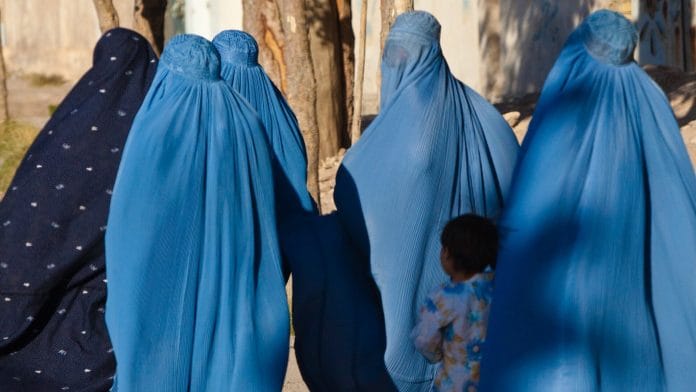


Long after the black-turbaned shadow who ruled the Islamic Emirate had prohibited happiness for Afghan women, it refused to be erased. Light danced over faces exposed to the summer sun; melodies were sung at weddings and on social media; flashes of colour glinted off makeup hidden in a secret beauty parlour; words were whispered in underground classrooms run from a back room; fists landed against padded bags at Taekwondo classes. Each month, hundreds of women found to have defied the Emir’s hundred-page edict on the new moral order have been flogged in public or even shot dead in cold blood. This is a war against women—and in wars, people die.
Five years after Kabul fell to the Islamic Emirate, world leaders are quietly marketing their acceptance of this regime as realism. In the pursuit of national interests like counter-terrorism, or containing the flow of narcotics or stemming human trafficking. Even if the Taliban’s values are repugnant, the argument goes, the world must hold its nose and do what it must.
Leaving aside Russia, no nation has granted the Islamic Emirate of Afghanistan formal diplomatic recognition, and the United Nations has refused to let the Taliban take their country’s seat. Yet, more than a dozen countries operate their diplomatic missions in Kabul as normal. European nations, eager to remove Afghan refugees, have resumed deportations to Kabul.
A moral choice has been made: More than 22 million women living under a system of subjugation more savage than South African Apartheid just do not matter enough for the world to care.
Freedom lost
Timur Shah, Abdur Khaman, Habibullah Khan Barakzai, Amanullah Khan Barakzai, Nadir Shah, and Zahir Shah. Three months after 9/11, journalists who entered the conference room of the new republic’s Information Ministry were watched over by the kings who built Afghanistan. There was just one portrait with a woman, a reproduction of a photograph of Amanullah with Queen Soraya Tarzi. She was a radical who tore off her Hijab at an assembly of tribal elders in 1928, and founded the country’s first schools and hospitals for women. In the picture, Tarzi had been covered-up with a veil that hung down over her body, all the way to the floor.
Laura Bush, the United States first lady, speaking two days after the Taliban had been evicted from Kabul in September, 2001, announced that “The fight against terrorism is also a fight for the rights and dignity of women.” The portrait was a warning of how difficult that fight would be.
Emir Abdur Rahman—the ruler who laid the foundations of the modern Afghan state—had introduced shari’a law in the late 19th century, as part of a wider effort to displace local identities with a single, overarching national culture. The selling and exchanging of wives, historian Amir Tarzi writes, were proscribed, and Islamic laws came to replace the tribal customs that denied women the right of inheritance. For the first time, Afghan women could litigate for their rights; a serai in Kabul was set aside for women who came to the city to argue cases.
Local shari’a courts, anthropologist Ashraf Ghani has shown, avoided barbaric punishments like stoning-to-death, even when adjudicating cases involving infidelity.
The much deeper efforts at gender reform made under King Amanullah ended up precipitating a revolt, though,. Efforts to emancipate women did not end. King Zahir set up faculties of medicine, the sciences and the humanities exclusively for women, in the mid-1940s. The king’s cousin, Prime Minister Daud Khan, who deposed him and set up a one-party republic, ensured his two wives, and those of other senior officials, appeared unveiled at the 1959 independence day celebrations.
As Laura Bush noted in her speech, there was dramatic progress in the decades after: “In 1977, women comprised more than 15 per cent of Afghanistan’s highest legislative body,” she said. “By the early 1990s women comprised 70 per cent of schoolteachers; Women made up 50 per cent of government workers; and 40 per cent of doctors in Kabul were women.”
Then, she did not say, America took the hammer to it all.
The national interest?
Three years before the September 11 attacks, former United States National Security Advisor Zbigniew Brzezinski was asked if he regretted unleashing global jihadists in Afghanistan.
“What is more important in world history?” he replied, disdainfully. “The Taliban or the collapse of the Soviet empire? Some agitated Muslims or the liberation of Central Europe and the end of the Cold War?”
As Brzezinski would admit, the US had long sought to bait an economically fragile Moscow into going to war. For Brzezinski, the anti-Soviet jihad that began in 1979 was an inexorable consequence of Cold War competition.
Yet, 9/11 made it impossible to avoid the question: What was the national interest? Even though diplomats all claimed to be guided by the national interest, just what it was wasn’t self-evident. Edward Carr, the historian whose work, The Twenty Years’ Crisis, 1919-1939, is considered among the key building blocks of hard-headed realism, argued that power and need drove nations, not norms or ethical considerations.
This position, however, led the historian into a position of indifference toward the crimes of totalitarian states.
Thus, the 1939 edition of Carr’s book applauded doomed efforts to appease Adolf Hitler. He argued, too, for “assuming British predominance over western Europe as a quid pro quo for Soviet dominance over the east.” The uglier passages were excised from a second edition in 1946.
Even today, some historians argue that the United Kingdom erred in going to war against Nazi Germany. The historian John Charmley, for example, has asserted that the country ought to have sought an accommodation with the Third Reich, since the war left it without an Empire. The conservative writer Patrick Buchanan, who served as advisor to three American presidents, made a similar argument in his 2008 book. This would have had obvious consequences for all those at the receiving end of Nazi genocide.
America’s Cold War campaign against the Soviet Union also involved ethical choices. From 1973 on, the scholar and diplomat Husain Haqqani has written, Islamabad and Kabul became locked in “a low-intensity proxy war.” The Afghan government’s efforts to ensure women received an education, and could marry by choice, led to a succession of rebellions.
The Inter Services Intelligence Directorate threw its weight behind Islamists like Gulbuddin Hekmatyar, hoping to deter Afghanistan from seeking territory in the North-West Frontier Province.
The American-led jihad which began in 1979 was to destroy the hopes that had emerged for a society in which Afghan women might have a voice.
Also read: Russia’s role is now to feed China. The Xi–Putin bond is like a loveless marriage
The end of equality
From 1989, the signs of a new order were visible in the refugee camps around Peshawar. In 1989, psychologist VM Moghadam records that orders were issued for women “not to wear perfume, noisy bangles or Western clothes”. Veils had to cover the body at all times and clothes were not to be made of material which was soft or which rustled. “Women were not to walk in the middle of the street or swing their hips; they were not to talk, laugh, or joke with strangers or foreigners.” The Islamists cast Kabul as a centre of sin, anthropologist Julie Billaud writes, “precisely because of the high visibility of educated, emancipated urban women.”
“Every new Algerian woman unveiled,” the Algerian writer Frantz Fanon had declaimed, “announced to the occupier an Algerian society whose systems of defencee were in the process of dislocation, open and breached.” Afghanistan’s Taliban resolved this problem by exercising complete control over the bodies of women.
As the Taliban began executing women in Kabul’s football stadium—while vendors sold pistachio nuts to a cheering crowd—Muhammad Ghaus, the Taliban’s foreign minister, led an expenses-paid delegation to oil giant Unocal’s headquarters in Sugar Land, Texas, at the end of 1997. The clerics, housed at a five-star hotel, were taken to see the NASA museum, several supermarkets and the local zoo.
Even though American diplomats were aware of crimes against women—the closing down of schools, the denial of medical care facilities, public floggings and institutionalised child-rape—the relationship never broke, right up to the September 11 attacks.
From recent history, we know nations have fought not just to protect their interests, but also for principles, many times since the Second World War: The East Pakistan war; Tanzania’s 1978 war to overthrow the despot Idi Amin; the West’s intervention in Kosovo; the struggle to bring down Apartheid. There is nothing to stop the world from acting against 22 million women being held in a gigantic prison by a sadistic regime—unless 22 million just don’t matter that much.
Praveen Swami is Contributing Editor at ThePrint. His X handle is @praveenswami. Views are personal.
(Edited by Ratan Priya)