



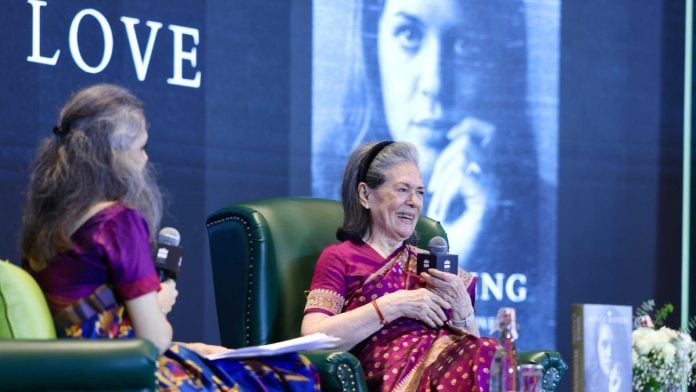
In her autobiography Belonging, Sonia Gandhi has created an entirely new template for the Indian political memoir. A new genre has been born. Into the staid procession of bloodless volumes by public figures — books that tell us everything about their careers and little to nothing about their personal lives — has now arrived a blood-and-guts, unguarded confessional. A book that lays bare grief, fear, love and loneliness in a way that Indian public life has rarely allowed.
For decades, the Indian political memoir has been an exercise in self-curation. A laundered record of achievements in which the author stands like a statue rather than a person. Belonging breaks that mould. It takes down the statue to give us something far more eye-catching: the real woman.
Here’s a fun fact. India has had 14 prime ministers since 1947. Not one of them has written a tell-all memoir of their years in power. Jawaharlal Nehru, India’s first and greatest prime minister, was an exceptional writer and a scholar-statesman. But Nehru’s beautifully written and deeply introspective autobiography was written in a British jail and published in 1936, more than a decade before he took office. Nehru left no account of 1962, the war that broke him.
It’s not for want of truth-telling. Both Nehru and Indira Gandhi were emotionally articulate and opened up easily on paper. They wrote copious, revealing letters to their friends — Nehru even wrote candidly to his colleagues — and to each other, and both gave remarkably frank interviews. But neither wrote a memoir that truly laid bare their years in office.
There’s a nice irony here. Two volumes of letters between Nehru and Indira Gandhi, Freedom’s Daughter and Two Alone, Two Together, were edited by Sonia Gandhi. My 2017 biography of Indira Gandhi became a bestseller, I believe, because it was full of personal insights and anecdotes, the human details that “political” books so often leave out.
Morarji Desai’s two-volume The Story of My Life, published in 1974, three years before Desai became PM, is as austere as the individual. It is analytical about politics but says little about personal ups and downs. Beyond blaming Indira Gandhi’s power play, it reveals almost nothing about what the 1969 Congress split may have cost him personally.
PV Narasimha Rao hid behind fiction. In 1995, as a reporter with Outlook magazine, I broke the story of Rao’s still-secret, unpublished novel, complete with a romantic subplot. My story was a lead in the inaugural issue of Outlook. I remember reading the manuscript and thinking that the protagonist was so transparently Rao himself that it was hard to see why he hadn’t simply written about his own life. By the time the novel appeared as The Insider, the romantic bits had mostly been edited out, and what remained was rather bland. Rao’s version of the run-up to the Babri Masjid demolition, Ayodhya: 6 December 1992, appeared only after his death, and it reads like a personal defence, not a personal memoir.
IK Gujral called his memoir Matters of Discretion, and it lived up to its name by steering clear of anything personal. Atal Bihari Vajpayee and Manmohan Singh wrote no memoirs. For my biography of Vajpayee, I had to piece together his unconventional personal life from his friends and confidantes. For all Vajpayee’s prolific poetry, he never wrote about it.
LK Advani, who never became PM, did write. My Country My Life is a doorstopper, rich in rath yatras, party history and ideological proclamations. But the inner Advani — beyond the ups and downs of his ‘friendship’ with Vajpayee — stays firmly offstage. As for Narendra Modi, the flood of biographies since 2014 is an assembly line of paeans that are not only rather dull but also reveal a quiet contempt for the reader’s intelligence.
Into this long silence comes Sonia Gandhi’s Belonging. Readers are riveted and I think the reason is simple. We have never had a political memoir like this before.
India’s political memoirs follow a set formula. The author tells a weighty political story, ponders at length on grave national issues, glorifies his own role, settles scores, defends his or her record and reveals a great deal about everyone except themselves.
Sonia Gandhi has turned the formula upside down. On politics she is careful, even cautious. Those hoping for a full reckoning with the Congress’s decline or for explosive political headlines will not find them here.
But on herself, she holds back almost nothing. She writes of losing her first child, born prematurely in 1969, and of insisting on a burial at the family farmhouse. She writes of her Italian family, her later struggle with cancer and the trauma and depression that dogged her after the assassinations of Indira Gandhi and Rajiv Gandhi. She writes of quaking before her mother-in-law’s temper as a young bride, of the sharp disagreements with her sister-in-law Maneka, of how hard it was to give up her Italian citizenship, and of two children who did not want their mother to be prime minister. The emotional landscape is drawn in clear, contrasting colours.
The thread through it all is in the title. Belonging is the story of someone struggling to belong to a family, a household and a country, and of how that struggle opened into a deep love and redemptive acceptance. The book also explores what belonging means. Not necessarily just birth in a particular territory; belonging also means falling in love and making a choice to belong.That is the new template. Confessional, unapologetic about her dutiful, family-first loyalties, and tell-all on the personal front.
Also read: There are 3 different books in Sonia Gandhi’s memoir
Belonging, before and after
Why has no senior public figure in India written such an intensely personal autobiography before? I can think of three reasons.
The first is our cult of hagiography. We turn leaders into VIPs and demigods, and demigods are not supposed to have insecurities, personal struggles or bouts of self-doubt. To admit that you were frightened, or lonely, or wrong is to hand your opponent a potent weapon or admit weakness. Let the mask slip and you open new flanks for attack.
The second is our compact of silence about private lives. No sex, please, we’re Indian. We have no prying media of the British tabloid kind, and politicians are intensely cautious about anything personal. Vajpayee’s decades-long relationship with Mrs Rajkumari Kaul, which the RSS thoroughly disapproved of, was something all of political Delhi knew but almost nobody printed. Vajpayee never hid it but never spoke of it either. The discretion of the press and Vajpayee’s own silence protected his privacy. But people were thus denied a full picture of the man.
The third reason is less flattering. Most of our leaders are dyed-in-the-wool politicians who lead fairly humdrum, almost dull personal lives. The life of a traditional patriarch and householder is unlikely to keep many readers turning the pages in our attention-deficit times.
Sonia Gandhi, by contrast, is a memoirist’s dream. A girl from small-town Italy marries into India’s first family. She cradles her blood-soaked mother-in-law, is widowed by an assassin, turns down the prime ministership and leads the Congress longer than anyone before her. It is a tumultuous, extraordinary life.
It has also been a hidden one. For two generations the Gandhi family has been an enigma, wrapped in aura and distance. The fascination with this book is in direct proportion to that silence.
A memoir like Belonging humanises a public figure. In an age of managed images, PR campaigns and scripted appearances, it offers a way to touch voters’ hearts directly and personally. But it demands a kind of courage our politics rarely rewards: the courage to say, I was afraid, I grieved, I wept, I felt I did not belong. It takes the courage of Mahatma Gandhi, who wrote with disarming openness about his experiments with truth. It’s the courage our national motto asks of us — Satyameva Jayate. Let truth prevail.
So has Sonia Gandhi opened the floodgates? I don’t believe so. Few leaders will risk writing a new Experiments with Truth. Almost no one will take such a risk. But at least a new template now exists. An Indian politician has shown that you can reveal yourself and not only survive, but even grow in the telling. Revealing the personal does not diminish stature; it adds to it.
This is what makes Belonging a watershed. It may change how leaders see themselves and how we see them: not as cardboard cutouts or statues or faces in the headlines, but as fellow human beings.
Sagarika Ghose is a Rajya Sabha MP, All India Trinamool Congress. She tweets @sagarikaghose. Views are personal.
(Edited by Prashant Dixit)