





When ChatGPT and other generative AI tools were first released at the end of 2022, they were quickly, obviously, and anxiously recognised as proficient in a variety of creative domains.
AI soon created a song mimicking Drake and The Weeknd. A year later, it “Ghibli-fied” the internet by enabling anyone with access to the latest ChatGPT model to create images in the style of Hayao Miyazaki, the co-founder of Studio Ghibli. Hand-drawn, soft-palette imagery, which takes the animators at Studio Ghibli a month for a minute of finished footage, was now being generated in seconds with prompts like “render this picture of my wife, our computer, and I into a Studio Ghibli-style anime with soft, painterly textures and gentle linework.”
I watched people in these professions—music, design, the visual arts—squirm with a sort of glib satisfaction. As a writer, it seemed to me that writing of all kinds—comedy, fiction, ads, screenwriting, poetry, non-fiction, journalism—would remain the province of the human creator. AI-generated “slop” seemed to be so easily distinguishable from solid human writing.
But now, with the Commonwealth Short Story Prize being awarded to an allegedly, at least partially, AI-generated story, I am not so sure. The story was also carried by Granta, one of the world’s premier literary magazines.
AI writing is not suddenly on par with or better than human writing, but people at large, and the most hallowed literary institutions of our times, are all sufficiently confused about what good writing looks like.
Unlike code and mathematics, where sheer computation and machine learning techniques can create immense progress, writing is a sort of rule-based yet anti-obvious, consciousness-driven artform where just following the rules does not result in good output. Which is why an AI-written story, wholly or partially, being judged by experts in the field as award-winning is a turning point.
This isn’t about how tell-tale AI writing is. It is about whether a machine can translate feelings and lived experience into prose that actually means something, or synthesise connections between disparate fields to come up with insight, nuance, and criticism. But it has no such feeling, lived experience, or advanced lateral thinking—yet.
I have a unique vantage point as an essayist, part-time journalist, and generalist writer, who currently works at an agentic AI company.
And it looks like the commodification of writing has finally led to human writing getting the social and economic value it was due, especially in a country like India. AI makes it easy to build and ship products, but selling them still requires talent that is not easy to automate. Literature, the humanities, storytelling and “taste” are now getting the respect once reserved only for “hard” subjects. We’re witnessing the rise of the “Corporate Storyteller”, as more writers and journalists take up employment in the marketing or communications departments of tech companies.
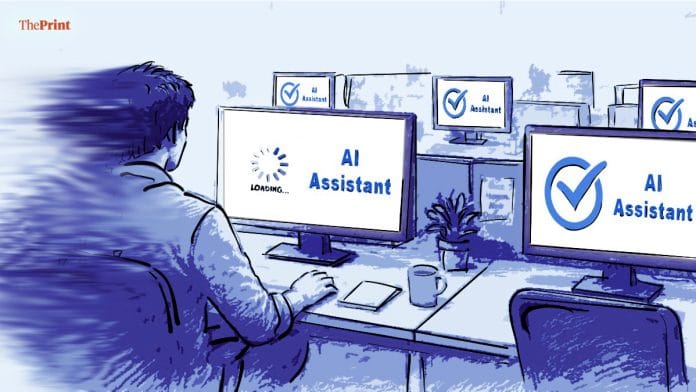
A large part of the corporate storyteller’s work involves fixing or correcting the bad AI-generated writing, as entry-level marketing becomes outsourced to AI tools. They must also keep up with AI and the growing intensity of work with it—to experiment with new models and features and look for an edge where something can be automated. AI is used to produce email copy, blogs, to automate outreach, SEO, and various workstreams or functions entirely.
And with every company now using AI for these, causing what might be the end of thought leadership itself, we need to have humans writing brand copy again.
Also read: Agentic AI is the real threat to white collar jobs. It’ll spell more trouble for Indian middle class
Questioning the gatekeepers
What is more interesting to study is on the other side of the line. In the realm of literary fiction, as an AI-written sentence might begin—am I AI? Is this AI-generated? Let us test the limits of your confusion and paranoia!—imagery, metaphor, texture, interiority, dialogue; these make all the difference
But the story at the center of the CW controversy is so laden with these devices that it reads as obviously bad. Not just because of any chance of AI, but because of the parodic density of “lush, evocative” sentences. The story seems to have come from someone who has just been told what fiction is and has tried to create their own for the first time. Nearly every sentence has some contrived analogy: “Hard living lays itself on a man like wet sacking”; “Air clung thick as porridge skin”; “Sound as if sound were taxed”: “Coins slid across the counter and came back white rum hot as apology”; “The girl smiled like sunrise over a sink.”
What do any of these sentences mean? Why was any reader impressed by this kind of story? It isn’t bad in the way that AI slop usually is. It’s bad in the original way writing is bad. It seeks to imitate an idea of good literary fiction.
The accusation that some of their winning stories are AI-generated finally confirmed a feeling I’ve long had about literary prizes and magazines: Do they really know what good writing is? Would I care to win these prizes if it weren’t for the credibility and prestige they provide? Why should we defer to institutions that perform literariness with a confidence that they might not deserve?
Having used AI for research, brainstorming, writing emails, designing party invites, Jungian therapy, casual astrology and tarot readings, coding websites, etc., I know the aspects of writing that AI still fails at,—interiority, synthesis, insight, argument—and also what it can succeed at, with the right fine-tuning. For some time now, AI has been able to, with precise input and effort, produce writing in the style of preeminent authors that they themselves would say is indistinguishable from their voice and words.
AI writing tends to be as good as the human behind it. This is why writers across the spectrum, from the Nobel Prize-winning Olga Tokarczuk to the Booker-Prize winning Salman Rushdie, are divided on the question of AI. Tokarczuk says AI can be “an asset of incredible proportions” in literary fiction, envisioning a symbiotic creative future. Rushdie looks at AI as a threat to formulaic writing like screenwriting or science fiction, but not to original writers, especially the funny ones.
Perhaps our idea of good writing has always been a little formulaic. The primary revelation of the CW Prize debacle is not that AI-generated writing is finally good because it may have won a hallowed literary prize—but that the institutions that set the standard of good writing can now be questioned. Their literary judgement has always had its own blindspots and aesthetic conservatisms. AI has made those blindspots visible, maybe by learning to exploit them, but mostly by confusing us about what is good writing.
Our civilisational craft now stands on fragile, new terrain. The question we should be asking now is what comes next. What is the next innovation in writing?
In late 2022, when I first used ChatGPT, I thought LLMs might be for writing what the calculator was for mathematics. When the calculator arrived, mathematicians went from manual arithmetic and computation toward higher-order problems: Proof, structure, the logic underneath numbers. There was an opposite effect too, where generations emerged with weakened number sense, an inability to perform simple mental calculations, to have a feel for when an answer is wrong.
The high end got higher and the average got worse; both happened simultaneously, and neither cancelled the other out. The same thing is happening with writing—writers who were always going beyond the formulaic can reach further, and hopefully invent new great storytelling and media. The average, however, relieved of the necessity to think, will atrophy and produce slop.
Watching slop win can produce an instinctual reaction: Should we all just stop writing now? Why even bother? But now, more than ever, is when we need to go back to the fundamentals—of good writing, of using new technology with discernment, not abandon, so we can begin to trust our own instincts and taste once again.
Sanjana Ramachandran is an author (Famous Last Questions) and marketer. She tweets @ramachandranesk. Views are personal.
(Edited by Theres Sudeep)
Truly entering the era when words mean zilch. Humans have struggled to see through intent and LLMs which merely play along the probabilities of groups of words appearing together will never be able to decipher the intent. Maybe we could have writers narrate the most intense bits of work in front of the jury. But then that would transgress into another sphere of creative writing. It is nice to see humans finally able to “see” their limitations with regard to creative endeavours too.