





Lorry-loads of jute-mill workers had been ferried to erstwhile Calcutta’s Brigade Parade Ground to play their part in the last sunset of the British Empire, cheering each car that arrived carrying the rulers of their new nation. As midnight neared, the excited crowd pushed past the guards at the gates of Government House and gathered under the great chandeliers of the Throne Room, the innermost sanctum of the Raj. Fred Burrows, the last colonial governor, slipped out through a servants’ stairwell and the back gate, leaving his successor, C Rajagopalachari, to mingle with the unexpected guests.
“Fratricidal Bloodbath Suddenly Ends,” Amrita Bazar Patrika reported the next morning. For the first time since the Great Calcutta Killings of 1946, there had been no violence: Hindus and Muslims celebrated together on the streets.
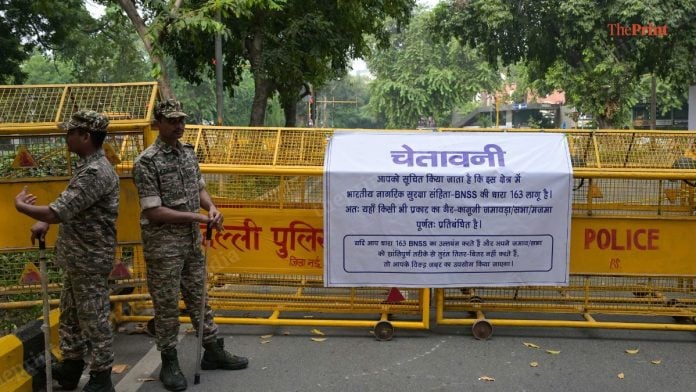
Today, as citizens struggle to understand how Indians came to lose the right to read, to speak, even to stand near Jantar Mantar, what happened next is key. Three months after the celebration at Government House, peasants marched down the same road to protest desperate food shortages and the collapse of the rationing system.
Lathis and tear gas were waiting. West Bengal’s premier PC Ghosh said his government would “prevent disorder at all costs.”
“A political action that would have been acclaimed as satyagraha a few months earlier,” historian Shekhar Bandyopadhyay has wryly written, “came to be branded as ‘disorder’.”
The Raj had been reincarnated.
Last week’s walling-off of the national capital was not remarkable for its scale. Forty thousand central police were pushed into Kashmir ahead of the revocation of the state’s special status in 2019, in addition to the Army and state police; about 29,000 were stationed in Manipur two years ago. Nor was the force used against the protesters exceptional: that miserable distinction still belongs to the Haryana violence of 2016, when police and the Army shot dead 14 people. Preventive detention is hardly unusual either: the Sikh chauvinist politician Amritpal Singh was held for three years without charge.
How, exactly, did repression become so ordinary?
Fractured land
The headless body hung from a tree, a placard placed over what remained of the neck: “Habib got Pakistan,” it read. Habibur Rahman—‘Habu’ to friends and enemies alike—was the hard-drinking gangster who ruled Lalbagan basti as its uncrowned king. He had risen under the Muslim League’s patronage from 1937, running the transport business and petroleum-trafficking rackets that funded the party’s hold on power, as historian Nariaki Nakazato has recorded. He played a key role in the Great Calcutta Killings of August 1946, which claimed thousands of lives, and died in a street battle at the corner of Grey Street and Chitpur Road.
Photographer Margaret Bourke-White’s apocalyptic images of vultures gorging on the victims make clear that freedom smelt of excrement and rotting corpses, not the night-jasmine that envelops the city during sharat, at the end of the hot season.
The new nation’s leaders knew its survival was far from certain. Less than two weeks after the celebrations of 15 August, communal fighting broke out at Kanchrapara after Hindu groups played music in front of a mosque. Police opened fire, killing several people, and fresh rioting broke out the next day. MK Gandhi’s enormous moral authority ensured that his hunger strike shamed leaders of both communities into promising to keep the peace. From the end of 1949, though, violence against Hindus in East Pakistan led to renewed carnage.
From 1948, the Indian state also battled insurgencies. Kashmir came under attack from irregular formations led by Pakistan Army officers, sparking a conflict that remains unresolved. The Indian Army was locked in a long and murderous war with Communist Party of India forces in Telangana.
Industrial violence erupted across West Bengal: three British managers were burned alive in 1949 in a raid staged by an extreme communist faction. The countryside saw clashes too, as disease and food shortages created desperate hardship. Faced with the prospect of capital flight and anarchy, the West Bengal government reacted with coercion. There were hundreds of preventive arrests under the West Bengal Security Act of 1948 and, when it was struck down, India’s new rulers turned to legislation passed in 1930.
Also read: Asim Munir has plucked the last thorn from Pakistan’s democratic rose
A maimed democracy
Emerging from colonial rule into crisis, Jawaharlal Nehru’s government moved quickly to arm itself with the powers it believed it needed—powers many in the Constituent Assembly had themselves suffered under. After a sharp debate, the Assembly carved out exemptions to the constitutional protections against arbitrary arrest. Less than a month after the Constitution came into force, Parliament passed the Preventive Detention Act, 1950, reinstalling the coercive framework of the Raj at the heart of the republic. The Act was meant to be in force for a year, V Krishna Ananth has written; it remained until 1969.
Not everyone was convinced the threat justified such measures. TG Sanjevi, the first director of the Intelligence Bureau, doubted there was any grand Communist conspiracy; to him, what was being cast as revolutionary activity was made up of local grievances against corruption and misadministration.
The Maintenance of Internal Security Act (MISA) came into force in 1971, citing the growing influence of the Maoist movement among young people.
“Libraries are being put to fire,” one Member of Parliament argued, “[and] statues and pictures of national leaders are being defaced and destroyed… Arms and ammunition are being snatched… Even policemen are being murdered.”
Four years later, MISA was turned on the Opposition to silence dissent against the government. After Indira Gandhi’s defeat in 1977, though, the new government retained the Act with only cosmetic changes. Each party, once out of power, has complained of coercive laws; none has abolished them.
The old soldier Mahavir Tyagi—court-martialled after resigning his post in the British Indian Army to protest Jallianwalla Bagh, and later repeatedly held under the notorious Defence of India Rules—rose to rebuke BR Ambedkar as the preventive detention proposals were being passed.
“Dr. Ambedkar will please pardon me when I express my fond wish that he and the other members of the Drafting Committee had had the experience of detention in jails,” he said.
“Kas rahe hain apni minquaron se halqa jalka,” Tyagi told the Constituent Assembly in 1946: ‘The birds are tightening the hunter’s net around their own beaks.’
Also read: India’s Zorawar talk is stuck in wars of the past. Look beyond the mountain tank
The spectre of everyday
Leo Strauss—the eminent American historian of philosophy who escaped Adolf Hitler’s Germany in 1937—famously warned of a logical fallacy. Following any discussion of the relationship between power and values, he observed, “We shall inevitably reach a point beyond which the scene is darkened by the shadow of Hitler.” For Indian liberals, Prime Minister Narendra Modi plays a similar role, embodying a fascist project to gut Indian democracy. For an earlier generation, the Emergency made Indira Gandhi the archetype of the fascist.
Fascism in Europe emerged from the deep crisis that followed the First World War and reordered the fundamental elements of state and society. Authoritarianism in India, by contrast, was a conservative force, seeking to preserve the existing social order. Faced with the prospect that anarchy might overwhelm the republic, the country’s new rulers embraced their one real inheritance from the Raj: coercive tools of state power.
Late in 1952, Nehru closed an argument on preventive detention in Parliament. “There were a number of cases of misuse, or if you like, of grave misuse,” he said. “The context was something near approaching war and challenges to the authority of the State, the context was civil war.” CPI leader TB Vittal Rao demanded to know what action had been taken against those who misused the law. Nehru brushed past the interjection.
There is indeed a spectre hanging over India, but it is not the spectre of fascism. It is the spectre of the deformed everyday that the republic’s founders chose as our inheritance.
Praveen Swami is a Contributing Editor at ThePrint. His X handle is @praveenswami. Views are personal.
(Edited by Prasanna Bachchhav)