




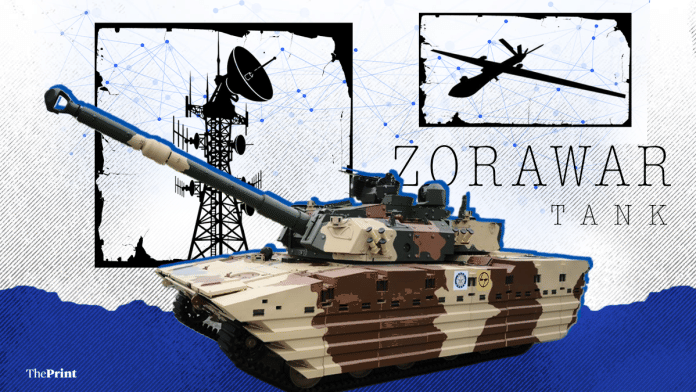

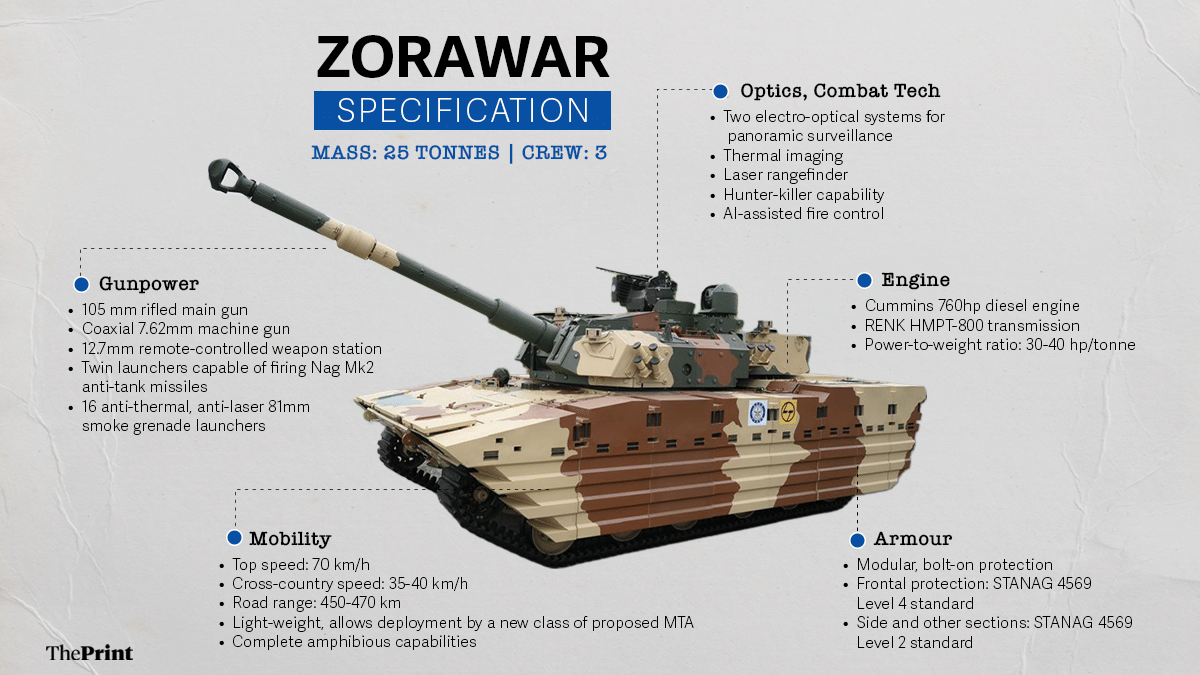
The Zorawar light tank has become a focal point of debate in Indian defence circles. A recent NDTV Ctrl Alt Defence podcast episode featuring Lt Gen Karanbir Singh Brar (Retd), former Director General of Armoured Corps, exacerbated arguments over its weight, protection, power-to-weight ratio, and induction numbers. Developed by DRDO and Larsen & Toubro with active participation from the Indian Army, Zorawar is a 25-tonne platform with a 105 mm gun, offering high mobility, amphibious capability, and air-transportability.
Zorawar was shaped by the 2020 Ladakh standoff. Heavier tanks struggled on the plateau, while China fielded Type 15 light tanks. Advocates of Zorawar see the tank as the way to rapidly place credible firepower on high ground. Critics, even as they agree on the need and operational logic of a light tank, focus their ire on limited numbers on order and armour upgrades that threaten the weight limit for airlift and mobility. They are worried that upgrades would cause delays that may push induction beyond 2028.
These debates are not trivial. Weight, protection (STANAG levels), power-to-weight ratios, and numbers matter for any armoured force. Yet, they address the wrong end of the problem. Zorawar fits the battlefield of yesteryear: one defined by terrain constraints, the need to manoeuvre heavy metal across passes and ridges, and the assumption that placing a gun-armed vehicle on high ground confers decisive advantage. The modern battlefield, saturated with drones and robotic precision, cares far less about traditional terrain. Mobility that ignores mountains, valleys, and ridgelines is already routine in the modern battlefield.
The big operational problem
The problem statement—as articulated by Lt Gen Brar in his interview—is to threaten the passage of Chinese forces transiting through valleys and passes. Zorawar solves the problem by placing armoured firepower (a 105 mm gun and supporting weapons) on commanding hilltops so that the tanks can dominate those approaches by direct and indirect fire. This works in theory, but it is a heavy, slow, and manpower-intensive way of solving a problem that is primarily about observation, timing, and rapid precision effects. A purpose-built high-altitude drone array (with adequate firepower), coupled with a meshed communication architecture, would address the same problem through persistent overwatch, rapid concentration of fires, and the ability to strike from any direction without first occupying the high ground. The advantages appear across cost, manpower, time-and-space, and command-and-control.
The tanks, once placed on a hilltop, are easy to identify and target. The room for defensive manoeuvre and relocation on the mountaintop is limited. Zorawar would come fitted with counter-UAS measures such as an active protection system (APS) and close-in weapon system (CIWS). However, limited magazine depth would make them vulnerable to drone swarms and attackers arriving in different azimuths and planes.
However, the drones are not a panacea. They come with their own challenges. Heavy electronic jamming and extreme weather (cold, high wind speed, icing) can severely degrade their performance. Operationally, small payload and inability to persist and stay can be limiting. Tanks, on the other hand, can continue firing under electronic jamming and weather. They also serve an operational purpose in peacetime, as they occupy terrain, signal intent, proffer deterrence, and mark possession.
India’s operational problem of denying Chinese forces freedom of manoeuvre through valleys and passes comprises three sub-challenges: deterrence, observation, and response. Positioning of tanks on overlooking hilltops conveys intent and should deter the adversary. Should that fail, and the adversary makes a move—we must be able to observe force buildup and respond before the enemy can. A Zorawar tank only takes care of the first. India needs a network of networks and a drone array to take care of the other two.
The discussion on Zorawar must move toward a solution that fits into the battlespace of the future. A tank alone is not enough. India must build a drone array, including a heavy strike drone (provisionally named Zorawar). This must be complemented with a networked communication architecture that receives and feeds information from/to all other sensors, including the Zorawar tank and the Zorawar drone.
Also read: Why India must obsess over growth
Lesson from the past
The parallel with an earlier crisis of manoeuvre is instructive. During World War 1, European armies entered the war configured to move. However, advances in machine guns and heavy artillery soon made exposed ground movement extraordinarily difficult. The ensuing trench warfare proved costly in blood and treasure, without any decisive advantage to warring sides. The fronts froze, and fighting turned into positional warfare. Massed artillery to clear the way for infantry only drove casualties higher without restoring decisive manoeuvre. The interwar solution was not thicker armour but a leap in mobility and tempo. Speed enabled surprise, limited the defender’s ability to organise, and enabled the manoeuvring force to set the pace of battle. Blitzkrieg (German for lightning war) proved immensely successful. Lighter, faster tanks often proved more effective than heavier, better-protected ones because they could act before the enemy could respond coherently.
Ukraine has produced a similar rupture. Response time trumps level of armour protection. Drones and robotic precision weapons fill the battlespace—detecting and destroying tanks and large vehicles before they can mass for effect. Armoured vehicles are proving to be vulnerable just because they are less manoeuvrable relative to drones. Unmanned systems also enjoy advantages in terms of observation, mobility, and concentration of firepower. Combined-arms massed-offensive operations are becoming less frequent.
Room for manoeuvre
Notwithstanding the advances in dronery, manoeuvre still remains essential for shattering enemy cohesion through penetration, flanking, and envelopment. Restoring its primacy requires platforms that match the response time of networks, speed of drones, and achieve genuine terrain independence. During Ukraine’s Operation Vivaldi, the Ukrainian Third Army Corps successfully broke through the drone-imposed battlefield deadlock near the Lyman sector. They achieved manoeuvre capability despite pervasive Russian drone threats by systematically dismantling the enemy’s reconnaissance-strike loop through dominating the manoeuvre in the third dimension. Delta (Ukraine’s situational awareness and battlefield management network) played an indispensable role in the coordination of joint fires, Op-logistics, and the eventual success of Operation Vivaldi.
The success came when tanks worked in cohesion with drones and networks.
Recent European exercises make the practical consequences clear. During NATO’s Hedgehog 2025 in Estonia, involving more than 16,000 troops, a small Ukrainian drone team, acting as a Red team, ‘destroyed’ 17 armoured vehicles and conducted around 30 additional strikes in about half a day. Two battalions were rendered combat-ineffective.
Comparable results appeared in other drills. Ukrainian operators from units such as the 412th Nemesis Regiment repeatedly ‘eliminated’ a US armoured brigade during Combined Resolve exercises in Germany. The rate of destruction was such that exercise directors had to restore vehicles to continue the exercise. Similar outcomes were reported against British, Estonian, Swedish, and other forces. These were simulations, yet the pattern matches Ukrainian battlefield experience: well-equipped armoured formations struggle against cheap, numerous, adaptable drones in capable hands. In all these exercises, Ukrainian forces used networked systems including the Delta battlefield-management tool for real-time fusion of intelligence and rapid coordination.
Also read: Washington returns to Myanmar. Will India lose strategic space?
India’s challenges
For India, the high-altitude frontier presents distinctive problems of positioning credible firepower among low air density, extreme cold, and limited infrastructure. Zorawar addresses them through its light weight, high power-to-weight ratio, weapon suite, and air transportability. Existing operational logic favours a lighter, reasonably well-armed, well-protected tank over a heavy MBT.
Unfortunately, current battlefield reality makes both vulnerable to systems that largely ignore tonnage, terrain, and protection.
Indian Army is seized of the challenge as well as the opportunity. It has already begun building relevant capability. The Army recently ordered 225 first-person-view drones from AeroDrone Robotics after competitive evaluation and field trials that included operations at altitudes up to 17,500 ft. These systems were assessed for endurance, accuracy, and performance in conditions relevant to Ladakh and similar terrain. Scandron platforms were tested until 18,000 ft with substantial payloads (reported examples include 50 kg in extreme conditions of cold and wind). Their CargoMax series drones offer high-altitude logistics with ceilings around 6,000 m AMSL and high payload capacity. Bajrang UAV tested a heavy-lift platform with a 30 kg payload at 16,000 ft in Ladakh. Other systems manufactured by NewSpace Research, Optiemus Vajra, and BonV Aero platforms have also been evaluated at passes such as Umling La (19,000 ft) with useful payloads and ranges.
There are, however, two missing ingredients: a strike drone that can carry payloads in excess of 100 kg at those altitudes and a network that ties all manned and unmanned capabilities into one seamless architecture.
The time is now ripe for the Army to develop a strike drone that can operate effectively at high altitudes. It would be best if this drone is operated by the armoured corps itself. The shift from horse-mounted cavalry to tanks answered industrial firepower that made massed flesh suicidal. Persistent sensors and cheap strike drones now impose similar costs on crewed metal. It’s time that armoured corps make another transition toward attritable unmanned systems—while retaining tanks for decisive shock, exploiting small windows of opportunity, under local air and tech superiority.
It’s time we start building a Zorawar that flies, alongside the Zorawar that treads.
Group Captain Ajay Ahlawat is a retired IAF fighter pilot. He tweets @Ahlawat2012.
(Edited by Prasanna Bachchhav)