





Saudi strategic folklore attributes to the kingdom’s founder, Abdulaziz ibn Saud, a deathbed warning: “The good or evil for us will come from Yemen.” The message endures because it captures a deeper truth about Riyadh’s approach to Yemen, which has never been just another neighbour.
In 1934, Abdulaziz fought Imam Yahya’s Yemen over the still-fluid south-western frontier. The Treaty of Taif confirmed Saudi possession of Asir, Jizan and Najran, although border questions lingered for decades. More important than the cartographic lines was the strategic inclination it created. Saudi rulers repeatedly tried to shape politics south of the border because disorder in Yemen rarely remained there.
A Jordanian scholar once said to me at a conference that the way to Saudi Arabia’s subconscious goes through Yemen. The present crisis reminds us why.
For days, Saudi Arabia and the Houthis—formally known as Ansar Allah—have exchanged air strikes, missiles and drones across the border. Houthi forces have made rapid territorial gains along Yemen’s Red Sea coast and around the approaches to Bab el-Mandeb. Riyadh, in turn, has bombed targets in Yemen. Saudi authorities have also said they intercepted a Houthi drone south of Mecca before it entered the holy city’s restricted airspace. Ansar Allah denies targeting Mecca, but the episode was serious enough for the OIC and several Muslim states to condemn the alleged attack.
How did a war that Saudi Arabia spent years trying to wind down return with such force? Part of the answer lies in the broader US-Iran war, but a bigger part runs through Yemen’s older veins of violence: its divided statehood, the rise of the Houthis from a Zaydi revivalist movement, the Saudi intervention of 2015, the deepening Houthi-Iran connection and the fragmentation of the coalition built to contain them.
But the present crisis also contains something new. Riyadh now finds itself squeezed between a receding America and an advancing Ansar Allah, while the Mecca Pact—the new Saudi-Pakistan-Türkiye defence agreement—has not proved a saviour.
To understand how Saudi Arabia arrived at this extraordinary position, we have to go back to the Yemen that existed before the Houthis, and indeed before Yemen itself existed as one country.
Also Read: India needs to stop looking at BRICS as some new world order. It’s more of a hedge
Yemen was two countries before it was one
For more than two decades, modern Yemen was two states, shaped by different imperial histories and opposite sides of the Cold War.
The north emerged from Ottoman rule under the Zaydi imamate. In 1962, the imam was overthrown, triggering a civil war in which Gamal Abdel Nasser’s Egypt backed the republicans while Saudi Arabia supported the royalists. To Riyadh, Egyptian troops on its southern flank turned republican radicalism into a direct security threat. Fred Halliday’s Arabia Without Sultans (1974) captures those revolutionary years.
The south followed another destiny. Britain had seized Aden in 1839, and its withdrawal in 1967 produced the People’s Republic of South Yemen, renamed the People’s Democratic Republic of Yemen in 1970 — the Arab world’s only Marxist state and a Soviet partner. North and South fought twice, in 1972 and 1979, before unifying in 1990. Today’s fragmentation therefore did not begin with the Houthis. Southern separatism, tribal networks and competing ideas of the state predate Ansar Allah.
When did the Houthis become Iran’s proxy?
There is no single date.
Ansar Allah grew from a revival movement of the Zaydi Shia sect in Sa’ada in the 1990s and fought six wars with Ali Abdullah Saleh’s government between 2004 and 2010. Iran did not create it. Early work on this matter, such as Thomas Juneau’s piece in International Affairs in 2016, argued that calling the Houthis simply an Iranian proxy overstated Tehran’s control.
What changed was the collapse of the Yemeni state after 2011, the Houthi takeover of Sana’a in 2014 and the Saudi-led intervention of March 2015. The relationship deepened as the war regionalised. UN investigators later documented Iranian-origin missile and UAV components, while Iranian and Hezbollah training and technical assistance increased the group’s military reach.
But dependence has limits. The Houthis have a Yemeni political project of their own: territorial power, revenue, salary payments, access through ports and Sana’a airport, recognition of their authority, and a settlement that preserves gains made by force. Tehran benefits from this, but that does not make the Houthis simply an Iranian proxy.
Their geography also makes them unusual within Iran’s regional network. Hezbollah and Palestinian groups sit closer to Israel, and Iraqi militias give Tehran depth to the west. Yemen lies far to the south, beside Bab el-Mandeb and on Saudi Arabia’s vulnerable flank.
After the US-Israel war with Iran began on 28 February, the Houthis did not enter immediately. They stayed out for four weeks, despite predictions that they would join, and launched their first attack on Israel in the current war only on 28 March. The delay showed that the state-proxy relationship was not so linear.
Come September
What has happened this month is more consequential than another round of missile strikes. In a lightning advance, Houthi forces seized Yemen’s entire Red Sea coastline, including Mocha, and captured islands at the mouth of Bab el-Mandeb, among them Perim/Mayun. Reports describe the gains as giving the Houthis ground overlooking the strait and a foothold from which they can threaten shipping and Saudi oil exports. While this is not uncontested control over the waterway, it is strategically serious enough
Saudi Arabia has consequently been dragged back into an air war it had spent years trying to leave. Houthi media reported fresh Saudi strikes on 17 September in Hajjah and around Taiz; a day earlier, Ansar Allah said Saudi aircraft had carried out 40 strikes across Taiz, Marib and Hodeidah in 24 hours. The Houthis have retaliated with missiles and drones against targets including King Khalid Air Base at Khamis Mushait and Aramco facilities at Yanbu.
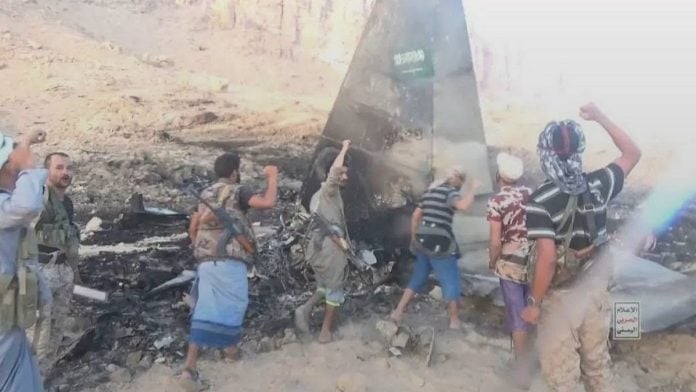
The most dramatic battlefield claim is still unverified. The Houthis have tried for years to erode the air-power advantage on which Saudi operations depend. Ansar Allah says it shot down a Saudi F-15 over Marib with a locally produced surface-to-air missile. Video released by the group shows charred aircraft wreckage and a wing fragment bearing Saudi insignia; the claim could not be independently verified.
Saudi-Emirati rift over Yemen
There is a second complication: the anti-Houthi camp itself has never been coherent. Saudi Arabia intervened in 2015 principally to restore the internationally recognised government, secure its border and prevent an Iran-aligned movement from dominating Yemen. The cleverer UAE shared the anti-Houthi objective but developed different priorities: influence over southern and coastal Yemen, security around Aden, Socotra and Bab el-Mandeb, hostility towards Islah, and support for southern forces, above all the Southern Transitional Council.
Those differences became an open rift by late 2025. UAE-backed STC forces pushed through Hadramawt and Al-Mahra, and Saudi forces later struck Mukalla port after alleging that vessels from Fujairah had unloaded military support for the separatists. Abu Dhabi then announced the withdrawal of its remaining forces. What had looked from outside like one coalition had become nakedly fragmented.
That fragmentation matters now because the Houthi breakthrough did not come against a single coherent front. Reports show that the Houthis had quietly massed about 100,000 fighters and that Saudi-backed Yemeni forces collapsed in several sectors, abandoning US- and Saudi-supplied equipment. The Houthis had indeed become extremely good at exploiting their rivals’ fissures.
Two straits, one economic problem
Today, the strategic geometry is vicious. The Strait of Hormuz remains doubly blockaded and now the alternative Red Sea route has been disrupted. Saudi Arabia’s East-West pipeline exists precisely to move crude to the Red Sea when Hormuz becomes dangerous. But its western exit leads towards Bab el-Mandeb, where Houthi territorial gains have increased the risk to shipping. The pipeline itself has been shut after an attack that Riyadh said originated in Iraq.
The two chokepoints are therefore no longer separate problems. Not only has traffic through Hormuz been disrupted for weeks, traffic through Bab el-Mandeb has also fallen. Oil prices remain above $100 a barrel and the cost of refined fuels has climbed even faster.
India has already seen one version of this problem. During the 2024 Red Sea crisis, the government said diversion around the Cape of Good Hope increased transit times by roughly 35-40 per cent; the Finance Ministry estimated that around 80 per cent of India’s merchandise trade with Europe used the Red Sea route. In August 2026, India’s crude-oil import bill rose 25.8 per cent year-on-year to $16.69 billion as the Indian crude basket averaged $90.19 a barrel. Not all of that is a Houthi cost, and that is precisely the point. Once theatres merge, allocating the economic consequence neatly to one set of actors becomes less useful.
Interceptors interrupted
The escalation has exposed another scarcity — interceptors. Saudi Arabia is reportedly running low on missile-defence interceptors and has sought assistance from France, Britain, Pakistan and Egypt. The otherwise obvious supplier, Washington, is watching its interceptor stocks diminish after months of war with Iran.
Washington’s response to the Houthis is particularly revealing. President Donald Trump has so far declined Saudi requests for direct US military support, but US officials met senior Houthi representatives last weekend in talks facilitated by Oman. The Houthis told the Americans they intended to observe their 2025 ceasefire with Washington and would not target US vessels.
It is an oddly multipolar arrangement — America is trying to support Saudi security while avoiding reopening war with the very adversary attacking Saudi Arabia.
Pakistan illustrates the same problem from another angle. Last month, Pakistan, Saudi Arabia and Türkiye signed the Mecca Joint Defence Agreement, under which an armed attack on one is to be treated as an attack on all three. Yet the Houthi escalation has immediately tested how far the collective-defence claims translate into action. Pakistan has troops deployed near the Saudi-Yemen border and has tried to mediate with Tehran, while avoiding being pulled directly into combat.
Also Read: Iran can survive the war. But the cost of survival is changing
Forgotten wars do not stay forgotten
The temptation will again be to look for a military answer to Ansar Allah. Military force may be unavoidable when national territory, energy infrastructure and shipping are attacked. But Yemen’s history should make everyone cautious about conflating degradation with settlement.
Saudi Arabia spent the first phase of this war trying to reverse the Houthi takeover, and the later phase trying to make Yemen stable enough to withdraw. The 2022 truce sharply reduced violence. It did not settle questions of authority over Yemen, how revenues would be divided, what would happen to the south or how armed movements would be incorporated into the state.
Now the war has returned inside a wider regional conflict. More than 100,000 Yemenis have already been displaced by the latest fighting; AP puts the figure above 125,000, including about 57,000 children. Saudi aircraft are again striking Yemen. Houthi missiles and drones are again crossing into the kingdom.
That is the danger of the forgotten war. It does not disappear but evolves while nobody is looking.
Yemen was once treated as a peripheral conflict in a poor Arab state. Today it sits between an Iran-US war, a Saudi security crisis, a fractured Gulf partnership and two maritime chokepoints whose disruption is already being priced into oil, shipping and inflation.
Swasti Rao is a Consulting Editor (International and Strategic Affairs) at ThePrint. She tweets @swasrao. Views are personal.
(Edited by Asavari Singh)