






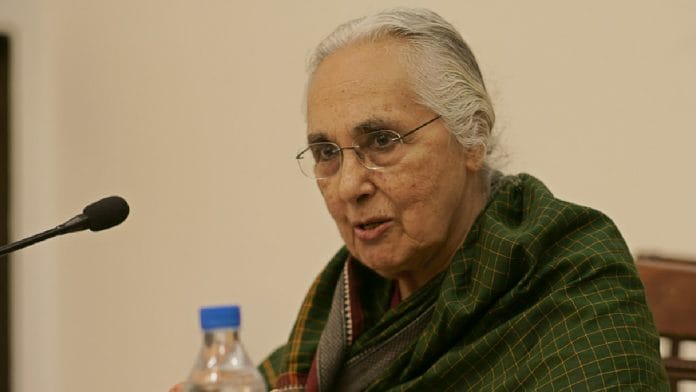

Romila Thapar is a major figure in the intellectual history of contemporary India. However, many, both inside and outside India, consider her first and foremost as an expert on the history of early India. Yet, behind Thapar’s multifaceted work, starting from her research on Asoka and the Decline of the Mauryas to her memoir, Just Being, one finds a strong intellectual figure with a system of thought, who has profoundly influenced Indian historical thinking and beyond.
Certainly, Thapar studied history less as a curiosity about what was there before her and more to try and trace a pattern. As she points out in Talking History: “The intrinsic link between the past and the present – and the fact that the present grows out of the past and, therefore, the patterns of past societies are important to our understanding of present-day societies.” In other words, what we can learn from more than half a century of Thapar’s work is that one studies history not only to understand the past, but also to comprehend the present.
During her 60 years of research and writing, Thapar has contributed to the comprehension of history as an intellectual adventure, by bringing this discipline to the centre of the Indian public sphere. Undoubtedly, she has been an important transmitter of culture and a significant animator of ideas in Indian society. As such, her mission as a historian has been more than just writing about Indian history. Her task as an engaged intellectual has also been that of speaking truth to power, enlightening Indian public opinion on issues such as Aryanism, and taking a critical stand as a dissenter in Indian society. What Romila Thapar’s work attests to is that every piece of historical analysis is a manner of engaging in the present regarding the past. This is how she approaches a historical fact.
As she underlines in Just Being, “History, when studied properly, has its own complexities. It requires wide reading as well as an awareness of evidence both from historical sources and from related sources of other disciplines.” As such, by calling into question the dogmatic and fanatic foundations of historical interpretation and analysis in India, Thapar forces Indian society to confront its own prejudices and discriminations.
A sharp distinction
It is always difficult for a historian to step back from her practice and reflect on the present state of the historical discipline and its emerging developments. But if for Thapar, the writing of history takes shape in critical reasoning, it is because she speaks not on behalf of the established power, but in relation to the historical truth. She insists on the openness of historical writing, while highlighting the numerous possibilities of which the past is the bearer. The result is a sharp distinction between Thapar’s critical historiography and that of the historian-ideologues who remain prisoners of their religious or sectarian dogmatism.
This line of separation is very clear for Romila, as presented in her memoir. She affirms: “History when reformulated to support the nationalism of a single religious community has to find legitimacy from the past in the form of endorsing the activities of that community.” Here, Thapar is against the act of reducing her historical questioning either to a philosophy of history or to a writing of history as an affirmation of the self in opposition to the other. On the contrary, her intellectual sensibility as a dissident and dissenter brings her to ask the question of the interface of an established society and religion with the other. According to her, a historian should be attentive to the changes that appear in the identities of the self and the other. Therefore, what becomes abundantly clear when we leaf through the pages of Thapar’s memoir is that a historian-intellectual like her never searches for readymade answers in the historical approach to Indian society.
If we consider Thapar as a historian-intellectual, it is because she is more than just a pillar of modern Indian historiography. She is certainly among those rare historians of ancient India who have given us the sensibility and the objective gaze of looking at an archive or a monument, while asking us to think freely about historical research.
Thapar considers history to be mobile, which changes from generation to generation, and every generation asks questions that the previous ones did not. But she also knows that history should be written with the rhythm of its time. According to Thapar, “It’s up to the historian in interpreting a particular body of evidence, to prioritize what she thinks is the most significant and what is less so, and while doing so to explain the basis of that prioritization. It cannot be arbitrary and determined only by the likes and dislikes of the historian.”
Also read: Glorifying Mughals understandable in 1947. Today, we must face historical truths
Demystifying history
Truly speaking, Just Being is not an ordinary memoir. As a matter of fact, one of the hallmark qualities of Thapar’s autobiography is when her bold historical attitude intersects with a philosophical self-awareness of her era. Thus, she is also the historian-intellectual who introduces a reflexive practice of history, where the historical truth is not veiled, masked, manipulated or distorted. This is a work of demystification in history and in intellectualism that she practices away from the established powers. As an intellectual, therefore, she often stands in a posture of denouncing impostures and engaged in the re-evaluation of Indian democracy and its democratisation. Thapar is not a thinker who has set herself up as a self-proclaimed guardian figure of Indian history. Quite the contrary, she takes a distance in her historical-intellectual work from all those who consider themselves as spokespersons of either ancient or modern Indian history.
Though a child of her time, Thapar remains a historian-intellectual who knows how to liberate herself from the lies, delusions, and falsifications of history, but also from those of her own time. Never has this been more important in Thapar’s work than when, as in her memoir, she reaches the question of asking questions.
The most urgent among these questions emerges at the end of the book, where she asserts: “The freedom of expression may or may not affect the large number of people, but it is a foundational component of any society that calls itself a democracy. A free nation emerging from colonial rule may face obstacles like these: people, long accustomed to being ‘unfree’ as under colonialism, often refrain from insisting on their rights given by the Constitution, leaving space for others to seize as much power as they please. This prevents the nation from becoming a democracy. It is at this point that extreme authoritarianism and dictatorship become feasible.”
As the German philosopher Arthur Schopenhauer says, “History is the long, heavy, confused dream of humanity.” This may be true, but when we look back at 60 years of historical-intellectual work done by an exceptional historian of ancient India, we can find in her work the virtue of creating a quality of listening to history and a moment of love of human destiny, shared with her readers and students on a historical journey. But more than anything, what we can learn from her existential journey, as portrayed in her memoir, is the moral courage of a Socratic Indian gadfly.
Ramin Jahanbegloo is an Iranian-Canadian political philosopher. He is presently the Executive Director of the Mahatma Gandhi Centre for Nonviolence and Peace Studies and the Vice-Dean of the School of Law at Jindal Global University. Views are personal.
(Edited by Aamaan Alam Khan)
The book won’t sell despite this ad disguised as an article.
> one studies history not only to understand the past, but also to comprehend the present
More.
Arguably, we study history to understand the future. Because the past is never dead; it’s not even past.