





In 2014, when Parliament reorganised itself to split the newly-created state of Telangana from Andhra Pradesh, the Telugu Desam Party received a promise. A financial package, a special category status designation, infrastructure investment to compensate for what Andhra had lost when Hyderabad went to the new state. The promise was made in Parliament. It was never fully delivered.
Over the following eleven years, TDP’s Rajya Sabha members have filed questions about this package far more relentlessly than a delegation their size has any business doing. Finance ministry, Commerce ministry, session after session, across three different Parliaments. The same demand, formally dressed as a request for information, was presented to whichever minister happened to be in the chair. Answered, deferred, noted, and asked again at the next session.
This is the Rajya Sabha at work. Not quite what its designers imagined.
The people who built India’s upper house had something grander in mind. Members would serve six-year staggered terms, elected by state legislatures, shielded from the daily arithmetic of individual constituencies and electoral cycles. The thinking was that such insulation would produce different legislative behaviour: Calmer, more principled, less hostage to the immediate demands of any particular district or voter bloc. A chamber of deliberation, not transaction.
I wanted to know whether the data bears that out.
The short answer is: Partly, and not in the ways that matter.
I looked at 9,315 starred questions filed in the Rajya Sabha between 2014 and 2025, by 264 members across 14 party groups, and ran the same analysis on them that I’d earlier applied to the Lok Sabha. The comparison turned out to be more interesting than I expected.
Also read: India doesn’t have Left-Right divide in Lok Sabha. MP concerns are tied to geography
The experiment
The earlier Lok Sabha analysis found that Indian MPs’ question vocabulary is driven by geography, not party ideology. BJP and Congress members sit almost on top of each other in vocabulary space. What actually separates MPs is the kind of constituency they come from: Agrarian districts versus urban ones, flood-prone versus drought-prone, infrastructure-poor versus relatively developed. Party ideology gets drowned out by local demand.
That finding has an obvious explanation. MPs ask what their voters need. A BJP member from a flood-prone district in Assam and a BJP member from a Mumbai suburb represent different problems, so they ask about different things. The party manifesto barely registers.
The Rajya Sabha takes that mechanism away. No constituency. No individual voter base to answer to. The same parties, the same Parliament building, but the one variable that seemed to explain everything in the lower house is simply absent. It is about as close to a controlled experiment as parliamentary data allows.
If constituency pressure was really what was suppressing party ideology in the Lok Sabha, the Rajya Sabha should look different. BJP and Congress should diverge. Ideological patterns should surface.
What the numbers say
Here is the finding that seems to confirm the theory. In the Lok Sabha, BJP and Congress are almost indistinguishable in the kinds of questions they ask. In the Rajya Sabha, the gap between them opens up to nearly eight times as wide. Take the constituencies away, and the two big national parties finally begin to sound different from each other. There is a real party signal under the noise.
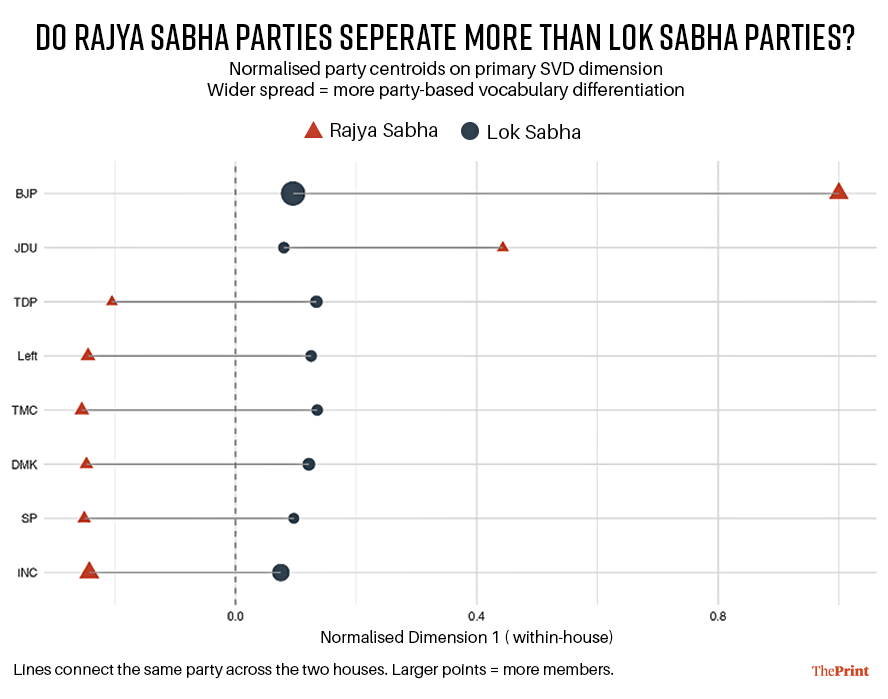 But then there is the other number, and it cuts the other way. Look across all the parties, not just the big two, and the chamber without constituencies turns out to be less divided by party, not more. On the whole, Rajya Sabha parties sound more like one another than Lok Sabha parties do.
These two findings seem to pull in opposite directions. They don’t. What they reveal is something more interesting: In the Lok Sabha, constituency vocabulary was itself creating between-party differences. Different parties hold geographically different seat bases. BJP’s MPs represent different kinds of places than Left MPs do, and that geographic sorting was showing up as apparent party separation in the vocabulary data. Take the constituency away and that geographic sorting disappears. Parties become more similar overall, even as BJP and Congress specifically diverge more.
The net result is the same in both houses: Individual variation dominates. The individual member’s home state, personal interests, committee work, and length of tenure predict their question vocabulary far better than party membership does. The Rajya Sabha didn’t fix this. It just changed the shape of the noise.
Parties that have it figured out
The most striking finding in the RS data has nothing to do with BJP or Congress.
One way to measure how coordinated a party’s parliamentary bloc is to ask how similar the individual members’ question vocabularies are to each other. If every member is asking about roughly the same set of things, they’re disciplined. If each member is off in their own direction, they’re not.
The most disciplined Rajya Sabha parties are all small and all regional: YSRCP at 0.616, AAP at 0.588, TDP at 0.540, then DMK at 0.455, with TRS, BJD, AIADMK and NCP clustered just behind, between 0.38 and 0.44. (The very smallest delegations score a little higher simply because a handful of members is easier to keep on message. TDP and DMK, with eight and nine members, are the most telling cases.)
The least-disciplined party is BJP, at 0.185. INC is second-least at 0.201.
Read that list again. Every single high-discipline party in the Rajya Sabha is a state party with a single-state agenda. Every low-discipline party is a national one. This pattern holds without exception.
The logic is not complicated, but it is illuminating. A TDP bloc of eight RS members can coordinate because there is essentially one agenda: Andhra Pradesh. The bifurcation grievance, the special category financial status, Amaravati, Polavaram, revenue-sharing disputes. Every question the bloc files is, at some level, about one variation of this. There’s no room for individual members to develop personal portfolios on defence procurement or foreign policy, because every question slot matters and the party’s priorities are narrow enough to be held in everyone’s head at once.
BJP, with 90 Rajya Sabha members spread across 28 states, has no equivalent center of gravity. Its members pursue individual agendas shaped by where they’re from, which ministry relationships they’ve cultivated, what committee they sit on, how they see their political future. The governing party’s sheer size and geographic spread makes coordination at the question level almost structurally impossible.
And this is not just about size. It is about purpose. TDP’s RS delegation is there for one thing. BJP’s RS delegation is there for many things, or no particular thing at all.
Also read: BJP MPs barely raise issues from election manifestos in Lok Sabha. Congress even less
The Andhra invoice
Return to TDP for a moment, because the ministry-targeting data makes the picture even sharper.
When you measure which parties hammer which ministries far above what their overall question numbers would predict, the five sharpest concentrations in the entire Rajya Sabha belong to: The Samajwadi Party on water, TRS on commerce and industry, TDP on commerce and industry, AIADMK on coal, and RJD on railways.
All five are regional parties, and every one of them is pressing a state agenda: Uttar Pradesh’s water, Telangana’s industry, Andhra’s trade, Tamil Nadu’s power, Bihar’s trains. Not one is an argument about national ideology. And just outside that list sits the single clearest political signal in the whole dataset: TDP pressing the Finance Ministry on Andhra’s bifurcation compensation, question after question, far above what its small numbers should produce, a paper trail of ministerial commitments and evasions stretching back to 2014.
None of it is abstract. The Samajwadi Party leans on water because Uttar Pradesh lives and dies by its canals and groundwater. TRS presses commerce because Telangana wants its share of industry and investment. RJD asks about railways because Bihar has demanded better lines for decades. AIADMK concentrates on coal because Tamil Nadu runs on coal-fired power and has long fought for a fairer cut of central coal blocks. Each is a state sending its delegation to the capital with a list of demands and the discipline to keep submitting them.
What is missing from that top five is just as telling. There is no ideological entry at all. Every one of the five is a state with a shopping list. You have to drop well down the table before you find the Left pressing on education because it believes in a particular vision of public schooling, the lone flash of ideology in a ranking otherwise made entirely of geography.
Who is attacking and who is invoicing
There is one more dimension to this worth sitting with. Starred questions can be framed in two fundamentally different ways: As information requests, neutral in tone, asking what the status of something is, or as accusations, framing the topic in terms of government failure, negligence, or contradiction.
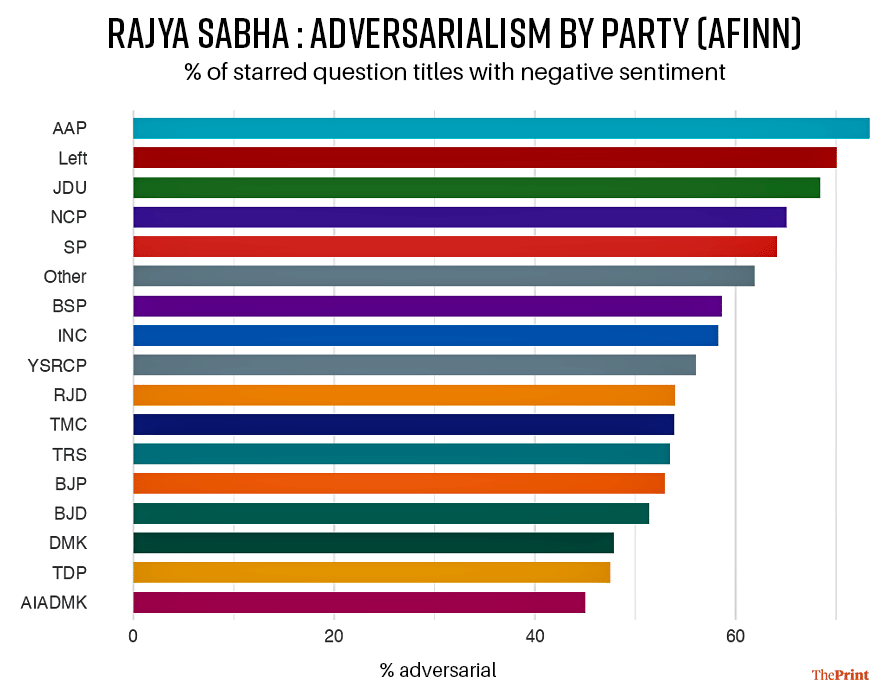
In the Rajya Sabha, AAP files 73 per cent of its questions in the adversarial mode. The Left is at 70 per cent. JDU sits at 68 per cent, though most of that was accumulated during the years before the party returned to the NDA fold in 2022, when Nitish Kumar was in Opposition and using every available instrument to signal distance from BJP.
Congress’ questions are 58 per cent adversarial. BJP, despite being the governing party for this period, is at 52 per cent, which reflects the unusual fact that BJP was in a RS minority until around 2022-23 and had reason to use questions as pressure instruments even against its own government’s policies at the state level.
At the other end, AIADMK is 45 per cent adversarial, the least accusatory party in the RS. DMK is at 47 per cent. TDP is at 48 per cent.
Maharashtra’s NCP belongs to the adversarial camp too, at 65 per cent, fourth behind AAP, the Left and JDU. That is a useful complication. The invoice style is not simply a regional habit: A state party that has spent most of these years in opposition, as the NCP has, reaches for the question as a weapon as readily as any national party. And where the NCP leans, it leans toward people rather than projects. Its questions tilt more toward Women and Child Development than toward any other ministry, the clearest thematic signature in its Rajya Sabha record.
The Tamil parties’ restraint is deliberate. DMK and AIADMK both understand, from decades of navigating center-state relations, that the RS question is more useful as an invoice than as an indictment. An adversarial question gets you a defensive answer and a news cycle. A neutral question asking the Finance Ministry to state, on the record, what the status of Andhra Pradesh’s special package is gets you a commitment on the parliamentary record that can be cited the next time you file the same question. AAP treats the Rajya Sabha as a stage. TDP treats it as a ledger. The data suggests TDP’s approach has been more productive.
 What the Upper House has become
The Rajya Sabha has become something its designers understood partially but probably didn’t fully envision: The chamber where states that feel wronged by the central government come to press their case, persistently, publicly, and across multiple election cycles.
This is not necessarily a failure. A state government can go to court. A chief minister can seek a ministerial meeting. But a state party’s Rajya Sabha delegation can file starred questions across eleven years, forcing ministerial answers on the record each time, building a public paper trail of what was promised and what was delivered. There’s a certain democratic utility in that, even if it isn’t what Ambedkar had in mind.
What the RS hasn’t become is a deliberative national chamber above sectional interests. That function, if it lives somewhere in Indian democracy, isn’t visible here. The BJP-INC vocabulary gap is wider in the RS than the LS, which means removing constituency noise does let some party-ideological signals through. But it’s a signal swimming in a sea of individual variation, and the most organised, most purposeful actors in the chamber aren’t pursuing national ideological agendas at all.
They have a list. They keep submitting it. And the house that was built for deliberation has, in practice, become a room where states bring their unpaid bills. Andhra Pradesh’s bifurcation package. Tamil Nadu’s coal allocation. Bengal’s central fund releases. Odisha’s tribal welfare transfers. The specifics differ by state; the structure is identical. A delegation arrives, presents the claim in the formal language of a starred question, receives an answer that is rarely fully satisfying, and returns the following session to ask again. The framers imagined a chamber that would think about India. What they got is a chamber where India’s states come to think about themselves.
NOTE: The analysis covers 9,315 starred Rajya Sabha questions (2014-2025) and 4,315 matched Lok Sabha questions across the 16th, 17th and 18th Lok Sabha. In plain terms: the questions were compared by how much vocabulary they share, mapped onto a space that locates each member, scored for adversarial versus neutral tone, and tested for which parties target which ministries far more than their numbers would predict. Full methodology available on request.
Piyush Zaware is a graduate researcher in economics at the University of Chicago and a researcher at the Global Poverty Research Laboratory at Northwestern Kellogg School of Management. Views are personal.
This is the last in a three-part series analysing starred questions filed across the Lok Sabha and the Rajya Sabha between 2014 and 2025.
(Edited by Theres Sudeep)