






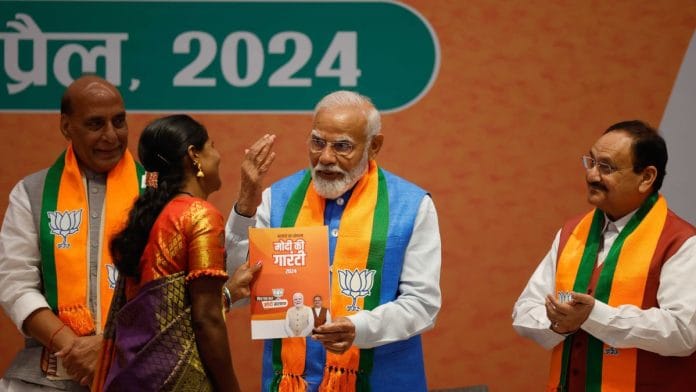


Every five years, the Bharatiya Janata Party releases a manifesto. In 2014, it ran to 42 pages and promised civilisational transformation: “sabka saath, sabka vikas”, a unified national consciousness, technology-led governance, cultural renaissance, water security, a science-driven education system. By 2019, there was Ayushman Bharat, PM-KISAN, and “Modi hai toh mumkin hai”, the party staking its identity on delivery.
Then Parliament begins. And the numbers tell a different story.
I matched the language of BJP’s election manifestos from 2009 to 2024 against the language BJP MPs actually used in their starred questions across three Lok Sabhas. Starred questions are not speeches. They are formal, numbered demands that ministers must answer in the House, on the record, in the chamber. The method is standard in computational text analysis: Turn each set of documents into a tally of how often each word appears, counting distinctive words more heavily, then measure how much the two tallies overlap. A score of 1.0 would mean the manifesto and the questions use identical vocabulary in identical proportions. Zero means no overlap at all.
BJP’s score in the 16th Lok Sabha: 0.24.
The gap
A score of 0.24 does not mean BJP ignored its manifesto. It means the two texts share roughly a quarter of their meaningful vocabulary, weighted by how distinctive each word is. The remaining three-quarters diverges, and the divergence is not random.
The 2014 manifesto’s most frequent substantive terms were development, national, technology, education, security, water, nation, rural, cultural. Broad and aspirational. Some of them, particularly development, water, and rural, do appear in BJP’s parliamentary questions. But many of the manifesto’s defining terms simply do not. Words like civilisational, consciousness, harmonious, progeny, prosperity, vibrancy the rhetorical scaffolding of BJP’s 2014 pitch appear in the manifesto multiple times and in Parliament almost not at all.
What fills that space instead? The questions run on a completely different kind of language: Scheme, fund, railway, Jharkhand, Rajasthan, Bihar, sanctioned, complaint, corrective. Administrative accountability at the state and sector level. The language of a party governing 1.4 billion people, whose MPs represent specific constituencies with specific infrastructure deficits, and whose most immediate legislative tool is asking a minister what happened to a particular budget line.
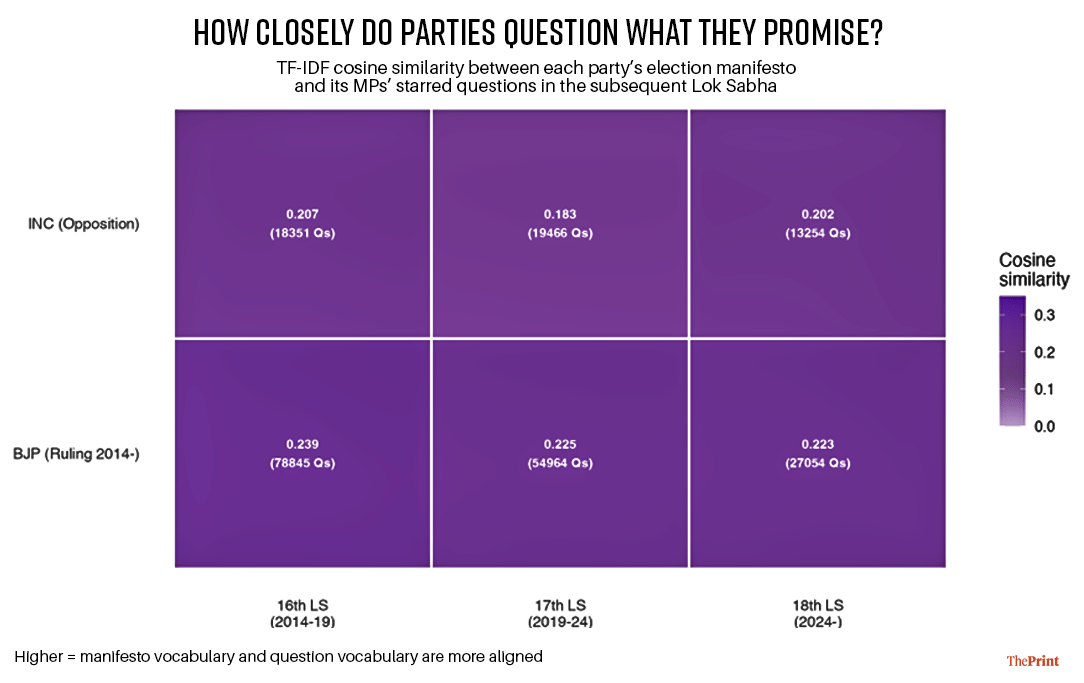 How closely do parties question what they promise? Cosine similarity between each party’s election manifesto and its MPs’ starred questions in the subsequent Lok Sabha. Higher scores indicate greater alignment between what was promised and what was asked.
Also read: Yesterday’s militants in Punjab are martyrs for today. BJP’s hope in a non-Hindu majority state
A dip, then a rebound
The 16th Lok Sabha score of 0.24 was already low. What followed was not a steady decline. It was something stranger.
In the 17th Lok Sabha (2019-2024), BJP’s alignment fell sharply, to 0.171, the lowest of any BJP Parliament in the data. Then, in the 18th, it rebounded to 0.262, its highest yet, above even the 2014 figure. The gap between BJP’s promises and its questions did not widen year after year. It collapsed in the middle parliament and then closed again.
This is what makes the 2019 data particularly striking. Before that election, BJP introduced Ayushman Bharat, a health insurance scheme that enrolled over 500 million beneficiaries, and PM-KISAN, direct cash transfers to farmers. These were large, visible, heavily publicised programmes. One might expect them to generate a surge of parliamentary questions on implementation, coverage gaps, exclusion errors, and funding delays.
They did not shift the needle upward. If anything, alignment fell. The 17th Lok Sabha, the Parliament of Ayushman and PM-KISAN, was the lowest-aligned of the three. Ayushman appears in both the manifesto and the questions, but nowhere near enough to close the gap. The new programs were promised; the questions flowed where they always had, toward state-specific schemes, railway projects, rural employment, and fund disbursal.
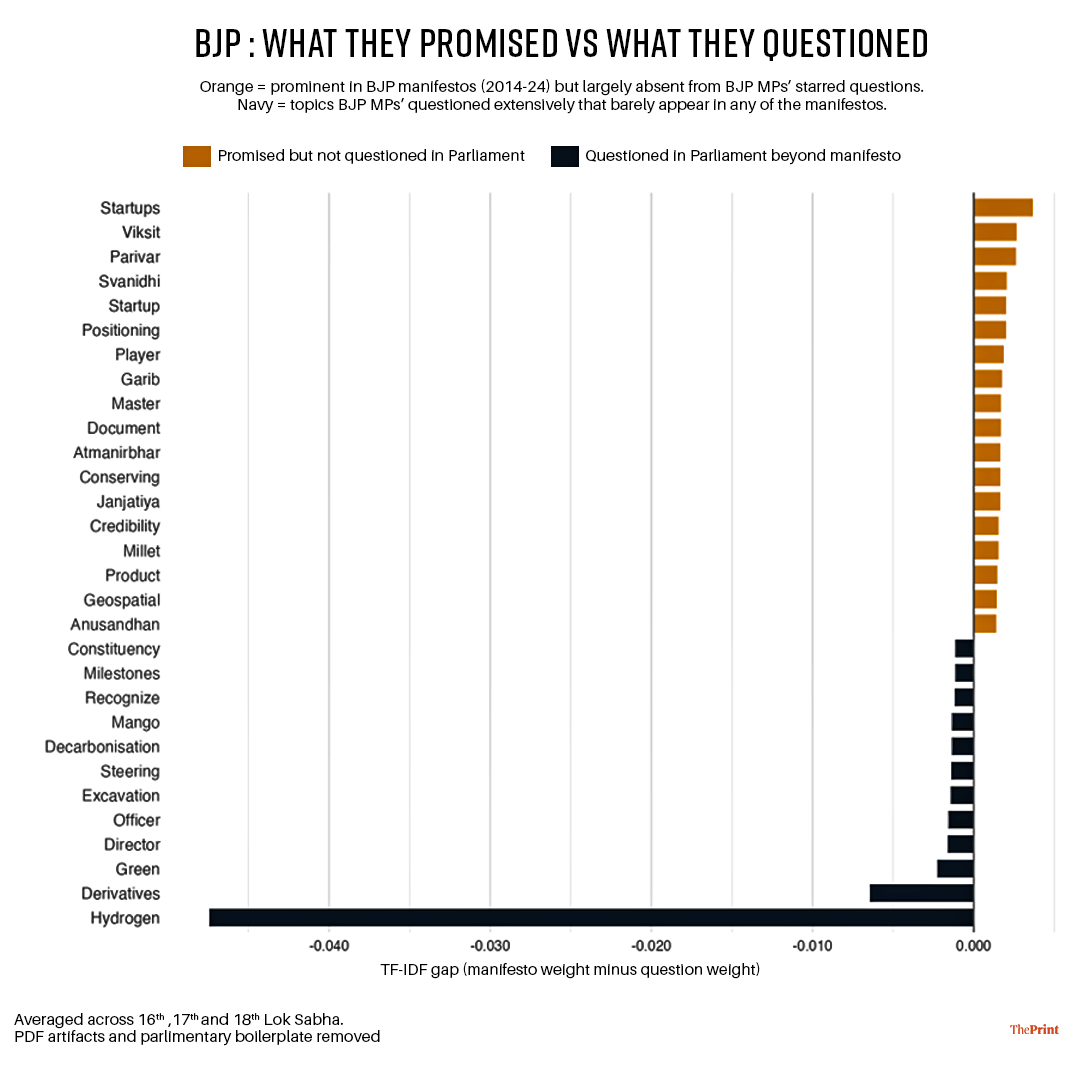 Orange bars are words prominent in BJP manifestos (2014-2024) but largely absent from BJP MPs’ starred questions. Navy bars are topics BJP MPs questioned extensively that barely appear in the manifestos.
Not simply a scandal
The temptation is to read this as hypocrisy: BJP says one thing and does another. The data is more complicated than that.
Manifestos are campaign documents. They are written to be quoted at rallies and shared on polling day. Their vocabulary is intentionally elevated. No manifesto anywhere in the world is a legislative work plan.
Parliamentary questions are something different entirely. An MP files a starred question to get a minister on the record about a specific, locatable problem: Why was the highway in Bettiah not completed, what happened to the funds sanctioned for Odisha flood relief, how many ASHA workers in Uttar Pradesh received their incentive payment last quarter. That is not the language of civilisational aspiration. It is the language of a constituent who needs an answer.
The gap between these two registers is partly just the gap between politics and governance. Every democracy has one. The manifesto is the party speaking to voters. The question paper is the MP speaking to the state.
But the size of the gap matters. The words most distinctly absent from BJP’s parliamentary record, civilisational, consciousness, harmonious, cultural, are not merely rhetorical flourishes. They signal a specific ideological project that BJP placed at the center of its 2014 mandate. That project does not show up as a priority in what BJP MPs actually asked about in Parliament. The culture war of the manifesto and the administrative routine of Parliament have been running on largely parallel tracks.
How Congress compares
Congress shows the gap too, but its trend runs the other way. INC’s manifesto-to-question alignment was 0.154 in the 16th Lok Sabha and 0.178 in the 17th. In the 16th it sat well below BJP; by the 17th it had edged slightly above BJP’s collapsed score.
Two things explain this. Congress was in Opposition for both parliaments. Opposition parties use starred questions to pursue the ruling government on its own stated priorities, not necessarily to advance their own manifesto themes. The incentive is to embarrass the ruling party, not to act out a shadow legislative agenda. And INC’s 2014 manifesto was drafted before the party knew it would receive its worst electoral result since Independence. The questions its reduced caucus filed reflected the politics of a diminished Opposition, not the ambitions of a would-be government.
In the 18th Lok Sabha, INC’s alignment rose again to 0.206, the third straight increase, after the party returned with a stronger 99-seat caucus through the INDIA alliance. Where BJP’s alignment dipped and then recovered, Congress’s has climbed steadily. Whether that reflects a more coherent legislative strategy going forward remains to be seen.
Also read: India doesn’t have Left-Right divide in Lok Sabha. MP concerns are tied to geography
The bigger picture
The picture across parties is mixed, not uniformly weak. DMK, in its single available parliament, scores 0.307, the tightest manifesto-to-question alignment in the data. BJP and INC sit lower and move around. The shared vocabulary is real, development, welfare, rural and water appear in everyone’s manifestos and everyone’s questions, but for most parties the overlap stays loose.
There is a structural reason for this. The starred question is as much a constituency-service instrument as an accountability instrument. MPs use it to signal effort on local issues to their voters: a road, a dam, a scheme. Not to prosecute a coherent ideological agenda. Manifestos are written nationally. Questions are filed locally.
One important caveat: The data cannot tell you whether BJP delivered on its manifesto through executive action rather than parliamentary questions. Cabinet decisions, budget allocations, scheme rollouts, administrative orders – these are outside the scope of starred questions. It is entirely possible that BJP’s promises were acted on through ministerial orders while its MPs were busy asking about constituency infrastructure.
What the data can tell you is simpler. The vocabulary of promise and the vocabulary of accountability in India’s Parliament are measurably far apart. For BJP, that gap was at its widest not in some half-forgotten term, but in the 17th Lok Sabha, the parliament of Ayushman Bharat and PM-KISAN, when its biggest welfare promises were freshest.
The gap is widest exactly where you would least expect it.
Piyush Zaware is a graduate researcher in economics at the University of Chicago and a researcher at the Global Poverty Research Laboratory at Northwestern Kellogg School of Management. He tweets @pzaware19 and his Instagram is @pzspeaks. Views are personal.
A note on method: Manifesto texts were extracted from official PDF releases. Parliamentary question text comes from the Lok Sabha question archive. Vocabulary was compared using a standard text-overlap measure (TF-IDF weighted cosine similarity) that counts distinctive words more heavily and discounts common ones. Common parliamentary boilerplate, MP names, and stop words were excluded before comparison. Full methodology available on request.
This is the second in a three-part series analysing starred questions filed across the Lok Sabha and the Rajya Sabha between 2014 and 2025.
(Edited by Theres Sudeep)