






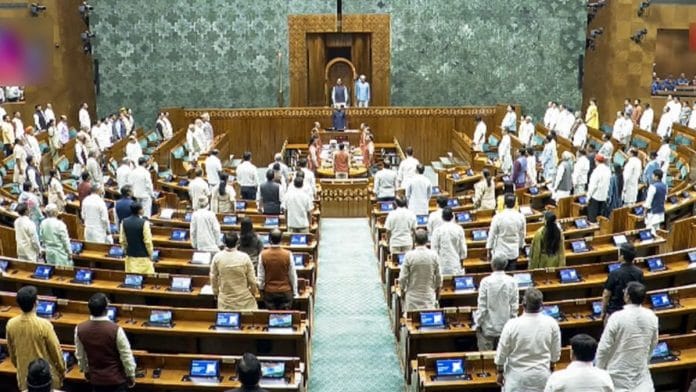


When you map Indian MPs on a political vocabulary space, leaders from BJP and Congress end up in almost the same place. It shows the real dividing line in the Lok Sabha is not party; it is geography.
In 1985, two American political scientists named Keith Poole and Howard Rosenthal did something that changed how we think about legislatures. They took decades of congressional roll call votes, ran a matrix factorisation (a technique for finding hidden patterns in a large table of numbers) on them, and produced a single number for every senator and representative: their “ideal point” on a Left-Right scale. The result, published as the NOMINATE model and refined over the following decades, showed that the US Congress sorts itself into two near-perfectly separated clusters. Democrats on one side, Republicans on the other, with almost no overlap. The party predicts legislative behaviour with striking accuracy.
The question I wanted to answer was whether the same is true of India’s Lok Sabha.
The answer, based on data from 1,50,000 starred questions filed across the 16th, 17th, and 18th Lok Sabhas, is no.
The reason reveals something important about how Indian parliamentary democracy works.
Also read: The math behind India’s elections—Why proximity matters
What ideal points measure
A “starred question” is one of the most direct forms of parliamentary accountability available to an Indian MP. It is a formal, numbered question that a minister must answer in the chamber, on the record. Unlike unstarred questions answered in writing, starred questions can generate supplementary exchanges on the floor. They are, in effect, the vocabulary of parliamentary scrutiny.
The method I used mirrors NOMINATE but substitutes vocabulary for votes. We turn each MP into a list of the words they use most distinctively in their questions, then use a standard statistical method to reduce those thousands of words to the two underlying patterns that best separate one MP from another. In the US model, Dimension 1 almost always captures the liberal-conservative axis. I wanted to see what it captures in India.
The answer: Not party.
Also read: 2026 election results show power is rarely defeated by rivals. Credibility matters more
The BJP-Congress overlap
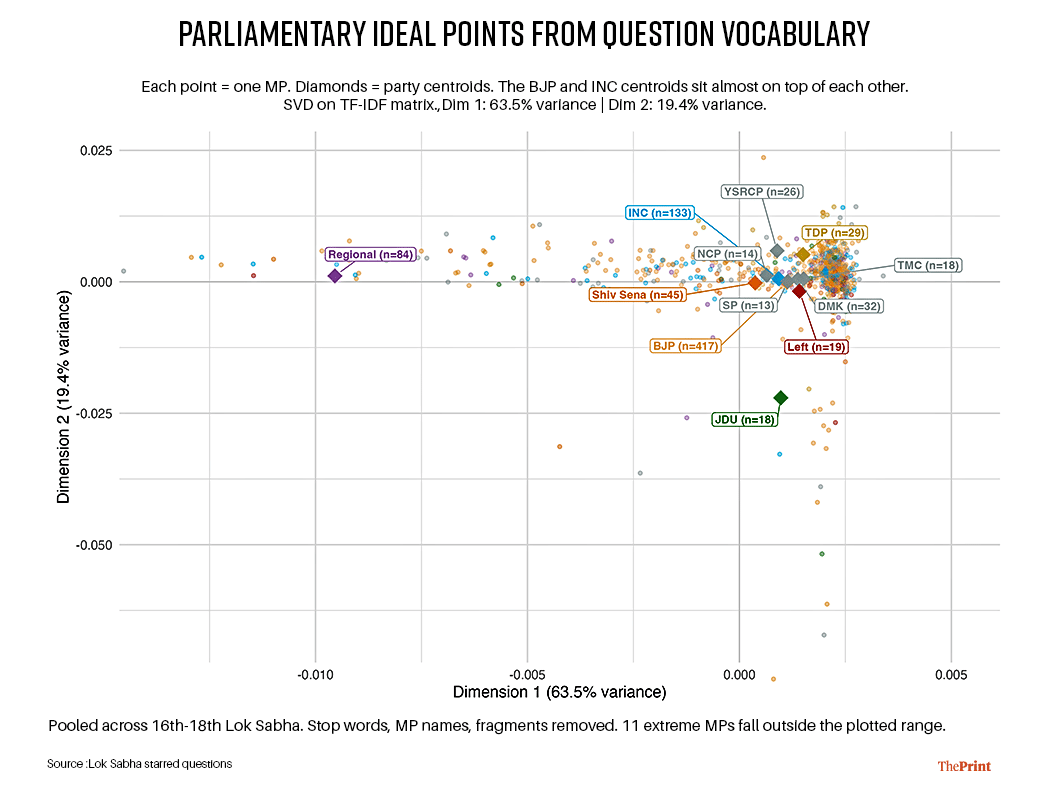
After running the SVD (the pattern-finding method just described) on a matrix of 860 MPs and 5,713 vocabulary terms (filtered for minimum usage and stop words), the first dimension explains 63.5 per cent of the variation captured across the top three components. The second explains 19.4 per cent.
On Dimension 1, the BJP centroid centroid (a centroid is the average position of a party’s MPs) sits at 0.00112. The INC centroid sits at 0.000928.
Those numbers are, for practical purposes, the same.
The standard deviation of BJP MPs around their centroid is 0.00253. For INC MPs it is 0.00277. The BJP-INC centroid gap (0.000192) is less than one-tenth of one standard deviation for either party. The two distributions overlap almost completely. If you were handed a single MP’s Dimension 1 coordinate and asked to guess their party, you would do barely better than a coin flip.
This is not what the NOMINATE model finds for the United States. There, the first dimension separates the parties so cleanly that knowing a legislator’s ideal point tells you their party affiliation with greater than 90 per cent accuracy. In India’s Lok Sabha, that number would be close to 50 per cent.
On this main pattern, MPs differ more from their own party colleagues than the parties differ from each other: the gap between parties is smaller than the spread within them (a ratio of 0.82). For reference, US Congressional NOMINATE produces ratios above 10. Indian parliamentary parties, in their question vocabulary, do not sort.
 What Dimension 1 actually captures
If Dimension 1 does not separate government from Opposition, what does it capture?
The word loadings point to geography and sector. MPs on one end of the dimension ask questions predominantly about railways, roads, rural employment, and fund disbursal. MPs on the other ask about urban infrastructure, financial regulation, and national schemes. This is not an ideological divide. It is a constituency-type divide—agrarian, rural, infrastructure-poor districts versus urban and semi-urban ones.
In the US, a senator from rural Alabama and a senator from urban Massachusetts vote differently because their parties are different. In India, an MP from rural Jharkhand and an MP from urban Mumbai ask different questions because their constituencies are different but both can belong to BJP or INC with roughly equal probability.
Also read: The sociology of 2024 Lok Sabha elections in 10 charts
Dimension 2 and the Telugu exception
Dimension 2 tells a different story, and it is revealing precisely because it is the exception to the rule.
On Dimension 2, most parties cluster tightly near zero. BJP sits at −0.000064. INC at 0.000571. Left parties at −0.00179. The differences are modest.
TDP sits at 0.00518. YSRCP sits at 0.00591.
Those are not rounding errors. The Telugu Desam Party’s centroid sits nine times further from zero on Dimension 2 than the INC centroid, and the YSR Congress Party sits fractionally further still. These two parties—both Telugu-speaking, both anchored in Andhra Pradesh and Telangana form the clearest cluster in the Dimension 2 space. TDP’s within-party standard deviation is just 0.00678, confirming that this is genuine internal coherence, not one or two outlier MPs pulling the centroid.
What is driving their separation? The word loadings on the positive end of Dimension 2 are almost entirely Telugu-specific: References to Andhra Pradesh’s bifurcation, the special category status dispute, Amaravati, Polavaram, and a set of place names and administrative terms specific to the Telugu-speaking region. TDP and YSRCP MPs ask, overwhelmingly, about Telugu constituency concerns. That disciplined geographic focus is what shows up as a distinct cluster in the ideal point space.
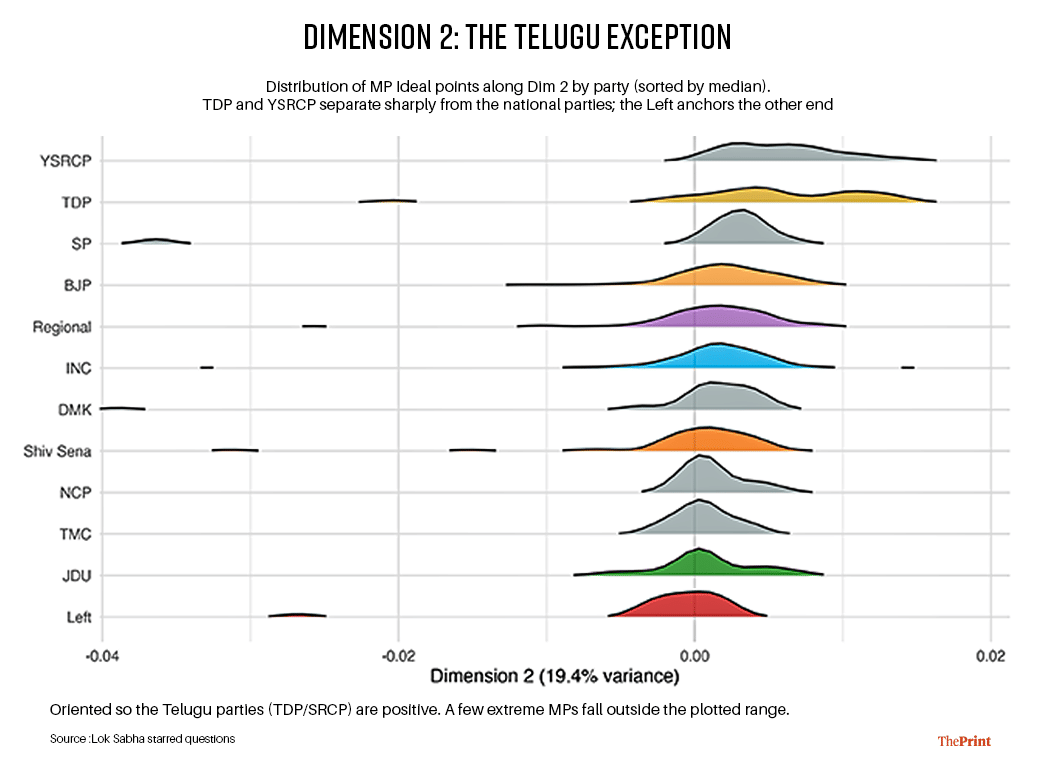 This is a useful calibration. The method clearly detects real structure when it exists. What it tells us about BJP and INC is not a null result from a weak method. It is a genuine finding: National parties, which field candidates across hundreds of constituencies with vastly different economic profiles, produce MPs whose question vocabularies reflect their constituencies rather than their party platforms.
Why there is a difference
The structural reason for this finding is worth stating clearly, because it has implications beyond this particular analysis.
In the US, congressional votes are whipped. Parties instruct their members how to vote, and defection carries real costs. Roll call votes therefore contain party signals almost by definition. NOMINATE’s power comes from the fact that it is analysing a behavior that parties tightly coordinate.
Starred questions in India are not whipped. An MP chooses what to ask based on their own calculation of what is useful: To constituents, to their career, to their local political standing. There is no party directive telling a BJP MP from Bihar to ask about railways rather than cultural nationalism, and no penalty if they do. The result is that the question paper reflects the individual MP’s incentives, which are primarily local.
This does not mean parties are irrelevant to Indian parliamentary behavior. The party determines votes on legislation, confidence motions, and supply bills. The whip is enforced where it matters for the government’s survival. But the starred question is not where the whip runs. It is where constituency service happens.
The Rajya Sabha offers a partial test of this interpretation. Rajya Sabha members represent states, not individual constituencies. If constituency variation is the main reason Lok Sabha parties do not cluster in vocabulary space, Rajya Sabha members should show more party-based sorting. Running the identical SVD pipeline on the Rajya Sabha question archive produces a BJP-INC Dimension 1 spread that is roughly eight times wider than in Lok Sabha consistent with constituency variation accounting for a significant share of the Lok Sabha finding. Even so, within-party variance still dominates in the upper house. The party whip does not reach starred questions in either chamber.
What this means for accountability
The finding has a practical implication that goes beyond political science methodology.
If Indian MPs’ question vocabularies are driven by geography rather than party ideology, then starred questions are a form of constituency representation, not a form of ideological contestation. An MP’s question record tells you where they are from and what their district needs. It does not reliably tell you which party they belong to.
This is not necessarily a failure of Indian democracy. Constituency representation is a legitimate and important legislative function. The argument that MPs should be asking more pointed ideological questions assumes that Parliament is primarily a site of ideological debate. The data suggest it is, at least in this dimension, primarily a site of local demand aggregation.
But it does raise a question worth taking seriously: If starred questions are predominantly constituency service, where does the ideological accountability happen? Where does the Opposition prosecute the government on its ideas rather than its budget lines? Where does the BJP’s cultural agenda get interrogated, or Congress’s redistributive ambitions get challenged on their merits?
That conversation appears to be happening mostly somewhere else.
Note: The analysis uses 1,50,629 starred questions from the 16th, 17th, and 18th Lok Sabha, covering 860 matched MPs across 15 party families, with ideal point estimation via truncated SVD on TF-IDF weighted question vocabulary.
Piyush Zaware is a graduate researcher in economics from the University of Chicago and a researcher at the Global Poverty Research Laboratory at Northwestern Kellogg School of Management. He tweets @pzaware19. Views are personal.
This is the first in a three-part series analysing starred questions filed across the Lok Sabha and the Rajya Sabha between 2014 and 2025.
(Edited by Theres Sudeep)
Starred questions in India are not whipped. Are questions in US whipped? Voting in US is whipped. Is it not the same in India?
All are shameless third-rate socialists. Swapan Dasgupta wrote that according to L K Advani, there is economics agenda in Indian politics., no one bothers about the economy.