




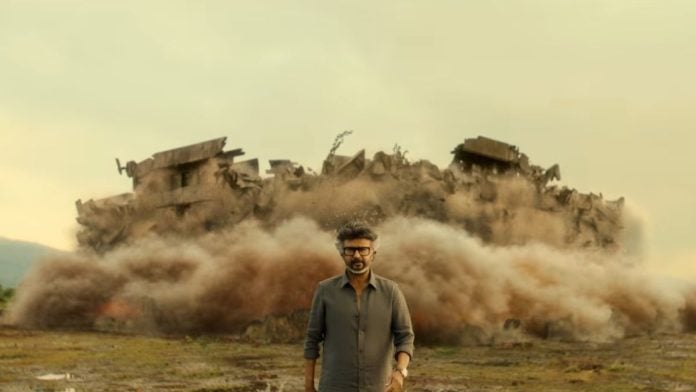

At 75, Rajinikanth, the OG badass grandpa of Indian cinema, is still here to kick ass, not hand out life lessons. In the Jailer 2 trailer, Rajinikanth plays a grandfather who wields a machine gun, throws villains around, and makes people half his age look like they need retirement plans. Just as countless Rajini memes have long suggested, Rajinikanth doesn’t retire. He makes retirement run for its life.
Indian cinema has spent years telling its ageing male stars to graduate into patriarchs, mentors and wise old men. Rajinikanth seems to have missed the memo, and the movies are better for it.
The older he gets, the bigger the spectacle
Rajinikanth is not de-aging, but his filmography seems to be. With every film, his action sequences grow more elaborate, and his movements more finely tuned. His characters may be getting older, but the number of people getting beaten up around them certainly isn’t decreasing.
He is unapologetic about the kind of star he is, and that is what makes him the grandpa Indian cinema needs right now.
While the rest of the industry is busy debating what mass cinema should be, and whether action films such as Dhurandhar (2025), Animal (2023) and Toxic (2026) promote violence, Rajinikanth is busy defying gravity himself.
We can debate these films over their core themes or action sequences that make Newton look like a fool. But I personally do not want to analyse a Rajinikanth film that way.
In Yajaman (1993), he is the saviour of an entire village. In another film, Kaala (2018), he controls an entire slum. In between scenes, he performs action sequences that make absolutely no sense. But when he does it, somehow, it all works.
A villain can have 50 men, a gun, a knife, and possibly a family history of martial arts. Rajinikanth needs a cigarette, a coin, and a background score. The outcome is already decided. The only suspense is how stylishly he will finish the job.
Whether it is his clothing, the way he makes a phone call, or the way he flips a coin, everything has a style uniquely his own. Rajinikanth could probably make checking the time on his phone look like the climax of a ₹500-crore film. He understands the grammar of that world.
From the Angry Young Man to the Wise Old Man
Amitabh Bachchan began his career in 1969 and soon became Bollywood’s ‘Angry Young Man ‘, embodying the rage and rebellion of an entire generation. He became the face of a hero who challenged authority and fought injustice in films such as Zanjeer (1973), Deewaar (1975), Trishul (1978) and Mard (1985).
But as Bachchan grew older, his screen identity changed. In Sooryavansham (1999), he played a dual role of a father and his son. Over the years, he increasingly took on roles as patriarchs, mentors, and older men, in films such as Black (2005), Sarkar (2005), Cheeni Kum (2007), Piku (2015) and Gulabo Sitabo (2020).
These are not bad roles, and Bachchan delivered some remarkable performances in them. But with time, the Angry Young Man eventually became the Wise Old Man.
Rajinikanth, whose career began just a few years after Bachchan’s, took a different route. At around 60, he was playing Chitti in Robot, opposite Aishwarya Rai Bachchan, Amitabh’s daughter-in-law, who was around 36. He continued to headline mass entertainers such as Muthu (1995), Padayappa (1999), Chandramukhi (2005), Kaala (2018) and Jailer (2023). Rather than gradually retreating into the role of the wise old man, he has continued to occupy centre stage as the action hero.
There has hardly been a phase in his filmography when he seemed compelled to prove his acting credentials by playing a motivational father, a mentor, or a man crying in a corner to display every possible emotion in a scene.
That is what separates Rajinikanth from many of his contemporaries. He is not trying to convince audiences that he is a young man. He is showing them that an older man can still be the centre of an action spectacle.
Also Read: Geraftaar had Amitabh, Rajinikanth, Kamal Haasan—and a Hindu-Muslim friendship at its heart
What happens when the action hero gets old?
And this is where Rajinikanth matters beyond his own filmography. A whole generation of film stars is approaching 60 or has already crossed it. Salman Khan, Shah Rukh Khan, Ajay Devgn, Akshay Kumar and Sunny Deol have to confront the same question: what happens when the action hero gets old?
Imagine Salman Khan playing Varun Dhawan’s father in a film simply because the industry has decided that he is now too old to be the hero. It is not that Salman cannot play a father.
Bollywood has just spent decades selling audiences these stars as action heroes, from Wanted (2009) and Bodyguard (2011) to Kick (2014) and the Tiger franchise (2012-2023).
Rajinikanth is helping create space for a different possibility. He is showing that even a septuagenarian can perform elaborate action sequences, beat up baddies, and look uber cool while doing it.
This is why Indian cinema needs more grandpas like Rajinikanth. And honestly, if Indian cinema’s future grandpas are going to spend their retirement fighting crime, throwing villains through walls and making physics reconsider its life choices, I am all for it.
Edited by Maryam Hassan