






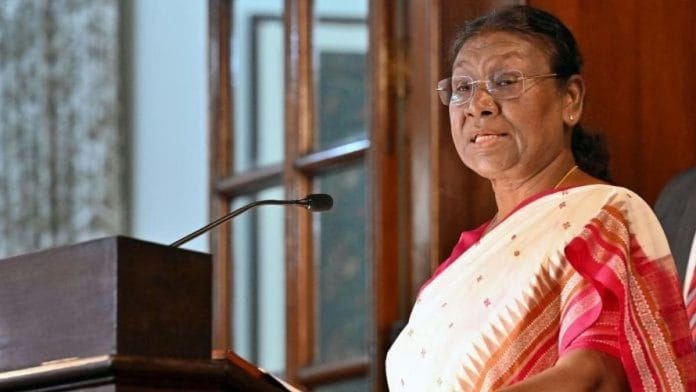



How bad is it for the chief minister to insult the President of India? The answer is obvious: it’s disgraceful—an insult not just to the individual but to the office of President and to the Republic itself.
So, should we all condemn West Bengal Chief Minister Mamata Banerjee? Well, the central government seems to think so. No sooner had the President, Droupadi Murmu, complained about how Mamata treated her than the Prime Minister issued his condemnation. Then, one by one, various ministers, former ministers, and wannabe ministers took to social media to issue their own condemnations.
Even External Affairs Minister S Jaishankar tore himself away from coping with a world in chaos to post a tweet that echoed everybody else’s tweets.
And indeed, all of us should condemn any disrespect toward our President—especially toward a tribal woman who has risen to the highest office in the land. And the incident raises many questions, some of them uncomfortable.
Not the first time
But, the notion of a conflict between the President and a politician is not novel. Apart from historical instances of Rajendra Prasad and Jawaharlal Nehru disagreeing (not sure it rose to the level of a conflict though because of the stature of both men), there are instances of SanjivaReddy and Morarji Desai fighting in 1978-1979, even though Reddy had been nominated by Desai’s government.
The issue was one that concerned the President directly. Reddy was upset about the backgrounds of businessmen that Morarji’s government was inviting to state banquets at Rashtrapati Bhavan. He complained that the Hindujas had been put on lists of invitees. Reddy’s real objection was that they were close to Kanti Desai, Morarji’s errant son.
Morarji got the subtext and made it clear to Reddy that he would not yield on this issue.
We know all this because Morarji stole PMO files and, some years later, gave them to a journalist who was writing a book about the period. The letters were included in those files. At the time it happened, though, hardly anyone knew about the conflict.
Also read: Indians laughing at their countrymen in Dubai are a disgrace. We have much to learn
More recently, there was bad blood between Zail Singh and Rajiv Gandhi. They never spoke on the record about their differences, but their aides briefed journalists. Essentially, Gandhi did not like Singh, blamed him for stoking the Punjab insurgency, and believed that he wanted to continue to interfere in Punjab. Gandhi had every right to this opinion, but he then went on to ignore Singh and refused to give him the respect his office deserved. Singh was annoyed, but when the opposition tried to persuade him to dismiss the Prime Minister and to politicise the issue, he refused. People who expected a constitutional crisis were disappointed.
Is the current incident like any of those?
Well, no, for several reasons. First, President Murmu has gone public in a way that no president in history (at least none that I can recall) ever has. Generally, such conflicts are kept out of public view and quietly resolved through the actions of officials or informal mediators. But President Murmu gave a speech about it. This is unprecedented.
Second, she has personalised the issue by saying things like “Mamata is like my little sister. I don’t know why she is angry!” On the whole, if you are the President of India and have a problem with your little sister, it’s better to just call your sister without publicly talking about it. That, at least, has been the precedent
Third, while any insult to the President is disgraceful, it is not clear that the circumstances that provoked this current outburst rise to the level of issues of such national importance as to overturn precedents. The President was upset because the West Bengal government made the organisation that had invited her change the venue of her event, that Mamata Banerjee did not accompany her, and, er, that there was no water in the bathroom.
Banerjee has offered her own rebuttals to each point raised by the President. The CM’s supporters have also suggested that the President is being used as a pawn in an electoral battle. Her public reference to being a ‘daughter of Bengal’ and the Prime Minister’s references to her tribal background are intended, they say, to create a narrative in which Banerjee has insulted all tribals by showing disrespect to such an important tribal figure. That is why so many ministers have been instructed to tweet about the incident, say Mamata’s supporters.
I think we owe it to the office of the President to reject all these insinuations from the Trinamool Congress. We must do everything we can to protect the dignity of the highest office in the republic.
Democracy suffers when people begin to suspect that institutions are being subverted for political ends. The office of the Chief Election Commissioner has already been damaged by the doubts that surround the incumbent’s actions. The Speaker of the Lok Sabha, Om Birla, is seen as partisan. Many governors have demonstrated that they are hit men for the central government (a process that began in Indira Gandhi’s time). And even the office of Vice President has been damaged by the way in which Jagdeep Dhankhar suddenly and inexplicably resigned.
In these circumstances, it is important for the President of India to be seen as above politics. But for that to happen, the President may be better off sticking to past precedents. If she feels disrespected by Mamata Banerjee, there is a well-established protocol for handling such apparent slights. Taking your problems to the public is clearly not the best way to protect the institution of the President.
Moreover, if you are visiting an Opposition-ruled state in the run-up to an election, it may be better to avoid personalising your unhappiness with the Chief Minister and declaring it to the world, in case it is misused for political purposes.
The other problem with becoming the sort of President who takes a stand against injustice is that while people might empathise with you at first (as we all do this time), the more you do it, the more you will be asked why you do not talk about other kinds of injustice—for example, the way tribal women in Manipur are being treated.
I have enormous respect for our President and it is possible that she reacted emotionally without even imagining that her unhappiness would become part of Bengal’s electoral battle. Unfortunately, when you are the President, you cannot afford to be spontaneous and vocal about these things. The President may benefit from using the standard precedents for communicating with politicians. Certainly, the institution she represents will gain enormously if she uses her discretion and avoids this sort of controversy.
Vir Sanghvi is a print and television journalist and talk show host. He tweets @virsanghvi. Views are personal.
(Edited by Ratan Priya)
When you have to defend something which is indefensible
And here comes the Mamata Banerjee fanboy. No matter what the ground realities of West Bengal are – this guy never ceases to worship Mamata.
Here comes the TMC apologist. This guy is so shameless that I have stopped taking him seriously.