






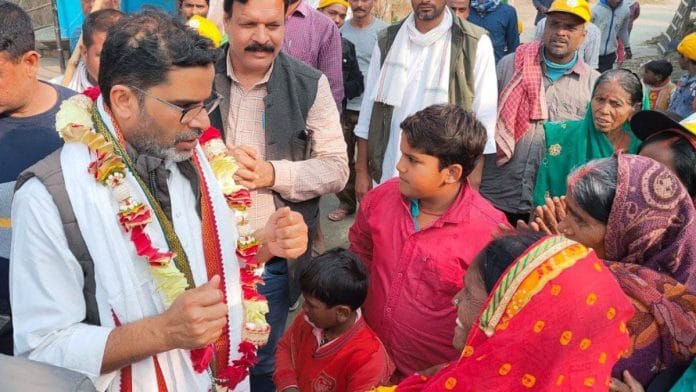


The convincing victory of Jan Suraaj Party chief Prashant Kishor in the Bankipur by-election in Bihar has everyone guessing about the possible changes in the state’s political landscape. The seat, previously known as Patna West constituency, had been a BJP stronghold since 1995. However, it fell vacant after BJP National President Nitin Nabin resigned as an MLA following his election to the Rajya Sabha.
His victory is attributed to several factors—the ‘success’ of the CJP protest, Gen Z’s anger spilling over to other states, the Brahmin lobby venting its frustration over the UGC circular perceived as anti-Brahmin, sparking major pushback from students and faculty in educational institutions, and renewal of the backward vote bank in Bihar. Still, none of these conjunctures seems convincing on why Kishor, a Brahmin leader of a one-man party, should win in a highly caste-ridden Bihar politics.
Kishor’s victory is not a defeat for the BJP, but a loud and clear warning bell for the ruling party. Kishor has all the attributes of a successful politician. He is cool, calm, and calculated. He knows how to strategise political contests, and appears to be a good listener. And in politics, one needs to be a good listener and absorb advice from as many sources as possible, but finally do what is best in the given situation.
It is attributed to an anonymous source that to succeed in politics, one should suffer fools gladly, and Kishor probably has many of them around him.
Alternative political platform
Kishor’s victory signals at least three probable significant changes in state and national politics. First, the response mechanism that the BJP and other state political parties will have to work on and implement in the state. How these parties interpret the electoral outcome and devise course correction measures is worth watching.
The loss surely means a serious political setback, though it will just reduce its number in the state assembly to 88 seats, which does not pose any serious threat to the BJP’s majority in the house, where the NDA coalition has 201 of 243 seats. Far from worrying about the unlikely event of losing majority in the assembly, the BJP will have to just take the result in its stride. But the party leadership in the state should be prepared to have Kishor breathing down its neck.
Soon there could be a demand for change in the state’s leadership, and that is when Kishor will put his weight behind those BJP legislators, demanding a change of guard. Once the party accepts this demand, Kishor will take the credit. He is already on record, stating that Bihar needs better leadership. The central leadership of the BJP will have to address this issue before it assumes serious proportions.
The second issue stems from the first possibility of the BJP replacing the present head man, CM Samrat Chaudhury, who has had stints at the Samata Party, Lalu Prasad Yadav’s Rashtriya Janata Dal (RJD) and Nitish Kumar’s Janata Dal (United). With RJD’s popularity nosediving and Nitish’s JDU not in the pink of its health, the non-BJP vote bank would be looking for an alternative political platform.
Also read: BJP’s good times are perhaps ending. But Modi is no Indira Gandhi
Long road ahead for Prashant Kishor
As of now, Congress is far from capable of providing any such platform. In the worst-ever debacle in the 2026 elections, it had won just five seats in a state where it once had its own chief minister. Beginning with zero seats in 2005, the Congress bagged 27 seats in 2015 and 19 in 2020. However, they have been reduced to irrelevance once again in Bihar.
It is here that Jan Suraaj Party (JSP), led by Kishor, could storm the political scene and hog the limelight. In his earlier avatar as the leader of the much-acclaimed ‘third alternative’ projected solely by him, he drew a complete blank, failing to win even a single seat. It was clear that the ‘Third Alternative’ and Asaduddin Owaisi’s All India Majlis-e-Ittehadul Muslimeen (AIMIM) mopped up a big chunk of anti-BJP votes, which would have otherwise gone to the Congress and the RJD. All these parties, the RJD, Congress, JSP and other outfits in the Mahagatbandhan had become history. Bankipur has revived Kishor’s fortunes.
This revival should serve as a warning to certain established regional parties and family fiefdoms, like the RJD. Kishor’s victory has bypassed regional identity, caste-based politics, and linguistic sentiments, at least for the time being. If it lasts till the next election, it could sound the death knell for parochial regional parties as voters of Bihar are weary of old caste equations and dynastic politics. Kishor has demonstrated that people will support a new face if a promise of development-based, clean politics is brought to the table.
In states like Tamil Nadu, New Delhi and Punjab, individuals without a cadre-based party apparatus and politically tested ideology have caught the imagination of voters and emerged victorious after defeating national parties like the Congress, the BJP and long-serving regional parties like the Dravida Munnetra Kazagam (DMK).
The next elections are in 2031, and the JSP has a long innings to play to sustain the momentum. For the BJP, if Bihar bucks this trend, it will bring great relief.
Seshadri Chari is the former editor of ‘Organiser’. Views are personal.
(Edited by Saptak Datta)