



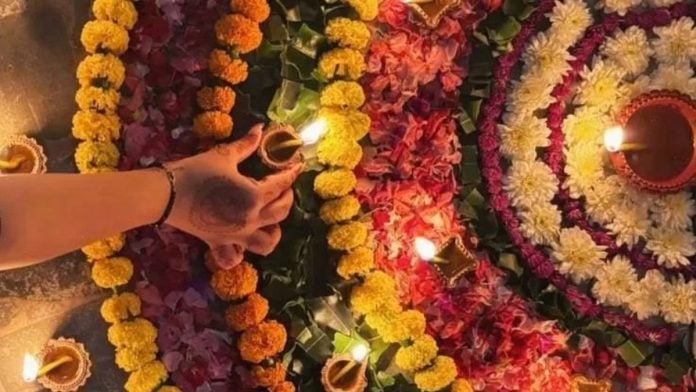
What are the ingredients of a quintessential Diwali party? Good music, gifts, games, lights, laughter, and food — all with a dash of tradition.
Of course, it all starts with the dreaded decluttering of the dwellings until they are squeaky clean. And the clean-up starts in the weeks leading up to Diwali—scrubbing the floors, removing the cobwebs from the otherwise neglected corners room by room, and donating clothes that haven’t fit us for years. Tidying up is serious business when it comes to Diwali, not only because cleanliness is next to godliness, but also because you may just chance upon a saree or kurta that was gifted by a distant relative years ago and it still fits you. But the fun starts after this purge.
The ambience instantly becomes festive when the tea lights are up. Not the purple-blue dancing lights that give you an instant headache if you look at them for too long. But the warm yellow lights, which are welcoming and acknowledge the nip in the air. If it were up to me, I would have opted for the multi-coloured tungsten bulbs, but the world has moved on to LED lights and is not kind to those who hang on to nostalgia for too long.
Then come the decorations. And I like to stick to handmade and natural ones, and make it a point to purchase them from artisans who set up shop either in melas or local markets. Online purchases feel dry and transactional, and I believe Diwali requires a more personal touch, one that spreads joy to the local craftsmen as well.
For instance, buying clay diyas over wax candles, or glazed or ceramic ones if you want to reuse them; cotton wicks separately, and lighting each one individually using mustard oil. Ancient wisdom says lighting diyas with mustard oil cleanses the house and keeps insects at bay; meanwhile, lighting wax candles will only release carbon compounds into the air. Besides, the process is meditative. Everything else is a shortcut.
Similarly, I prefer purchasing fresh flowers over artificial or plastic ones, though the latter may be easier to handle and would last longer. But they will never be able to match the sweet aroma of genda, rajnigandha and rose petals that lingers in the house. These must be coupled with mango tree leaves, usually strung in a maala, to repel bugs.
For the rangoli too, I would be inclined to throw in flower petals, rice flour, and dry colour into an imperfect artistic design as opposed to using stencils or worse, sticker rangolis. For authenticity’s sake. Not everything needs to be “Insta perfect.”
Once the diyas are lit and placed in straight lines, abiding by the literal translation of the word Deepawali, you know you are ready to host.
This is also that time of the year when everyone dresses in traditional Indian outfits. But that doesn’t mean creativity can’t take over their fashion. From a waist jacket over a dhoti to a saree with a corset, anything that is blingy will be appreciated. But for me, comfort is paramount.
Now the ingredient that can make or break the party: food. And by that I mean desserts — kaju katli, pinni, doda barfi, kalakand, or the homemade kheer and phirni. The good old chaat, served in forms old and new, makes for delectable appetisers. Between this and the desserts, no one really cares about the main course as the focus has shifted to winning the games.
Also read: Give Diwali its own cosy movie genre, just like Christmas movies
Traditions that matter
Diwali has traditionally been linked to playing cards, particularly teen patti, but over time it has evolved to playing UNO or poker. Tambola or Housie is another Diwali favourite — basically anything to try your luck at winning a little money. That is not to say that you can’t play Taboo or Mafia with your family and friends.
All this talk of tradition also takes me back to one that we created and follow each Diwali. My grandfather taught my mother and my aunts to play teen patti. After he passed away five years ago, my mother likes to keep his lessons alive. Every year, she takes out her father’s pack of playing cards with a bundle of tenners he left us, and we play teen patti with them as Brian Silas’ piano plays in the background. But each year, the winner doesn’t get the tenners. My mother transfers the earnings digitally as she collects the tenners and preserves them in the bundle the way she found them, ready to be opened next Diwali again.
The festival means more to me when all our cousins, aunts and uncles, and friends get together at one place, for one evening, which inadvertently ends up spilling onto the next morning. Yet, no one resists the urge to keep dancing, drinking and dabbling in card games and forget about their rozmarra ki zindagi, even if it’s for a little while. This, for me, is the key ingredient for a Diwali party. The rest is gravy.
Views are personal.
(Edited by Ratan Priya)