




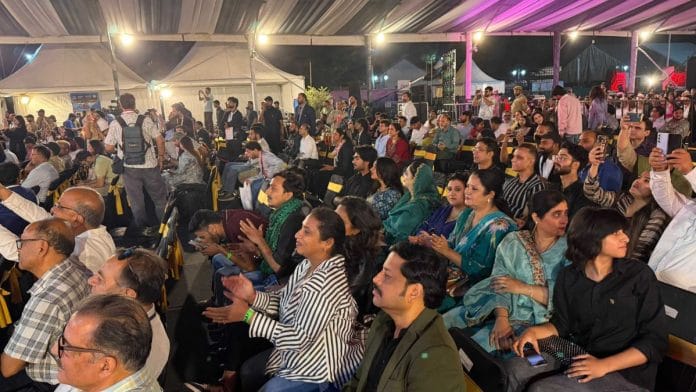

At the closing ceremony of Jammu and Kashmir’s first international film festival, singer Usha Uthup asked the audience to switch on the flashlights on their phones. Then she sang Saare Jahan Se Achha.
One by one, hundreds of tiny lights appeared and people joined in to sing along. I looked around and honestly, I got goosebumps. Because I was looking at a Kashmir that does not often make headlines.
For all the ways Kashmir has been described and defined, this was an alternate universe, one of people singing, celebrating, and simply being happy.
In the last four days, Srinagar rediscovered something that had been there all along: its appetite for cinema, music, and reveling in art.
Also read: Srinagar got star treatment at J&K film festival. Jammu got a supporting role
Theatre packed with joy
When INOX opened in Srinagar in 2022, it was said that cinema had returned to the city after 23 years. But, after attending the film festival, I found myself wondering if cinema and music had really gone anywhere at all. Sure, the screens had disappeared. The movie theatres were burned down. But it was very much alive in the hearts of people. You only had to look around.
At Sher-i-Kashmir International Conference Centre (SKICC), men and women both raised their hands. It is not a common sight for in this land. The women took up space, cheered with the kind of enthusiasm usually reserved for a cricket final. The young girls danced with infectious energy.
Kashmir has, for decades, been spoken about through the language of conflict. Violence, politics, security, shutdowns, borders and uncertainty have dominated the conversation. The region’s people, culture and everyday joys can sometimes get forgotten to a much larger, more complicated story.
But inside those halls at SKICC, people were laughing at films, discussing stories, applauding performances, dancing to music and arguing over what they liked and did not like. It seemed like their battered past had taken a backseat, even if it was for the four days of the festival.
It became a meeting point for filmmakers, actors, musicians, critics and audiences. The presence of familiar faces from Bollywood stalwarts like Ramesh Sippy, Imtiaz Ali, Sunidhi Chauhan, Pankaj Tripathi and the wider film industry added to the occasion.
Uthup’s musical performance truly unleashed their energy. The audience sang Hare Rama, Hare Krishna, Hokus Bokus, a Kashmiri folk song, and O Kali Bhaga Wala, a song in Dogri, along with many other Bollywood numbers.
Uthup changed languages, genres and rhythms, but the enthusiasm did not. It was a reminder that music transcends language.
At the film festival, a total of 135 films were screened in languages such as Kashmiri, English, Hindi, Persian, Italian, Korean, Nepali, Turkish, Japanese and many others. And, hundreds of people turned up at SKICC and INOX Srinagar.
The real draw? People had come because they wanted to watch films, discover new stories and talk about them.
For example, the Uzbek-language film, The Song of Sustxotin, a story about a remote village suffering through a severe drought, a covered-up crime, and a fight for justice, drew college students as the makeshift theatre got filled within minutes and barely had any room for others. The film by Khusnora Rozmatova went on to win the Best Debut Film and Best Director awards at the film festival.
The two J&K films screened at the festival, Batt Koch and Tasrufdar, also drew a warm response from audiences. Tasrufdar follows the life of a middle-aged Kashmiri Muslim man whose world is unsettled when he encounters a paranormal figure, the spirit of his late father’s childhood friend, a Kashmiri Pandit. The room was packed well beyond comfort, with people squeezing into seats meant for fewer, simply because they did not want to miss the film.
Batt Koch also struck an equally deep emotional chord. The film traces a Kashmiri Pandit’s journey back home, capturing the longing, memory and complicated relationship one can have with a place left behind. When the credits rolled, the audience responded with a sustained 2-3 minute-long applause.
So, the real story of J&K’s first international film festival was not that the cinema and music returned to Kashmir. It is that Kashmir was waiting for it. And, when the lights finally came back on, the audience was already there.
Views are personal.
(Edited by Ratan Priya)