






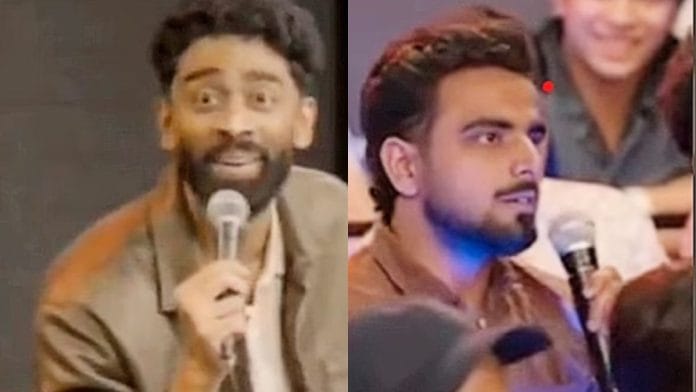


MBBS student Sejal Pawar’s comment about comparing the sizes of male cadavers’ genitalia at comedian Pranit More’s show has understandably provoked outrage. Pawar’s crass admission crossed a line, particularly coming from someone training to enter the medical profession.
Medical education is built not only on scientific competence but also on professional ethics. There is an expectation of empathy toward the dead. Any form of mockery, ridicule, or unnecessary commentary undermines a tradition of dignity that lies at the heart of medical training.
That said, the discourse around Pranit More’s show deserves a closer examination.
Pawar’s video from More’s standup show emerged right after a Gurugram man, Himanshi Jhangra—who is now famous as Rs 350 biryani guy—faced backlash for his objectionable comments. Pawar’s clip began circulating on social media only after Jhangra was fired from his job after a social media firestorm over his remarks.
Neither statement should be defended. Both inappropriate and warranted criticism. In fact, it was a big failure on Pranit More’s part. Instead of calling them out, he laughed along. However, just because both comments were problematic does not mean they were the same. Comparing Pawar and Jhangra’s statements is like comparing apples and oranges.
Also read: Women heard safety lectures for centuries. ‘Bandar’ gives the same to men now
It’s not the same
It’s appalling how some people have twisted Pawar’s comments in a way to question whether men are “safe” even after death. Respect for the dead is a legitimate concern. But if the discussion is to be grounded in reality rather than social-media point-scoring, I would like to remind everyone that violations of bodily dignity after death have historically involved acts far more serious than tasteless jokes. And most victims have been women.
Take the case of Devendra Bhosle, who was arrested in 2016 for the murder of his partner, Kinjal Shah. According to police reports, Bhosle confessed to engaging in sexual intercourse with Shah’s corpse after killing her. Or consider the 2015 Urmila Devi case, in which two men allegedly murdered her during a robbery and sexually assaulted her body before fleeing.
I am not citing these cases to say that Pawar’s remarks weren’t offensive. Rather, they illustrate an important distinction. A tasteless comment and an act of necrophilic sexual violence are not points on the same spectrum of misconduct. They occupy entirely different moral and legal categories.
At the same time, criticism of Pawar should not be weaponised to dismiss concerns raised in Jhangra’s case. Public accountability loses its meaning when it becomes a selective exercise.
Online discourse always turns every incident into evidence for a battle between men and women, feminism and now men’s rights. Such framing may generate engagement, but it does not help the conversation go in any constructive direction. We should be able to condemn both Pawar and Jhangra without using one person’s misconduct to excuse or diminish the other’s.
Views are personal.
(Edited by Ratan Priya)
Let me first clarify that I agree with the Author’s sentiment that is outlined in the title. Having said that, this is a very poorly written article.
To Ratan Priya who edited this article. I have one question to ask you? Did you read the article. The basic facts are wrong. It is Rs 370 not Rs 350. The person in question name is Himanshu, Not Himanshi.
What are you guys smoking there at the Print? Can I have some of it?
Such a pathetic article!! Someone has written with an IQ less than 50
There is a movie called “A Time to Kill” where the protagonist (a lawyer) who fighting for a father (person of color) who kills a rapist of hi child asks the jury to close their and narrates the who scene that happened on the eventful day. In the end, asks them to imagine the girl was white. Would like Triya to do the same, close your eyes and imagine it was say a Samir Pawar who had said and done those things. Would you be as apologitic?
In the era of a Atul Subhash where the alleged accussed for abetment of suicide is alive and employed by a big firm, the whole “we are women and hence always victim” is long gone. If you want equality, never give the excuse of being a women.
People like you have a single-digit IQ , your hypocrisy and generalisations have taken journalism down into a bottomless abyss.
I believe your words would have been different had a male made such a joke about a female cadaver. People like you have no empathy, dignity, or sense left.
Joking about the departed, and that too someone who has only his mortal remains left, especially while being in the service of mankind, should never be accepted.
Be it a man or a woman. That unempathetic doctor deserves strict punishment for her actions.
Also, this is the first time I am making a comment. Congratulations on your journalism take the award for being the very thing you pretend to criticise.
I generally don’t respond to very low level of journalistic articles. So when the author wrote hypocrisy article 101 I thought she jumped on the bandwagon too soon but then I did not comment on it because I generally follow that simple philosophy “that if words can evoke emotional response then it is easy to control your brain”.
There the author compared Apoorva to Pranit despite the positions of them, being very different. Apoorva whether correct or not was the one who made the comment and Samay was the host. I think Apoorva did not face the amount of backlash samay faced and instead Apoorva became more popular from that incident. Pranit was to be compared with samay and even Pranit has faced lot of abuses and had to shut his insta account down and he is facing FIRs too and rightly so. But then I thought I should give the author her lesson on Hypocrisy 102 which she might have missed in her undergrad second semester course after hypocrisy 101 course but then I stopped. But sometimes it is too much and needs to be called out.
But now the same author I mean I must say has so much of blind sided hatred and bias that she could not figure out the difference. Himanshu Jangra lost his job for something which had nothing to do with his profession but Sejal Pawar who made jokes on Male Cadavers genitalia was a professional misconduct full of sexism but she has not lost her job yet and there are many feminists like Triya Gulati who are already indirectly defending her by downplaying the incident. When you know you can not defend directly, you mount indirect defense.
And her act of comparing dead males genitalia size is as much sexual assault on a dead man, because the author seems to lack some basic biological knowledge. Dead men can not be sexually assaulted by women in a conventional sense, as their private part can not change shape or size, so best they can be assaulted is touching it with vulgar motives or maybe by sizing it’s length and comparing to make fun of it. Sexual assault is not just what the Indian law defines.
And then these feminist will say why raise the issue now after 3 months. You know why because when it would have been raised at that time it would have been put aside as a harmless joke and maybe the feminist would have attacked the men raising the issue. So even now when it is being compared against another gross act by a male and still being downplayed, we can only imagine what would have happened then. So dear author apart from the lecture of hypocrisy 102 you seem to have missed the basic class 9 and 10 biology lectures and basics of journalistic ethics.
And then it also raises another question who is a feminist? They call themselves who want equality of rights and freedoms. They say equality but what they care about is just women rights over men and implicating men in false cases as well many a times. They complain why men are not being feminist or any men not being considered a feminist are tagged as patriarchal or even worse tags than that. But the smart men understood that feminism is just as much a weapon to control power and narrative and it was never about equality. If it was about equality then the feminists would have raised the Sejal Pawar issue first because anyways feminists care about equality and men don’t believe in equality as per the feminist. But no even now when men have raised the issue, these feminist are downplaying it. So it just further exposes who feminists are.
So I turn back and ask the feminist why are they not men’s rights activist ? They too talk about equality and men’s rights and they are not against females. So they get aggressive and respond with nasty tags and worse names. Abuse, whether nasty terms or offensive mother-sister slurs they are abuse; just because women mostly abuse using sophisticated English terms and less of those slurs does not make it any less harmful. But yes males can not cry victim when they are abused or receive threats because they “deserve” it. But women despite making sexist jokes are the real victims because they can shed those tears and they are clean or their acts are best downplayed. So dear author I think you need some reflection on your part and also I think you said retrain yourself with certain journalistic ethics courses.
COPEEEEEEEEEEEEEEEEEE
Now let’s imagine if male has said something about female cadavers like this would you have said it as crass joke you can’t give your personal opinions on news site and if you are giving them why don’t you write in front that it is my personal opinion plz don’t make this about men and women it’s about ethics she is not layman who can joke anything she is doctor where certain etiquettes are expected if you will come out of your feminism bubble you can clearly see backlash is from entire medical community don’t write anything just for sake of writing it is about medical ethics not about men vs women
Here comes the Pope with the pontification.
Do you really think people care what you think or say?
I appeal to Mr. Shekhar Gupta to look into the state of affairs at ThePrint and initiate course correction urgently. Other wise his much vaunted ‘un-hyphenated journalism’ will get reduced to ‘pointless journalism’.
Mr. Gupta keeps requesting people for subscriptions but who would subscribe for such yellow journalism. The misdeeds of a few – Triya, Karanjeet, Stela – cloud the excellent journalism of DK, Apoorva, Swasti, Bidisha, etc.
Bwahaha ! Both are deplorable. Do not show such blatant bias the moment a female gender is involved. Let us flip the script and imagine a male doctor commented about female genitalia while conducting the post mortem of deceased ? Fair ?
The author downplays the incident of the female doctor violating the dignity of male cadavers simply because of gender. If a male doctor made similar remarks about the breasts and vulva of female cadavers and claimed he got a kick from comparing and humiliating female genitals, he would be charged with a sex crime, i.e., “outraging the modesty of women.” She got away with it because she violated male bodies, and the law does not protect men. It has nothing to do with lack of similarity but with the gendered nature of our laws
She literally said she and other female doctors got a kick from making fun of the male genitalia of dead men; this is a humiliation fetish that exists, i.e., SPH (all fetishes are acceptable if consensual). By any definition this is necrophilia; her own words condemn her, and no one is twisting her words to infer this.
“Equality looks like oppression when privilege is the norm.” This is, in my opinion, why the author defends the female doctor and thinks the comparison is unfair. Despite what the doctor did, it is arguably more heinous considering she is a doctor and her own words condemn her for kicking out necrophilia with a male cadaver.
Sejals comments are worse than that moronic comedian. She is joking about playing with dicks of dead cadavers who donated theri bodies for a noble cayse.
Stop this victim card. kick her out ofmedicine. she is fit to be a buthcer/. besides equality any one ?
if the guy is punished for a bad joke, girl should be too for a even worse one.
This selective amnesia is typ[ical of fake news peddelers of couptajis rag
Gr8 of you to share your ” personal opinions ” in a national newspaper
Triya i cant understand your problem of being hell bent to support a particular idea or some particular views which you think are right from your pov but how is this related to all of this case you just pointed out two cases from past of crime against women which i can understand are wrong and disgusting crimes but for defendimg her joke you pulled out some 10 year old cases to prove a point isnt healthy sign for some reporter or journalist it projects you as biased towards a particular idea i have problem with both jokes but why consequences faced by both of them are different one was fired from his job another gained followers listen if you continue writing these kimd of articles this only makes your views weak and even if you write something important about problems faced by women in indian society in future people will just ignore you and will not take you seeriously which will only weaken the true needs of true feminism views and ideas weak as these kind of articles will give reason to people that you just write non serious stuff which arent even requirements of women
This is the culmination of spiritual and cultural deracination of modern education system from Bharatiya roots.
I wonder if what that dude said is even a fact. Was it staged? Why did the liberal and socialist education produce these defunct behaviours, and also condone it?
Craas jokes on cadavers by a female are ok but a crude joke by a male are not. This blogger precisely exemplifies the disgust of modern education and depleting values. Such is her abysmal state of functioning.