






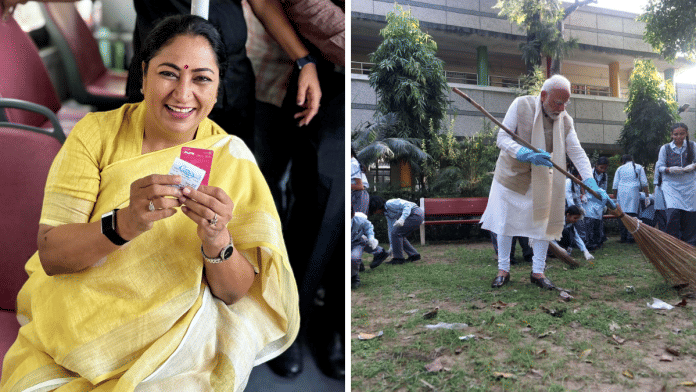


Chief Minister Rekha Gupta and her cabinet clique hopping onto the Delhi Metro and boarding the DTC buses was, believe it or not, meant to send a message. Cameras followed as the ministers smiled through the “tedious” commute, portraying an image of humility, accessibility, and the buzzword for the past two weeks—austerity.
Wait, when have we seen similar acts of humility on display? The Swachch Bharat Mission. When all our ministers, MPs and even PM Narendra Modi descended on the roads for one day—yes, just one day—with brooms in hand and swept the already cleaned streets and pavements in posh areas of the cities.
Now, once again, wrapped under the banner of the “Mera Bharat Mera Yogdan” campaign and high on the Prime Minister’s appeal to reduce fuel consumption, a similar exercise is being sold as the model of “leading by example” politics.
Some notable cabinet ministers like Ashish Sood, Manjinder Singh Sirsa, Kapil Mishra, and Pankaj Singh also took the metro to reach their destinations; all well documented, of course.
It didn’t stop there. BJP MP Manoj Tiwari, along with NDMC Vice Chairperson Kuljeet Singh Chahal, too, travelled through public transport but first travelled in a shared e-rickshaw to promote clean and convenient last-mile connectivity.
But Indians have seen enough political theatre, or as many like to call it “shoshebaazi” (show-off), over the years to recognise the difference between performance and governance.
The question here isn’t whether ministers can travel in the metro or public buses for a day. It is whether this is a sustained shift in governance culture or a mere choreographed photo-op meant to hog the headlines and distract the public from the very real concern of growing fuel prices, as the opposition has already accused them of. If history is any guide, the answer hides in plain sight and is painfully obvious.
Also Read: Why PM Modi’s austerity call needs real fiscal teeth
Is timing everything?
The timing of the spectacle, too, must be studied. India is feeling the heat, literally and economically. The ongoing US-Iran war has disrupted global supplies and triggered fuel price hikes worldwide. Diesel and petrol prices have already risen and are expected to keep rising if the crisis deepens. This means transport costs are climbing, inflationary pressures are building, and every household budget is under strain.
But the nightmare doesn’t end there. Indians are looking at yet another punishing summer. Remember when India dominated the global temperature charts, with over 95 of the world’s 100 hottest cities located across the country during the severe late-April heatwave? Yeah, we’re topping the charts again.
In the excruciating heat, metro platforms become ovens, bus stops offer little relief, and packed coaches are basically furnaces at this point. For the common commuter, public transport is not a patriotic duty or sacrifice but an exhausting necessity and reality.
And what is our government offering in response, you ask? Well… photo ops. Oh! and asking us to make sacrifices.
This is what makes this whole exercise feel hollow. If ministers really wanted to experience what real people do, they should’ve ridden the metro during the rush hour this scorching summer. I, for one, would like to see them grinning ear-to-ear when they are shoved between someone’s head and someone’s sweaty shoulder without any security bubble or reserved moving space. Let’s click a picture after they step out in the blazing sun, only to look for an overcrowded bus or e-rickshaw or walk the last mile to the office. Rather than jumping straight into their air-conditioned cars and cavalcades.
What is presented to us is not “leading by example” but curated symbolism. The average person doesn’t need their ministers to pose in a bus or metro, but rather practical relief measures. We need hard reforms. If we are to shift to public transport, where are the climate-resilient bus shelters and metro stations? Where is stronger last-mile connectivity? Where is a comprehensive public cooling infrastructure strategy? Where are the walkable pavements? There are none. These require planning, funds, and administrative discipline.
And let’s face it, a metro photoshoot doesn’t require all that. The irony is impossible to ignore. Ministers travelling via public transport only to go back to their sprawling offices with centrally cooled rooms, their convoys and privilege, once the cameras are shut off. Meanwhile, the common man remains stuck in the overcrowded coaches and waiting for buses that come too late or too full, all while paying for fuel-driven inflation.
Yes, Rekha Gupta has announced limits on official vehicle use. Departments have been told to encourage virtual meetings, carpooling, EV adoption, and “no-car days.” On paper, these sound commendable.
But India has heard these declarations before. It is our age-old story: spectacle over substance.
People do not need ministers acting like commuters for the cameras. That’s just performance. They need ministers to govern and make better decisions that make their life easier, not poorly mimic it and ask them to revel in their misery, all in the name of national duty.
Until that happens, this metro “campaign” will remain exactly what many people already recognise it as: not reform or leadership but just another round of political shoshebaazi.
Views are personal.
(Edited by Insha Jalil Waziri)