





Bollywood needs to be saved, and Bhojpuri stars are being called to the rescue. It is no secret that mainstream Hindi cinema has struggled both with stories and at the Box Office. To solve this, films are slowly becoming more grounded and regional.
The era of the larger-than-life star is fading, as audiences increasingly want to see actors they can relate to. When an actor belongs to their state, district, or speaks their language, it creates a stronger connection between the screen and the audience.
And this is where Bhojpuri stars come in. The same industry that once refused to respect Bhojpuri actors, often typecasting them and keeping them at the margins of mainstream cinema, is now forced to look toward them.
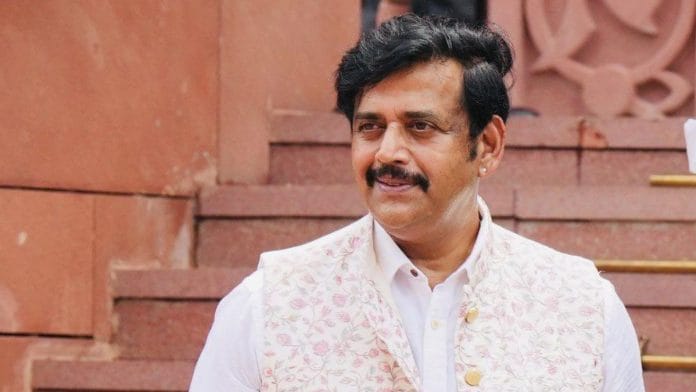
Ravi Kishan is driving this ride to Mumbai, and his internet virality is making the path easier for other Bhojpuri stars such as Dinesh Lal Yadav and Amrapali Dubey.
Kishan is now everywhere in Bollywood, from Laapataa Ladies (2023) and Maamla Legal Hai (2024) to Singham Again (2024), Son of Sardaar 2 (2024) and Dhamaal 4(2026). His casting reflects why Bollywood needs regional stars. As mainstream Hindi cinema struggles to create stories and stars audiences can connect with, actors who carry a language, region and cultural identity already familiar to millions offer an instant connection.
Mirzapur: The Movie (2026) is the clearest example of this shift. For three seasons, Pankaj Tripathi’s Kaleen Bhaiya was presented as the undisputed king of Mirzapur and the most powerful figure in the Purvanchal crime world. But as the franchise expands for a pan-India audience, Ravi Kishan enters that world as the main antagonist.
Also read: Mirzapur’s Beena Tripathi is proof — a woman doesn’t need a gun to wield power
The tight box of regional identity
Hindi cinema has fumbled way too many Bihari and Bhojpuri characters by casting someone completely removed from that world. It happened in Super 30 (2019), where Hrithik Roshan, who speaks Hindi with a noticeable English accent, played a Bihari character. They failed to get the language, dialect and expressions right. Roshan is a good actor, but he could not crack the character in the same way a Bhojpuri-speaking actor would have. Someone who lives that culture.
Then again, the actors from UP-Bihar are often cast for typical roles. The village don, the maid, a migrant famished in a farmland. It becomes a difficult Bollywood box to get out of. It doesn’t necessarily happen to other regional stars. Marathi actors such as Shreyas Talpade, Atul Kulkarni, Sai Tamhankar and Amruta Khanvilkar, and Bengali actors such as Jisshu Sengupta and Tota Roy Choudhury, have already found space in Bollywood without being reduced to their regional identities.
Now, some will argue that these actors work because they bring vibrancy to films. But that is subjective. Bollywood’s own cinematic standards have changed. The industry is increasingly embracing the very violence, crude language and objectification it once used to dismiss in Bhojpuri cinema.
The difference is not necessarily the content; it is the lens through which Bollywood chooses to present it.
While Ravi Kishan is not new to Bollywood, he started his career in Mumbai before failing and moving to Bhojpuri cinema, but Pawan Singh is a Bhojpuri star. Even in a Bollywood film, he carries the aura of a Bhojpuri star.
Although he only lent his voice to Stree 2 (2024) and Vicky Vidya Ka Woh Wala Video (2024), he was everywhere during the promotional run. Why? Because Pawan Singh can connect with the masses. He can make people dance, sing and vibe with him. And that is exactly what happened.
While Bollywood has long maintained a holier-than-thou attitude towards Bhojpuri cinema, it is increasingly turning to Bhojpuri stars for promotional appearances and smaller roles. In Welcome to the Jungle (2026), for instance, Akshara Singh was not part of the main cast, but appeared in the promotional song “Ghis Ghis Ghis”, which featured Akshay Kumar dancing to Bhojpuri beats.
Views are personal.
(Edited by Ratan Priya)