




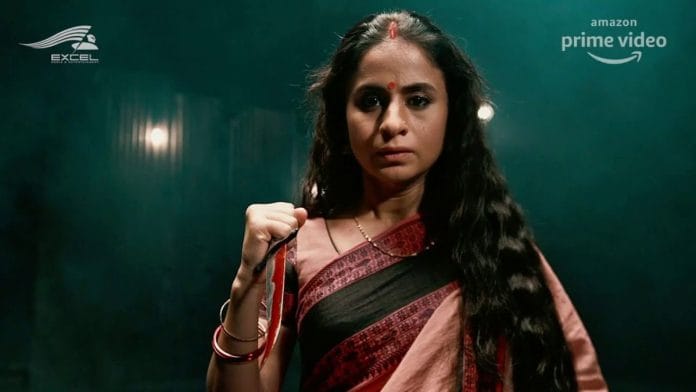

Money, muscle, guns and upper-caste syndrome are the mark of every male character in Mirzapur. And they use it to survive in Kaleen Bhaiyya’s kingdom. However his wife, Beena Tripathi is different. She has no muscle, no army of men, no gun in hand. What she has is intelligence and instinct, and those turn out to be far more useful weapons.
Beena, played by Rasika Dugal, never wanted the life she was forced into. She never wanted to marry Kaleen Bhaiya, played by Pankaj Tripathi. There is an age gap, he cannot perform in bed, and she hates the violent world he lives in. Even her father-in-law, Satyanand Tripathi, played by Kulbhushan Kharbanda, mistreats her. Beena is harassed by almost every man in the family.
But Mirzapur: The Movie (2026) tells us why she married Kaleen. Beena once loved Birju, a blacksmith from the village. Her father objected, not wanting his daughter’s bloodline to become “impure”. So she marries Kaleen Bhaiyya.
But Beena carries her love for Birju silently, for years, living in a family where every man believes that power equals violence. In that family, she is just a wife, a daughter-in-law, someone’s possession, but soon she becomes the person who holds the reins to every other character. And when Birju finally returns, he comes ready to take Kaleen’s life. He enters Kaleen’s mansion and attacks him. But, as always happens in Mirzapur, Kaleen Bhaiyya captures him.
Just when Birju is ready to confess why he has returned after so many years, Beena shoots him in the chest.
“Love hi toh hai, kaun sa lifetime rehta hai,” she says as ‘Saanson Ki Mala’ plays in the background.
That makes Beena one of the most powerful characters in the Mirzapur universe and one of the most interesting women characters that Bollywood has recently produced.
Lately, when filmmakers want to empower a woman, they give her a gun. She is a spy, an assassin, or at least someone who packs a punch much like Alia Bhatt and Sharvari in Alpha (2026), Taapsee Pannu in Gandhari (2026), and the heroines of Toxic: A Fairy Tale for Grown-Ups (2026).
There is nothing wrong with giving women guns. The problem is when the gun becomes the only language through which cinema knows how to empower a woman. Does a woman really have to imitate the men of Bollywood’s gangster-action genre to prove her mettle?
Not Beena. Her power lies in picking the best out of bad choices and seeing them through. Her power is a potion of patience and perseverance, whatever life throws at her. Even her relationship with Birju is proof. He represented the life she could have had and cherished. But she is pragmatic.
Beena accepts that she loved Birju in front of two of the most powerful men of the world she lives in, men who would not think twice before killing someone.
That is not to say that Beena is scared of picking a gun. The fact is that she can look at the gun, use it and still refuse to become the men who surround her.
Also read: Expats in Gurugram expected a global city. They are battling waste and waterlogging woes
Patience, wit, and instinct
Beena’s character evolves in complex ways through the series. She begins as a woman trapped in an unhappy marriage. She is unsatisfied in bed, and turns to drinking and flirting to escape her world. But Beena eventually finds her way.
When her father-in-law harasses her at gunpoint, she does not immediately pick up a gun and shoot him. She waits for her revenge. She watches, like a big cat on the prowl. She understands the power structure around her. When the right moment arrives, she shakes hands with the enemy, to take him down.
Unlike the men of Mirzapur, who use a bruised ego to justify murder, Beena is patient. The loud and violent underestimate her and that is why they lose.
While the men of Mirzapur are busy proving who has the most muscle, Beena quietly plots her vengeance. She survives because she understands them better than they understand her.
Beena lives in a world where men believe power belongs to whoever holds the gun. She proves that sometimes the most dangerous person in the room is the one everyone has overlooked.
(Edited by Janaki Pande)