






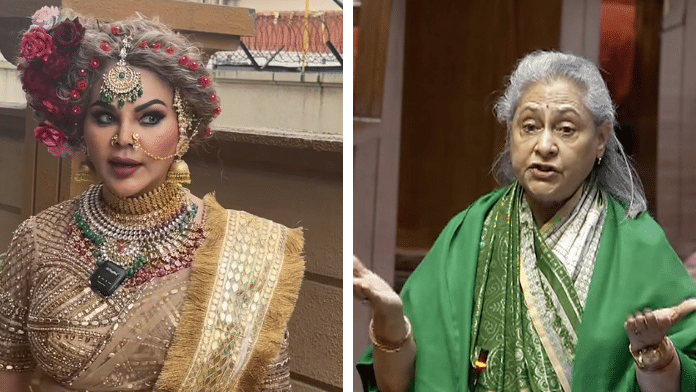



Rakhi Sawant has always functioned like a cultural mood board — chaotic, brutally candid, attention-hungry, and strangely precise in knowing exactly how to hold the country’s gaze. In a recent YouTube interview, Rakhi once again did what she does best: detonated a conversation that refuses to stay small. This time, the target was the long, unresolved love triangle that has haunted Hindi cinema’s popular imagination for decades — Amitabh Bachchan, his wife, Jaya Bachchan, and fellow actor Rekha.
In the nearly hour-long interview, Rakhi questioned why Rekha was “not chosen”, repeatedly describing her as more beautiful and elegant, and reducing Jaya Bachchan to a woman who does not groom herself enough, does not dress well enough, does not soften her face or her temperament enough — by implication, does not deserve the emotional centre-stage that public memory has always reserved for Rekha.
Rakhi Sawant has every right to speak. Free speech is not the problem here. The discomfort begins with what kind of speech we continue to normalise when it comes to women, especially older women.
Sawant’s candid style can at times also cross the line between honesty and offence. By referring to Jaya as a ‘naukrani (domestic worker)’ — a casual normalising of classed and gendered humiliation, completely uncalled for but accepted and applauded because of its source.
Jaya Bachchan is in her late seventies. She is not auditioning for anyone’s approval, nor is she obligated to remain visually palatable to an audience trained to treat female actors as permanently consumable objects. There is no civic duty attached to looking “pleasant”, sounding “soft”, or behaving “nicely”, least of all for a woman who has spent almost her entire life in the public eye.
To say that Jaya does not take care of herself is a familiar move, one that reasserts that a woman’s legitimacy, even now, flows from how attractive she is. Age does not dilute that pressure; it only sharpens it.
The bigger problem is how effortlessly Rakhi’s words slide into an old, extremely comfortable narrative: two women locked in rivalry over one man.
Also Read: Rakhi Sawant is the real Marathi Manoos—though Thackerays will disagree
The age-old tussle
For years, popular culture has sustained this framing with near-religious devotion. One woman is imagined as the rightful emotional partner. The other becomes the wife who stood in the way of true love. There is another unsettling possibility that rarely enters the conversation: that neither woman’s life should be reduced to a referendum on one man’s emotional availability.
Let’s not forget that the choices available to women in a different era were not the same as those available now. Who is aware of the private negotiations inside the Bachchan marriage? We do not know whether staying was an active choice, a strategic one, or a constrained one.
What we do know, because Jaya Bachchan has repeatedly stated so over the years, is that she has never romanticised her husband in public. She has spoken, often with remarkable candour, his emotional distance, his lack of romance, and a marriage that did not fit the glossy fantasy that audiences project onto celebrity unions.
At the same time, Rekha has expressed affection and emotional attachment towards Amitabh Bachchan publicly in a way that has kept the myth alive.
Two women, two entirely different emotional positions. Both public, both complex and both flattened by the same story. Yet the cultural gaze has never paused to ask the more uncomfortable question: why are two super-successful women still being evaluated on how they orbit a man?
There is something particularly dispiriting about another woman reducing a woman’s worth to cosmetic upkeep. Rakhi Sawant’s comments matter today because she has built a career on saying what mainstream celebrities carefully avoid. So people gladly lap up the patriarchal language that has been outsourced by society.
Even in 2026, when conversations around feminism and agency dominate public discourse, a woman’s credibility can still be dismantled through her appearance, age, and public behaviour.
Jaya Bachchan does not smile for paparazzi, she snaps. She looks visibly irritated by the circus around celebrity families. She refuses the soft tone expected from women of her generation who are meant to age into benevolent, non-threatening, almost maternal public figures.
Her refusal to perform for society unsettles because it disrupts a script that women in public life are still expected to follow.
What Rakhi inadvertently reveals through her comments is the endurance of a culture that still treats women as interchangeable emotional accessories to men’s legacies. If the conversation must evolve, and Rakhi ensures that it will, it needs to move beyond beauty, behaviour, and who “should have been chosen” by a man.
Views are personal.
(Edited by Insha Jalil Waziri)