






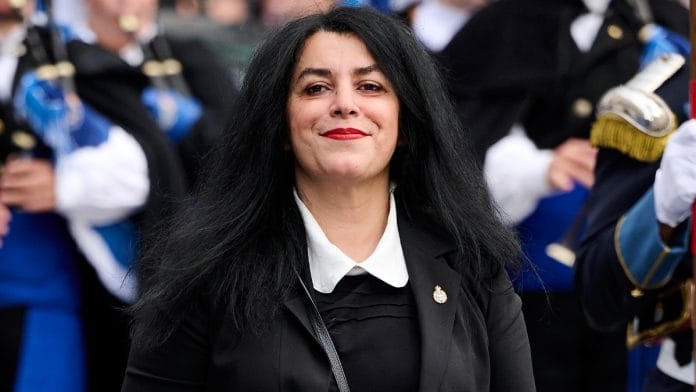


Marjane Satrapi died of sadness. It sounds like the kind of ending she would have mocked and understood in equal measure. For a woman who spent a lifetime insisting that politics was personal, it somehow makes perfect sense.
The 56-year-old Iranian-French writer and director best known for her graphic work Persepolis, passed away Thursday. Even her death seems like an act of rebellion.
Her family informed the press that she had “died of sadness” following the death of her husband, long-time collaborator, and Swedish actor Mattias Ripa, who passed away in April 2025. For someone who rebelled against every form of oppression, she refused to be oppressed by the grief of losing the ‘love of her life’.
Her death, like her works, feels personal. Perhaps that is how every reader or viewer feels when an author or filmmaker they could connect with passes away. I was introduced to Persepolis (2007) as a 21 year old liberal arts student by a friend who called it a ‘must watch’. Reluctant at first, I watched it before I read it.
Persepolis (2007) felt like a feminist manifesto. This was a woman who was allowed to be contradictory on the page — angry and vulnerable, political and frivolous, rebellious and frightened.
While for a lot of people, it was a mirror to the Iranian regime’s horrors, to me it was political and personal in the way it dealt with God and his believers.
Satrapi wanted to be a prophet when she grew up, God ended up being her BFF. In her emotional universe, God was not what the fundamentalists told you, God was someone who would never turn up at the right time because he was perhaps too busy watching Breaking Bad. How many people can one entity—real or not—cater to in a world where everyone is looking for the right answers at the right time?
The quote goes something like: “Why doesn’t God come to Marjane the night she decides to be a revolutionary? Is it because he doesn’t agree with violence? Or is he just catching up on Breaking Bad?”
Living on her own terms
Something that amused me was her nickname marji. In colloquial Hindi, marji is will. In Urdu, it is marzee. For a woman, who lived life on her own terms, it was oddly fitting.
In Marji’s world, God even comes up as an image of Marx. Satrape made it okay to question and ask, can faith be reduced to certainty? Marji, the child would tell you personal faith can differ from organised religion and you might not be a believer, but faith can move mountains. In her case, her wishes came true every time her mother prayed for her. Satrapi for me, answered a question—in the world of men, God is a woman.
Her work had a lingering aftertaste. If Persepolis (2007) told you about the aftereffects of the Iranian regime and who had the ‘divine’ right to rule over people and their freedom, Embroideries told you what conversations and a sense of solidarity can lead to. In all her works, women are at the centre — in chaos, conflict and captivity.
Also read: The Navy chief’s daughter’s tattoos and our obsession with ‘good women’
Stories of resistance
Satrapi’s premise might be Iran but her reflections are universal. Patriarchy is fundamentalism’s best friend and women are their favourite pawns.
Yet, women know resistance. Women resist as mothers, as grandmothers, as women meeting over tea to discuss men and marriage. Their tools are conversations, lessons, stories and imagination — no regime can cage a mind.
“The regime had understood that one person was leaving her house while asking herself: Are my trousers long enough? Is my veil in place? Can my make-up be seen? Are they going to whip me? No longer asks herself: Where is my freedom of thought? Where is my freedom of speech? My life, is it liveable? What’s going on in the political prisons?” Satrapi writes.
Ask any woman, and she knows why the sentiment is universal. Repression, censorship and catering to the gaze of authority are not alien concepts, be it Iran or India. Artists simply find creative ways to show you the hold they have in society.
This was perhaps why, in 2007 when Persepolis premiered at the Bangkok Film Festival, the Iranian government sent a letter to the French embassy to have it removed from the lineup. And Marji was busy writing an ode to smoking. For women who engaged with her work, her art was seminal in more ways than one.
And yet, news of her death followed a critique of her work. According to many online debates, her work ‘co-opted Iranian struggles, and led to regime change narratives’. This is nothing but yet another way to rob women of their agency, their voice, and their choice in telling their own stories of their homeland. Besides being political, Persepolis was also deeply autobiographical in tone. It was her lived experience. Satrapi spoke of Iran, her homeland, the way an artist speaks of a dream and a desire.
Satrapi refuses to be neatly categorised into a box. She knew that life, like art, can be fluid.
People, especially the criticism from men, come from a place where it is easy to romanticise a movement and critique a woman for choosing to depict her lived experience but far more difficult to live in it, and reimagine your idea of home and identity shaped by political forces. Her staunchly communist uncle who taught her about the world would laugh at the online left commentary dismissing her work as a tool for Western propaganda. It was anything but that. It is audacious to assume that she was writing with an agenda — even if she was, her agenda, like she publicly said, was to humanise her homeland and her people.
Also read: An Army captain proposed. The morality police reported for duty
Remaining human
Women who are out in public and especially from a place of conflict are expected to constantly perform. Before being a flawed human, she is made a spokesperson for her nation.
But in a world increasingly organised around camps and certainties, Satrapi remains stubbornly, provocatively human. She did not cause wars, neither did her work. And that is why when the din of criticism fades, Marji will remain. A girl will, years later, stumble upon her work and feel seen.
Raised in revolution and caught in conflict, Satrapi was never selling sadness. She simply refused to see the world in black and white, unlike her graphic work. Even in oppression, her works spoke of hope. The world might be filled with jerks, but as her grandmother told her, “Always keep your dignity and be true to yourself.”
Yet she knew the price for it. Born in Rasht, she spent most of her life in Paris. In a 2009 NYT essay, she talked about how a conversation with an Iranian man made her want to die in her homeland. But more than dying, she wanted to ‘live’ in Iran, otherwise, her life would be meaningless.
Satrapi died in Paris, the city of love and exile, consumed by ‘sadness’ over losing the partner of her life. Her work will remain eternal.
Goodbye, Marjane. Like you said: “Nothing’s worse than saying goodbye. It’s a little like dying.”
Those who are mourning her demise and celebrating her legacy the most (and very rightfully so) are the very ones who are supporting the murderous Islamist regime ruling Iran.
That’s the stark irony we are living with.
I remember reading Ms. Debdutta Chakraborty’s column where she unabashedly hero-worshipped the New York mayor Mamdani. Mamdani has time and again been exposed as another Sadiq Khan – hand in gloves with Islamists of all shades.