




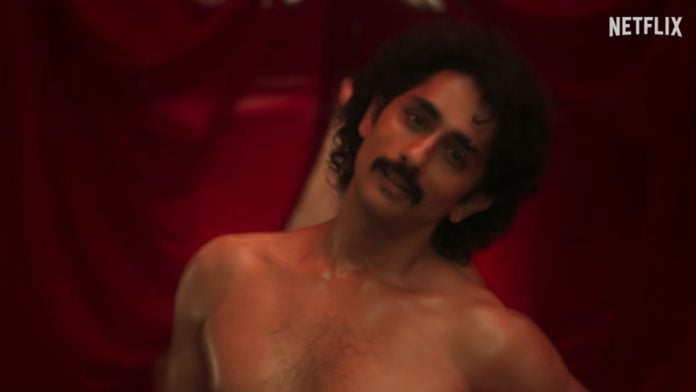

In Lust Stories 3, Vishal Bhardwaj does something Bollywood is rarely known to do with the male body. Instead of turning Siddharth’s physique into a symbol of masculinity, dominance, or conquest, Bhardwaj wraps his character Badru in a handkerchief-sized towel and lets his body exist simply as an object of desire, largely within his wife Saira’s imagination.
For years, Bollywood did not know what to do with the physiques its stars built in the gym. So, it tore their shirts, showed their biceps and abs, and called it a day. From Salman Khan in Maine Pyar Kiya (1989) to his bare-chested dance in Pyaar Kiya To Darna Kya (1998), the male body was put on display. The formula remained largely the same.
In Yalgaar (1992), during the song ‘Aakhir Tumhein Aana Hai’, Sanjay Dutt begins in a black coat, white shirt, and trousers. Then he gets soaked in the rain, throws away his coat, and starts dancing bare-chested. After that, he performs martial arts moves. The “macho man” performance is offered even when the story does not really require it.
Then came John Abraham in low-rise yellow trunks in ‘Shut Up and Bounce’ from Dostana (2008), taking the display of the male body a step further. The first 20 seconds of the song are almost entirely about putting his body on display; he repeatedly appears in those yellow trunks, almost like a toddler who has wet his pants and is being made to stand there. I say this because John barely dances through the song. He does, however, hit several impressive poses as he shows off his body.
Lust Stories 3 changes the packaging, but not the basic idea. Badru’s body is presented for Saira’s (Aditi Rao Hydari) gaze. At least, it is an unarmoured and relatively less toxic kind of objectification. But is it really that different?
Siddharth does not have to spend as much time showing off his muscles as John or Salman. The aggressive, always-pumped-up biceps have been replaced by an effortlessly toned body. It looks achievable.
That is what objectification means to me: treating a human being like a product and marketing them through one unique selling point.
Also read: Katrina Kaif’s body is not a before-after photo. It happened to Aishwarya too
Where is the ordinary man in Bollywood?
Badru is the desi version of Cupid. He floats around in Saira’s la-la land of desire and lust, while his handlebar moustache almost becomes Cupid’s bow, shooting all the masculine traits she imagines onto him. But what is Badru actually there to do? Not much. He is there to be looked at, desired, and imagined.
This is not limited to Siddharth. A lot of recent cinema represents masculinity through bodies. The man is either muscular, sexually desirable, violent, or dominant. It is a fabricated idea of masculinity, far removed from the ordinary men we saw in the films of Basu Chatterjee. In Rajnigandha (1974), Amol Palekar is an awkward, ordinary man who cares about work, falls in love, and is simply trying to make a life.
Then there was Aiyya (2012), one of the few Hindi films on female desire. Rani Mukerji’s character is intoxicated by the smell of Prithviraj Sukumaran’s character; she desires him almost viscerally, through scent before anything else. Yet, even in a film that ostensibly flips the gaze, the male body remains very much on display: Prithviraj is sculpted, bare-chested, and repeatedly presented as an object of visual pleasure, particularly in the many sexually charged songs.
This also narrows the space for the ordinary man, who is busy with his work, struggling to build a life, and does not have a sculpted body. Does that mean he is less worthy of love?
Indian cinema has objectified women from the beginning. Zeenat Aman’s Rupa in Satyam Shivam Sundaram (1978), where her body becomes central to Shashi Kapoor’s attraction; the Mandakini waterfall scene in Ram Teri Ganga Maili (1985); and recently, Janhvi Kapoor in Peddi, where social media users pointed out how the camera framed her body, all show how the female body has been presented for the gaze.
Filmmakers have now started doing the same to male protagonists. Not at the same scale, but it remains objectification. Every time a shirt is torn, a bicep is flexed, or a hero is shown walking out of water, the body is being used as a selling point. Like Ranbir Kapoor’s towel drop in Saawariya (2007) or Ranveer Singh’s shirtless snaps in Ram-Leela (2013).
The bigger problem is that they rarely allow men to exist outside the muscle dummies. Men can be vulnerable, ordinary, insecure, funny, broke, tired, or simply average-looking, like Siddharth’s character in Lust Stories 3. Bollywood should have space for those men too.
Views are personal.
(Edited by Prasanna Bachchhav)