






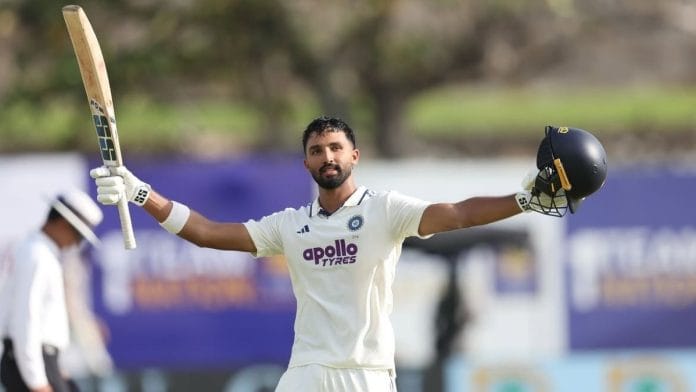

The recently concluded Test series in Sri Lanka brought a lot of positives for the Indian cricket team. But one stands above all the rest — the emergence of Devdutt Padikkal as India’s possible answer to the No. 3 spot.
For the better part of the 21st century, the No. 3 spot in the Indian men’s Test lineup was not only the binding glue to a glittering batting order, but also a fortress that seemed impossible to penetrate.
First, for a little over a decade, the great Rahul Dravid practically turned the coveted spot into the stage for one of the finest ever batters in the Test arena to show how the art of batting at No. 3 is done. Seamers — in Edgbaston, in Johannesburg, in Christchurch and Adelaide — arrived with a spring in their step and left with broken backs. Spinners, on the hissing dustbowls of the subcontinent, were smothered, cut, swept and flicked with resolve, finesse and disdain in equal measure. You just could not get past The Wall.
Then, when The Wall hung up his boots, came Cheteshwar Pujara. He, taking on from Dravid, turned the position into a site of attritional warfare. He collected bruises, absorbed marathon 200-ball spells, and wore down entire bowling attacks until their legs gave out on his way to over 7000 test runs — many of which came in series defining performances in Australia, South Africa and Sri Lanka.
However, unfortunately for Indian cricket, things took a different turn once Pujara was phased out of the side beginning late 2023.
Since then, it will not be unfair to say that the Indian team management has treated the No. 3 position like a musical chair. First, Shubman Gill, now captain of the side, was moved up to the anchor spot, only for him to look more naturally aligned with the tempo of No. 4 — the natural heir to Sachin Tendulkar and Virat Kohli. Other red-ball regulars such as KL Rahul and Washington Sundar were given opportunities too but they found their calling in other roles in the batting order. Options like Sai Sudharsan and Karun Nair were also tested, but injuries and inconsistent red-ball returns continued to keep the door open to the crucial position.
For the two-test away rubber against SrI Lanka, which India clinched 1-0, the selectors and the team management decided to pick Karnataka’s Devdutt Padikkal for the role, on the back of stellar domestic and Indian Premier League (IPL) campaigns. And the young southpaw grabbed the opportunity in some style, smashing tons in the first innings of both the Tests — a classy, mature 167 in the first match at Galle that set the tone for India’s victory, followed by a flowy 117 in the second game that ended in a draw.
The elegant batsman was not only a pleasing sight to the eye, but also a balm to the Indian cricket ecosystem which has sorely missed such kind of stability and sublimity at No. 3 for a while now.
Padikkal had already debuted for India in the longest format, in March 2024 against England in Dharamshala, scoring a fluent 65 in his first innings in India whites, that too at the coveted No. 4 spot. But after just two tests, he was back to warming the benches after first-team regulars recovered from the injury-induced hiatuses. The Sri Lanka assignment, therefore, was an opportunity the 26-year-old did not want to squander.
Also read: Ted Lasso is reusing Chak De! India plot in 2026. It is 20 years too late
What the position demands
To understand the weight of expectation that Padikkal carries, though, one must understand what makes the No. 3 such a hard role to perform, let alone master.
An opener expects a shiny new ball, pitched-up seam movement, and premium fast-bowlers steaming in on day 1 of a Test match. On the other hand, a No. 4 usually walks out when the narrative of the innings is already written, and one knows what to expect from both the pitch and bowling lineup. But a No. 3 lives in perpetual ambiguity. You might walk out in the second ball of the match under overcast skies at Headingley, or you might step in at 120/1 on a day-two flat deck in Ahmedabad.
Therefore, the position demands both the discipline of an opener and the strokeplay that defines the No. 4.
Padikkal, in his short career so far, has shown glimpses of possessing both. His long front-foot stride — coupled with his over 6-feet frame — allows him to smother turn early, while his unhurried, almost old-school tempo when batting shows that he is willing to let the opposition have the hour if that is necessary to triumph in the bigger battle. He seems to be at ease playing fast bowling as well. At the same time, Padikkal possesses the flourish and flair to change gears quickly and punish erring deliveries. In particular, his ability to hit through the covers off the back foot, against both pace and spin, is an opposition captain’s nightmare, causing field placements to shift quickly and making runs flow freely.
Yet, passing a verdict based on a few fluent innings in home and subcontinental conditions is a trap Indian cricket has fallen into far too often. Yes, the twin tons in Sri Lanka were a treat to watch, and could very well be the sign of things to come in the future. But the real test of an Indian No. 3 has never been in Galle, Kanpur, or Ahmedabad. It is in Wellington, Perth, Centurion, and The Oval. That is where the Dravids and Pujaras were born.
On bouncy, seam-friendly tracks a tall batter’s greatest strength versus spin — a long, committing front-foot stride — can also become a liability. When the ball nips back in or rises sharply off a length, early commitment often leads to edge and pad dismissals. So, whether Padikkal can adjust his instincts when the ball is swinging laterally at 145 km/h is still an unanswered question. But if that does happen, India’s No. 3 dilemma could finally be put to rest. Dravid and Pujara would have found their heir. That is a delectable prospect.
Views are personal.
(Edited by Aamaan Alam Khan)