




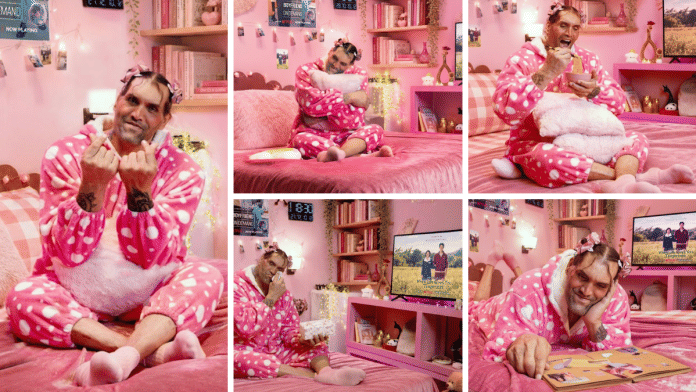

The Great Khali is not great any more. He has spent years making grown men look tiny. Now, he is making finger hearts in a pink polka-dot onesie, getting emotional over a K-drama.
Netflix India’s K-drama-themed photoshoot, captioned “K-paglu with a capital K”, is definitely funny.
But, Khali has become a convenient punchline for brands. His height, size, strength, and fearsome wrestling image are practically a ready-made creative brief. Take the giant, put him somewhere unexpected, and watch the internet lose its mind.
The formula works, at least for a few seconds of scrolling. But somewhere along the way, brands seem to have mistaken the ability to make Khali look ridiculous for the only interesting thing about him. He has basically become Indian advertising’s favourite human prop.
From Ambuja Cement and Cadbury Fuse to KFC, Nestlé Munch Nuts, Swiggy, Licious, Hindware, and Polo Elevators. Add Netflix’s recent makeover and Foxtale’s Grand Glowali Sale, and Khali’s ads have had the same template. The question isn’t whether Khali should be allowed to have fun. Of course, he should. The question is why brands keep reducing him to a joke.
Take Ambuja Cement’s 2015 advertisement. Khali’s extraordinary strength becomes a liability as he accidentally damages walls, floors and furniture. The solution? A home built with Ambuja Cement. His larger-than-life physique made the brand’s promise of strength memorable.
But even a joke with excellent comic timing can become tired when it is repeated multiple times.
Look at Rahul Dravid’s transformation into “Indiranagar Ka Gunda” for the CRED ad, for instance. The image of the former India cricket team captain adopting a rough and tumble persona was funny because it was totally unexpected. One unexpected turn can be memorable and help gather views. But it doesn’t mean every other advertisement must cast him as the same character. Repeatedly casting someone as the punchline, quite like Rakhi Sawant, risks making that the only side brands are interested in showing.
There is, of course, nothing embarrassing about a former wrestler wearing a pink onesie. Khali is an adult, a performer, and a public figure, perfectly capable of playing along with a joke. People are allowed to be silly. Khali can embody this soft-girl era.
The problem is the industry’s inability to imagine what else he might do.
Imagine a campaign that lets him play a genuinely romantic lead, a deadpan detective, a fussy food critic or a man with a sophisticated taste in single malts. Maybe an advertisement in which his size is incidental to the story rather than the punchline. The possibilities are hardly small. (Sorry, Khali.)
Brands love the unexpected because it grabs attention. But when everyone uses the same kind of unexpected, it stops being unexpected. The pink onesie works because it upends our expectations of Khali. The next campaign should give us a different reason to be surprised.
After all, The Great Khali deserves more than being the giant joke in every room.
Views are personal.
(Edited by Aamaan Alam Khan)