





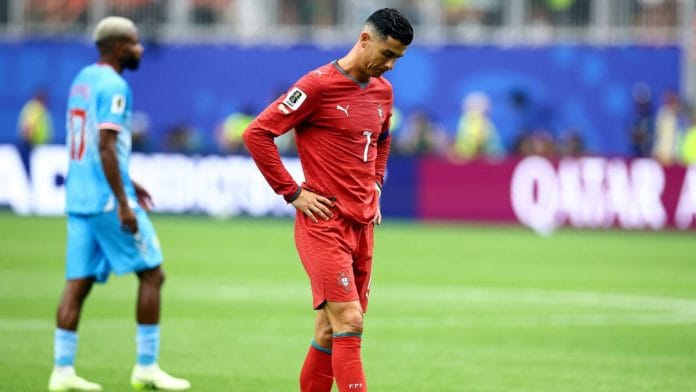


At 41, Cristiano Ronaldo became the oldest outfield player in the 2026 FIFA World Cup. He also featured in six World Cups, alongside Lionel Messi. While La Pulga flourished with a hattrick for Argentina in a scintillating 3-0 win over Algeria, the Portuguese veteran’s fate drew a different perspective on age, and the elite respect legends receive as they make their way onto the team sheet.
Football has always made room for greatness and ego in equal measure. Whether that ego is confidence can be debated, if the performance on the field is backing it up. But if that doesn’t happen, the very traits that turn players into legends, “obsession, confidence, and hunger”, can also become weaknesses and a burden for the squad when time catches up. That is exactly the uncomfortable conversation Portugal must now have about Ronaldo.
ThePrint earlier suggested that he should accept his fate and sit on the bench at this edition. He can be a better super substitute in this World Cup. That is what Portugal needs right now.
For almost two decades, Ronaldo’s selfishness in front of goal was fruitful as he could convert the goals, be it for Portugal, Manchester United or Real Madrid. He is a force made with sheer pride and confidence. With him being at the end of every play seemed somewhat necessary for the team’s success.
For Ronaldo, nearing the 1,000-goal mark would have been impossible if he were not selfish. You do not dominate football for 20 years by constantly looking for the extra pass.
An ego coming in the way of reality
Ronaldo built his legacy on an almost unmatched obsession with goals, records, and statistics. That mentality made him one of the greatest footballers the sport has ever seen.
But the problem is that the same mentality that once elevated Portugal is limiting them. For Portugal, he spent almost more than a decade as the only performer at the biggest stage. Although his record in the World Cup has always been up for debate.
Against DR Congo, there was one sequence that perfectly captured Portugal’s current dilemma. When a low cross came down from the right flank, midfielder Bruno Fernandes was in a far better position to finish the move, yet Ronaldo drifted directly into the path of the attack, trying to get onto the end of the ball himself. Instead of leaving the ball for Bruno, he hunted glory for himself.
Ronaldo, with an awkward backward movement, desperately tried to get hold of the ball. The result was neither a proper receive nor a lethal shot, which would have tested the goalkeeper. Instead, the shot wobbled wide, probably costing Portugal the match.
The criticism afterward was unusually blunt.
Former Arsenal and France legend Thierry Henry broke the play down in brutal detail, saying: “The team needs to score, not you.”
Henry argued that Ronaldo made the wrong run because he was focused on scoring himself rather than helping the team create the clearest chance. He explained that if Ronaldo had attacked the six-yard box properly, he would have dragged defenders away and left a simple finish for Bruno Fernandes. Instead, he moved into Bruno’s space and made the play easier to defend.
That criticism mattered because it came from a player who understands elite strikers better than almost anyone. Henry was not attacking Ronaldo’s legacy. He was pointing out a football reality: Portugal’s attack still revolves around Ronaldo’s instincts from his prime, even though he is no longer the devastating force he once was, and that is not disrespectful to say. It is reality.
Also read: Cristiano Ronaldo can learn from MS Dhoni. Sit on the bench this FIFA World Cup
Portugal is no longer a one-man show
Ronaldo remains a legendary figure, but the numbers and performances are becoming harder to ignore. Against DR Congo, he failed to register a shot on target despite Portugal dominating possession, and he had the fewest touches among Portugal players who played more than a half. Portugal has moved beyond the one-man show aura, but Ronaldo cannot accept that reality.
This generation is loaded with talent — Bruno Fernandes, Bernardo Silva, Rafael Leão, Vitinha, João Neves and others — who are capable of deciding games at the highest level. Yet too often, attacks still bend toward Ronaldo as if it were still 2016. Crosses are forced toward him. Attacks slow down to find him. Teammates sometimes seem obligated to feed him rather than simply choose the best footballing option.
The opponent can easily predict their game. You do not even need to an expert to do that. A run from the flanks or mid would eventually lead to him and no one else. That’s it. That’s Portugal’s gameplay.
When DR Congo’s midfielder Ngal’ayel Mukau was asked about their game plan against Ronaldo, he said, “To be honest, not really [a special plan], because we know he isn’t the same as before. He’s a bit older now… For sure, when you are old, things are not the same anymore. He is one of the greatest to ever play the game. Much respect.”
The teams that win World Cups are collective, flexible, and fluid. Argentina won with Lionel Messi as the star, but the team was not built purely around feeding him every touch. France spread responsibility across the pitch. Spain dominated through movement and system football.
This conversation didn’t start now; it began in the 2022 World Cup. At the 2022 World Cup, Ronaldo scored just once — a penalty against Ghana — and failed to score in the knockout rounds. Portugal’s best performance of the tournament came the moment he was dropped against Switzerland, when Gonçalo Ramos led the line in a 6-1 demolition.
Also read: Morocco match was a wake-up call for Brazil. Individual magic is not enough for 2026 FIFA
‘Leave football, before it leaves you’
The uncomfortable reality is this: If Portugal had better options at the striker position, Ronaldo would not have been called up for this World Cup.
For Roberto Martinez no one can replace Ronaldo because of his goal scoring ability.
“It made no sense at all to take off Cristiano Ronaldo, who is the best goal scorer in history, off the field when we were looking for goals… Clearly, when you look for goals, you need to have Cristiano on the pitch,” he said.
But, Ronaldo struggles to make space amid defenders, his mobility has sharply declined and he contributes very little outside the penalty area. However, as ‘Ronaldo is Ronaldo’, Portugal is still looming in the 2016s hangover.
Ronaldo’s greatness is already secured. Nothing changes that. But true greatness at the end of a career is also about understanding when leadership matters more than statistics, when movement matters more than shooting, and when trusting younger teammates gives the team a better chance of winning.
Jamie Carragher described this situation aptly.
“Leave the football before the football leaves you,” he had said. It feels increasingly relevant here. The quote was never about disrespecting greatness. It was about recognising the moment when adaptation becomes necessary.
(Edited by Saptak Datta)