





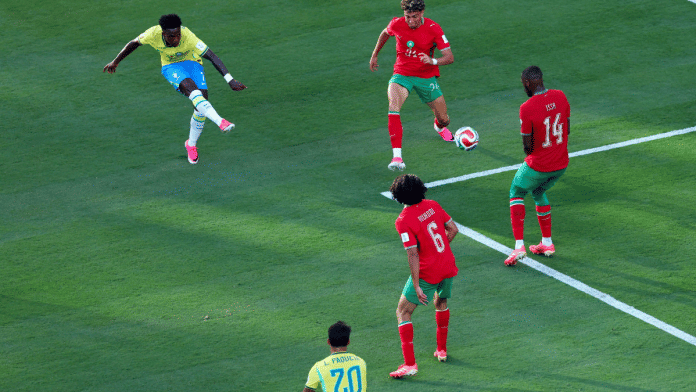


New Delhi: It took Vinícius Júnior’s solo effort to snatch a point from the 2022 semifinalist Morocco during the FIFA World Cup 2026. After the latter opened up the Seleção’s defence with a beautiful pass from Brahim Diaz to Ismael Saibari within 21 minutes, who ran past Marquinhos and Gabriel Magalhães to chip it beautifully over an advancing Alisson. Eleven minutes later, Bruno Guimarães found Vinícius on the left side, who cut past the defence and buried a thumping shot into the far left corner past the Atlas Lions’ number 1 Yassine Bounou to level the game.
The draw, however, was not a complete disaster. Brazil remains one of the favourites for the World Cup. But it was perhaps the first genuine reminder that talent alone will not carry them to the trophy. If there was one team that emerged from the match with greater satisfaction, it was Morocco.
Brazil, who have long relied on individual brilliance, met the reality of the modern tournament—the romance with individual talent may cost them against teams who can dominate games as a collective unit.
Morocco’s Atlas Lions once again demonstrated why their run to the 2022 World Cup semifinals was no accident. Organised, disciplined, and tactically mature, the team looked every bit a side that understands its identity. They limited Brazil’s space, frustrated their attacking stars, and proved capable of competing with football’s traditional giants. Their full-backs, Achraf Hakimi and Noussair Mazraoui, shone as they contained Brazil’s star wingers for the majority of the game, followed by a rigid and organised double pivot of Neil El Aynaoui and Ayyoub Bouaddi, who, along with their wingers, pressed higher up the pitch and tried to win the ball in Brazil’s half making life difficult for Carlo Ancelotti’s men in the opening 25 minutes of the game.
Can Brazil make it to the finish line?
The Seleção hopes to get its hands on the most prestigious trophy in world football after 24 years. But the Brazilians now face a tough question, which lingered beneath the surface during the entirety of the World Cup qualification process, where they finished fifth: How far can the expectation of individual magic to rescue games take them in this tournament?
Relying too much on individual moments can be a dangerous habit in the World Cup where small margins play a deciding factor.
Against Morocco, there were periods where Brazil controlled possession without controlling the game. They had quality, but lacked clarity. Their attacks frequently depended on individual actions rather than coordinated patterns capable of breaking down a compact defensive block.
Morocco remained organised. Although Bounou was called into action after some good efforts from Lucas Paquetá and Raphinha, as the Seleção pushed to get a winner in the second half. The task still remains in Ancelotti’s hand, an Italian and the first non-Brazilian coach to lead the team in a World Cup, who must transform this talented group of players into a solid collective unit, as they will prepare to face Haiti in the second round of the group stage on 20 June.
(Edited by Insha Jalil Waziri)