






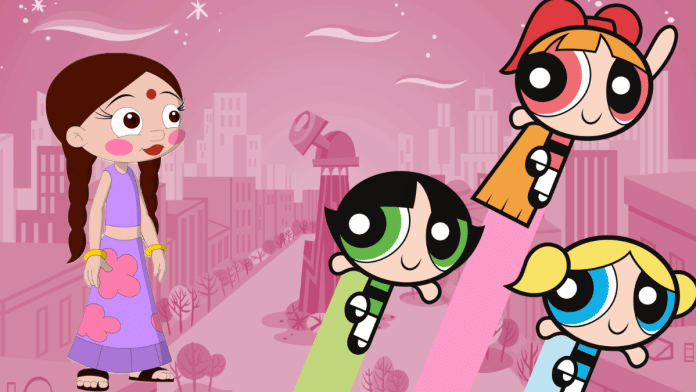


To save the day, you must ruin it first; a script followed by most cartoons. Our entire childhoods were built around that idea. Shin Chan treated every adult instruction as a creative challenge. Chhota Bheem was Dholakpur’s national security policy, because who needs armies when you’ve got a nine-year-old and his biceps? Little Singham somehow balanced primary school and policing an entire town. But where was the girl who got to be foolish? Chutki could be brave and clever, but she was rarely allowed to be petty, impulsive or spectacularly wrong. Boys got entire personalities out of their worst habits. Girls were expected to outgrow theirs before the episode even began.
But cartoons aren’t memorable because they made good decisions; sure, there were morals at the end of the story, but there was also a piano falling on your head. Indian male cartoon characters have been given this opportunity to be memorable because they keep making bad ones. Cartoons have always understood that adventures begin with curiosity, overconfidence and one spectacular lapse in judgement. The mistake is never what interrupts the story. It creates it.
Cartoons treated failure with remarkable generosity. In Motu Patlu (2012), Motu was the embodiment of the “This time it will work” ideology. His unyielding hunger for samosas regularly landed him in hot water but he never learned. Growth was never the point. Bad judgement could keep coming back because children thrive on trial and error.
Failure was not the detour from the adventure. It was what kept the adventure going.
Also Read: Reading in the age of distraction is quietly becoming a radical luxury
Justice for Chutki
Girls, meanwhile, were often written around patience, responsibility and good judgement. They knew the sensible answer before everyone else did. Wonderful qualities in real life, but surprisingly unhelpful when the plot needs someone to unleash a monster, press the forbidden button or trust the suspicious stranger. The sensible child can prevent the episode. The foolish one gives it a plot.
While no one is born responsible and pragmatic, Indian cartoons imply that girls apparently learn it from a young age, prompting the question: What happened to their childhood? Children are messy, loud, unpredictable and learn through the error of their way. But in cartoons, that privilege of messing up and trying again tomorrow is reserved for the boys.
Perhaps that’s why girls in Indian cartoons aren’t allowed to be funny. Comedy needs friction. It needs someone to say the wrong thing, misread the situation or pursue a terrible idea with complete confidence. Shin Chan was shameless, Motu was greedy, and Bheem frequently thought almost everything could be solved with a punch. Their flaws did not interrupt the story; they gave it somewhere to go. A perfectly sensible child can solve a problem, but a problematic one turns it into an episode.
Also Read: Ramayana doesn’t need Marvel-style spectacle. It needs good storytelling
Girls just wanna have fun
The gendered typecasting didn’t just make girls less funny; it also robbed cartoons of their whimsy.
Indian cartoons are often criticised for being loud, fast and violent, but that is only part of the problem. They also resemble their parent, Bollywood’s, idea of entertainment: bigger villains, louder fights, higher stakes and spectacle piled on spectacle.
Boys are allowed to be reckless, greedy and absurd, creating room for comedy and surprise. But girls can only be sensible, their role functional; they serve less like a character and more as a prop. The result is a world with plenty of action but surprisingly little oddness. Everyone is busy saving the day. Far fewer are allowed to ruin it.
Capability was never the issue. Across Western cartoons, girls are often creating mayhem but also fixing it. Kindergarten icons, Powerpuff Girls (1998-2004), are sugar, spice and everything nice, but they are also three kids learning to deal with big feelings. Despite their occasional toddler meltdowns, the girls never fail to save Townsville. Gwen from Ben 10 (2005-2008) is often the smartest person in the room and understands the problem before her cousin does. But despite her intellect, she often causes chaos of her own.
Even the Winx Club (2004-2019) fairies get to mess up and also save the day. But Stella’s self-absorption and shallowness have often moved the plot forward. (Special mention for Bloom’s anger.) The fairies, like the specialists and the witches get the privilege of making the terrible decision that sets everything in motion. But in Indian cartoons, girls are often handed the second half of the episode; they restore order after the excitement has begun. The child who creates the problem usually gets the adventure. The child who solves it gets the supporting role.
Can you imagine how boring and tedious Phineas and Ferb (2007-) would be if Candace didn’t try to interfere with their plans?
So, why were Indian cartoons so reluctant to imagine a girl at the centre of chaos?
Perhaps because, like Professor Utonium, we, too, have a specific formula for childhood: noisy, impulsive, overconfident and fast. The basics don’t include virtues, just the most Freudian id, making it the perfect raw material for adventure.
It’s interesting why girls in cartoons weren’t fed the same formula. Do they not deserve a childhood? Are we so scared of the infamous “girls gone wild” that children must act like adults? Or is it just the age-old sexism that we insist on passing down like generational trauma?
Childhood became gendered. Curiosity looked masculine. Messiness looked masculine. Even being spectacularly wrong began to feel masculine.
The few exceptions mostly arrived from outside Indian television. Dora got to lead an adventure, even if she was also perhaps the only explorer whose expeditions came with directions. Blossom could be bossy, Buttercup could be reckless, and Bubbles could be underestimated. But the Powerpuff Girls were not memorable because they were powerful. They were memorable because they were contradictory. They were allowed to be children before they were expected to become role models. Even Velma and Daphne from Scooby Doo, Where Are You! (1969–1970) were both catching the bad guys and imperfect. Their toxic traits often guided the story forward and even helping unmask the villain.
Perhaps we have spent years asking the wrong question. Cartoons did not need more girls who could save the day. Chutki could have broken the window. Buttercup could eat the cookies, kick the villains and cause trouble. Gwen could press the wrong button. Dora could take the wrong turn.
Girls had plenty of ways to make a mess. Cartoons just kept handing them the mop. In a genre where gravity was optional, girls were given remarkably little room to be foolish.
Views are personal.
(Edited by Insha Jalil Waziri)