








In the early 2000s, being called a bookworm wasn’t exactly a compliment. It conjured up an image of someone who is socially awkward with their nose buried in books while the rest of the world got on with their lives. Reading for pleasure, once a mark of curiosity and self-betterment, slowly became an indulgence people claimed to admire but rarely practised.
Books have been having a moment for some years now. BookTok’s colour-coded shelves and Bookstagram’s lays of hardcovers and lattes, linen throws and picnic blankets have made their not just to Pinterest but almost everyone’s feeds. But much of that fascination was aesthetic. Books became props as much as portals. Owning them often seemed more important than opening them.
More recently, another iteration of the literary rebrand presented itself: the “intellectual man”. You might also know him as the “performative male”; he carries a tote, listens to indie artists and loves Joan Didion. Suddenly photos of men reading philosophy, feminist literature or the classic battered copy of a Dostoevsky novel were all over social media. There is even an Instagram page called “Hot Dudes Reading.”
The hope was that reading would become a shorthand for depth and desirability. Instead, it soon became performative, another carefully curated personality trait for the ‘gram.
Lately, though, there is a disturbance in the force.
Like most influencers, books have also transcended from the aesthetic and segued into the luxury world. They’re becoming cultural accessories signalling genuine aspiration. As the age of AI begins and the world descends further into the Orwellian, the slow burn of books has become a luxury.
Also Read: India’s teens are reading Young Adult fiction. They don’t want myth & morality lessons
Reading is vogue
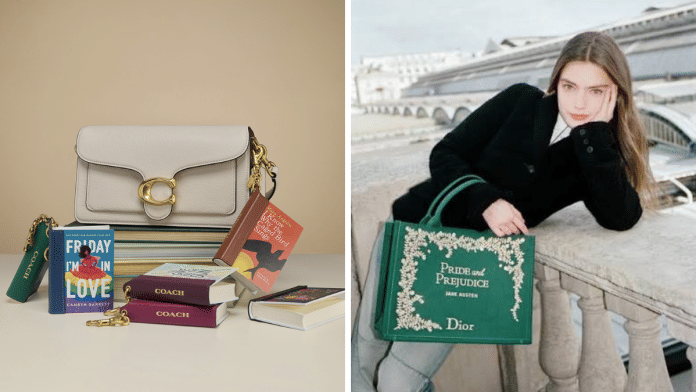
Luxury houses have caught on. Dior’s iconic Book Tote turned literature into fashion. The Book Cover Collection from Spring/Summer 2026 focuses on iconic works such as Les Liaisons Dangereuses (1782) by Pierre Choderlos de Laclos, Madame Bovary (1856) by Gustave Flaubert, Dracula (1897) by Bram Stoker, and Ulysses (1922) by James Joyce, to name a few.
But perhaps the first to latch onto the trend was Coach. The American fashion house’s whimsical book charms—tiny, fully readable literary classics—suggest that books have become objects worth displaying, collecting and carrying. Actually, there are this year’s Labubus. Books are no longer hidden inside bags; they are the bag.
The Italian brand Miu Miu even started a literary club. Gone are the days of Dua Lipa’s book club being one of a kind. Celebrity book clubs are now a dime a dozen.
Much like smoking, books too are back in Vogue. Gone are the days of the literati; now is the time of the “hot literati”. Books are props to boost your sexual, intellectual and economic appeal. After all, being well-read is the ultimate symbol of wealth.
Also Read: Why ‘disgustingly well-read’ is a win for modern literacy
Need a break? Try a book!
But while social media is known for its mood changes, trends often reveal something deeper about the cultural moment.
After years of endless doomscrolling and 30-second reels, we have finally begun to experience the fatigue of perpetual consumption.
In a world where efficiency is the highest virtue, the constant SparkNotes edition of every book, plot and movie has become tiresome. No, I don’t want your lukewarm takes; I want 300 pages of intense pining.
Once again, rom-coms saved the day. The oft over looked romance literature drove sales, marketing and recently, almost half of Prime Video’s original releases. Slowly, reading was everywhere. Book influencers emerged, focused not on the aesthetics but the texts.
Reading was never meant to be efficient. It lingers and withholds the instant gratification that social media gives. It allows suspense to build, characters to breathe, and emotions to settle. But lately, it has also allowed communities to emerge. Books are portals where you get to cosplay a different life. Reading focuses patience in a culture that demands immediacy. Perhaps, that is why books are making a comeback.
Recent data from India’s Time Use Survey suggests that leisure reading is not disappearing because people no longer value book, but because they no longer have time.
Between 2019 and 2024, the share of Indians who reported reading for leisure fell from 5.4 per cent to just 4 per cent. Combined with a shortening attention span and longer work hours, the simple joy of hallucinating while staring at words on a page has disappeared. The time one would want to get lost in a novel is now spent squinting at screens.
Perhaps that is why this ‘book-ssaince’ feels hopeful. Once celebrities glamorise it, anything can become cultural cachet. The literary resurgence is just the latest, revealing the extraordinary influence of aesthetics on behaviour.
But unlike cigarettes, books leave behind something more valuable. They ask us to slow down rather than burn out (pun intended). If reading is returning because it has become fashionable, perhaps that’s not such a bad thing. Culture has always found strange pathways back to worthwhile habits.
So, in an age defined by noise, distraction and relentless productivity, burying your nose in a book feels quietly radical. It asks nothing of you except your attention. No likes. No metrics. No performance. That is a luxury.
And so, being a bookworm just might be the coolest thing.
Views are personal.
(Edited by Insha Jalil Waziri)