






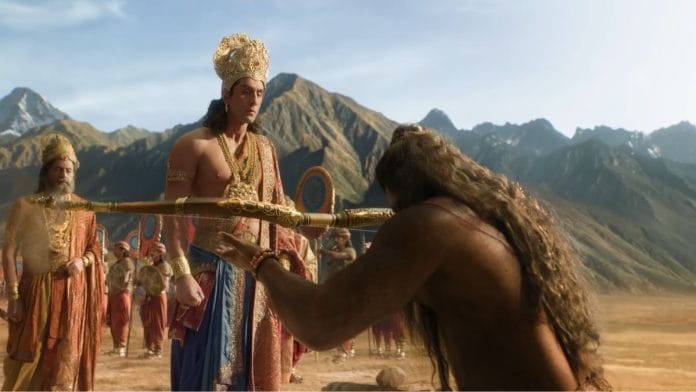

Every time a new live-action adaptation of Ramayana is announced, the chatter shifts from the story, or what the makers are offering extra, to questions like: can someone who played a gangster portray Ram? Can a romantic actor play Hanuman? And that’s not all. Keyboard warriors even start digging up actors’ old videos where they’re talking about eating meat or drinking alcohol, just to prove that the actor is not worthy of playing the gods.
But that changed in 1993, with the Japan-India co-produced animated film Ramayana: The Legend of Prince Rama. Directed by Ram Mohan, Yugo Sako, and Koichi Sasaki, the film is appreciated till today, with no controversies around it.
Animation allowed the audience to immerse themselves in the story they had heard from their grandparents, in temples, and on the streets, without heavy VFX from an Academy Award-winning company, unlike what we saw in the trailer of Nitesh Tiwari’s upcoming film Ramayana. Most epics are passed on orally from generation to generation. That’s what the Japanese creators understood but many contemporary Indian adaptations struggle to. Mythology is often strongest when the characters become larger than the people portraying them.
Staying true to the epic
The trailer of Ramayana feels less like a story adapted from a centuries-old epic written by sages and more like an adaptation by a modern-day novelist. The opening scene, where Ravan is standing in front of a huge door, feels too inspired by the White Walkers from Game of Thrones.
This is where the animated film stands out. The story was told as it is. It looked Indian and ancient in its visuals. The story was about Prince Ram, about his love for Sita. The action scenes were never so exaggerated that Maryada Purushottam looked like someone we had never imagined in that avatar. But in the new trailer, the first image we see of Ram is him riding a horse and aiming his bow. Ram is much more than a master archer. His humanity, kindness, and wisdom were more beautifully captured in the animated film.
The budget of the new Ramayana is said to be nearly Rs 4,000 crore. But do we really need to spend so much on VFX and massive sets for a story that is performed on street stages in every corner of India? We have all heard stories of entire neighbourhoods gathering to watch Ramanand Sagar’s Ramayan on television. That togetherness was always the real spectacle.
The makers have said in interviews that they are making the film for a global audience. But why is presenting Ram as a larger-than-life warrior the only way to prove the greatness of our epic to the world?
The Japanese Ramayana simply documented oral history. It made culture, religion, and history simple to understand.
And it’s not like the animated film followed a different storyline or had some cutting-edge animation. It felt complete because it didn’t distract itself from the epic.
Just recall the conversation around Adipurush, released in 2023. Directed by Om Raut, the film starred Prabhas as Ram, Kriti Sanon as Sita, Saif Ali Khan as Ravan, and Devdatta Nage as Hanuman. Much of its marketing revolved around its stars, and the film often felt bigger than the story itself. Saif Ali Khan’s Ravan rode a bat-like creature instead of the Pushpak Viman. Devdatta Nage’s Hanuman looked as if the actor was chosen more for his physique than the depth of the character. Is Hanuman just a being with a jacked body?
The film faced more hate for its dialogues than for its storytelling and sloppy visual effects. Hanuman, voiced by Sharad Kelkar, delivered lines like, “Kapda tere baap ka, tel tere baap ka, aag bhi tere baap ki, aur jalegi bhi tere baap ki.” Would anyone ever accept that the same Hanuman, whom we grew up hearing leapt toward the sun as a child, would threaten someone like a man in a Thar shouting, “Do you Know who my father is?” The dialogue became more memorable than anything else in the film.
The story remained the same, but the film tried to be more than the epic. Its reimaginations, dialogues, and larger-than-life spectacle overshadowed Valmiki’s story, resulting in what many still consider as one of the worst adaptations of the Ramayana. People criticised almost every frame of the film. More than anything, Adipurush left audiences believing that filmmakers cannot simply reimagine the epic without first understanding what makes it endure.
In the recent Ramayana trailer, Yash as Ravan looks threatening, as he should, but he still appears like just another villain in a film. Ravan was much more than merely a villain.
Also read: Dear Indian parents, women also use gaalis. It’s not just men’s domain
When characters outlive actors
Just in the name of storytelling, filmmakers are turning these epics into Bollywood masala films, where the actors’ names come before the legends, such as Ranbir’s Ram, Yash’s Ravan, Sai Pallavi’s Sita.
This is where Ramanand Sagar’s Ramayan television series stands out. Most of us who watched it with our parents during the Covid re-telecast don’t even remember the names of the actors playing the gods. We know them simply as Ram, Sita, and Hanuman. Arun Govil, Dipika Chikhlia, and Dara Singh have all spoken in interviews about how people kept their photographs in temples, sought their blessings, and began associating them with the deities they portrayed.
That is what a masterpiece does. Instead of the actors’ identities defining the characters, the characters become the actors’ identities. Dara Singh was immortalised as Hanuman, Arun Govil as Ram, and Dipika Chikhlia as Sita. Even today, Arun Govil, who plays Dashrath in Nitesh Tiwari’s Ramayana, is introduced as the man who once played Ram. The story and the characters outlived the actors.
Bryan Cranston gave his voice to the English dub of the film. Years later, he became globally known as Walter White, the drug kingpin from Breaking Bad. Yet it never changed how people looked at Ramayana. No one went back and questioned whether the voice of Ram belonged to an actor who later played a methamphetamine dealer. There was no face to judge, only a voice serving the character.
The audience wasn’t watching Bryan Cranston; they were listening to the story. That is something Nitesh Tiwari’s Ramayana should remember. Filmmakers can not change the core story of the Ramayana, but they can reimagine how it is told.
There is much more to the epic than Hanuman jumping across the sky, Ram drawing his bow, or Ravan simply being the bad guy. We want to know why Shurpanakha came to Ram’s hut, how Jatayu spotted Sita’s abduction, what Ram was like in his childhood, the stories around Sita’s birth, and who Ravan really was beyond being the final enemy.
The Ramayana has been written, retold, and performed across different parts of India for centuries. The characters remain the same, the core story remains the same, but every region has found its own way of adding depth and meaning to it. That is where a filmmaker’s imagination should lie.
That is what makes the Ramayana so unique. Filmmakers can’t reduce something that has lived through so many versions into a two-hour superhero spectacle about good defeating evil. It is a civilisational story, not a cinematic universe.
When big corporate studios make the film with a Rs 4,000-crore budget, Ramayana is converted into a corporate intellectual property. The story is changed into a three-act blockbuster: Act One becomes the setup of the universe, Act Two the confrontation and Sita’s abduction, and Act Three the climax with the killing of Ravan, reducing Ramayana to a “hero defeats the final boss” storyline.
Ramayana is not that simple. Some of Ram’s decisions, like accepting exile, testing Sita after her return, or killing Vali from behind a tree have remained subjects of debate among people for centuries. They are meant to make people think. The characters and the gods themselves have layers; they are not gallery figures, which these action-heavy reimaginings of the epic often try to turn them into.
By doing this, Nitesh Tiwari risks taking the safer route of presenting characters as simply good or evil, without giving the audience enough time to understand their depth. The film may be one of the most anticipated releases in Indian cinema, but whether it truly understands the Ramayana is a question that will remain unanswered.
Views are personal.
(Edited by Aamaan Alam Khan)
How can one criticize a movie after viewing only its teaser or trailer ? only a casteist with a highly misplaced notion of supremacy can attempt to do it.