



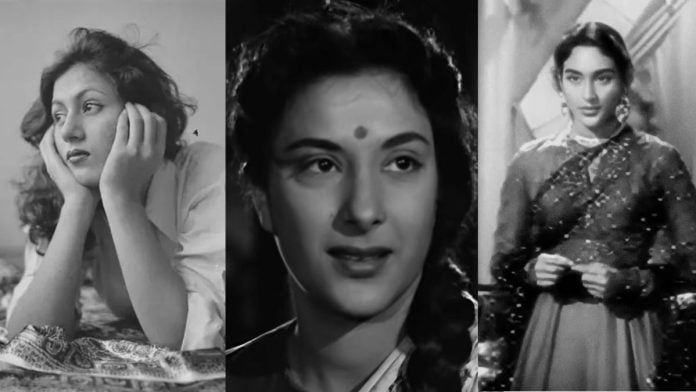
It has taken Indian cinema decades to turn the camera towards the women who helped build the industry. With Geetika Narang Abbasi’s upcoming biopic on Meena Kumari and Sanjay Leela Bhansali reportedly revisiting Madhubala’s life, the film industry seems to be making a belated attempt to celebrate its female icons.
While regional actresses such as Silk Smitha and J Jayalalithaa have also been the subjects of biopics, their stories have largely been brought to the Hindi-speaking audience through Bollywood actors, with Vidya Balan and Kangana Ranaut stepping into their shoes in The Dirty Picture (2011) and Thalaivii (2021).
But why has it taken so long for Hindi cinema to recognise the lives and contributions of its own leading ladies?
Bollywood had no hesitation in making a big-budget biopic on the controversial life of a male superstar who was still alive. Sanju (2018), based on Sanjay Dutt’s life, explored his personal controversies, relationships, and struggles. Yet, when it comes to remembering his mother, Nargis, one of Indian cinema’s most celebrated actresses, the industry has largely remained silent.
Nargis carried the weight of Mother India (1957) on her shoulders, delivering one of the most defining performances in Indian cinema. Her personal life was more complex, and her contribution to the industry deserves more than a passing reference in the story of her son.
Then there is Smita Patil, an actor who moved between mainstream cinema and parallel films, and stood at the forefront of feminist filmmaking in India with films such as Bhumika (1977), Chakra (1981) and Mirch Masala (1985).
She challenged conventions, changed the way women were represented on screen and left behind a body of work that continues to influence cinema. And what about Nutan, whose performances helped redefine the Hindi film heroine?
We have heard stories of actresses working without vanity vans, facing unequal working conditions and challenging societal conventions simply to continue doing their jobs. Yet, their stories remain scattered across archival footage, interviews, and old newspaper reports. If filmmakers do not preserve these histories now, many of them risk being forgotten.
The women who built the industry
And this is not just about actresses from the golden age of Indian cinema. We are also forgetting the women who helped lay the foundation of Indian cinema itself.
Dadasaheb Phalke is celebrated as the father of Indian cinema for making its first feature film, Raja Harishchandra (1913). But how many remember the film’s producer and editor, his wife, Saraswatibai Phalke? She sold her jewellery for the film and contributed to its making.
If filmmakers are yet to tell the stories of women who were there at the very beginning of Indian cinema, it is difficult to expect them to turn the camera towards figures such as Saraswatibai or Bhanumathi Ramakrishna, who directed, produced and wrote films, and even ran her own studio.
Also read: No love stories for Bollywood’s married heroines. Only guns, revenge and trauma
Beyond scandal and tragedy
The question is also about what filmmakers believe makes a woman’s life worth adapting into a biopic. Does it need drama, controversy, rebellion, and a tragic ending? If so, the lives of these actresses had all of that and much more.
The Dirty Picture (2011), inspired by Silk Smitha’s life, focused largely on the actress’s rise, sexuality, relationships, and tragic end. Later, Shakeela (2020), starring Richa Chadha, explored the personal struggles of South Indian actress Shakeela Khan, who became a major star in adult cinema.
Both films brought attention to women whose lives had rarely been discussed in mainstream films. There is nothing wrong with telling these stories. The problem arises when personal controversies and eventual downfall become more important than the artistic contributions of the women themselves.
Why is an actress’s life so often framed through scandal, sexuality, or tragedy? Why do filmmakers rarely explore her as an artistic genius, an ambitious professional, or someone who challenged the conventions of her time?
These films also reveal the industry’s hesitation to take responsibility for the stories it tells. Both The Dirty Picture and Shakeela opened with disclaimers describing them as works of fiction. Filmmakers seem comfortable presenting an overly glamorous version of the film industry on screen while distancing themselves from the responsibility of telling these women’s stories truthfully.
Their struggles and suffering become entertainment, even after their deaths. There is plenty of attention on their personal lives, but very little on their craft.
(Edited by Maryam Hassan)