



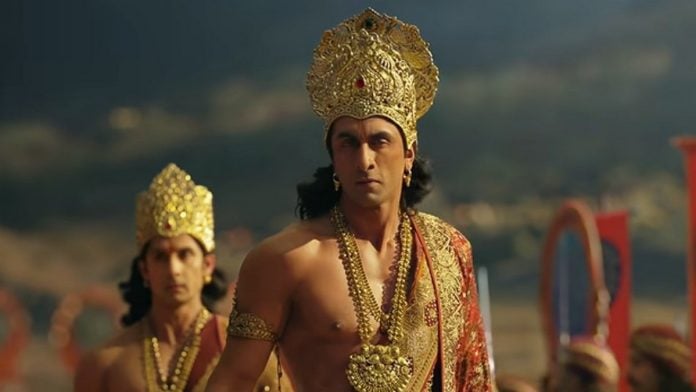
Bollywood has always had a defining masala, and it changes with every decade. Patriotism dominated the 1990s, with films such as Tirangaa (1993), Border (1997) and Sarfarosh (1999), followed by Salim-Javed’s angry young man era. The 2000s belonged to comedy, with films such as Hera Pheri (2000), Welcome (2007) and Golmaal (2006) becoming audience favourites. For a while, slice-of-life films also found their audience. Now, mythology is making a comeback, with gods, epics and ancient legends returning to the big screen.
The biggest film of the decade so far is Namit Malhotra’s Ramayana. And if the scale of ambition is anything to go by, Bollywood is preparing for a decade of gods, legends and folklore.
The protagonists of the 2000s and 2010s were often urban drifters trying to figure out life. Whether it was Ranbir Kapoor in Wake Up Sid (2009) or a group of friends discovering their purpose in Dil Chahta Hai (2001), these films captured the anxieties and aspirations of an entire generation. But the landscape has changed completely. Filmmakers are no longer as interested in quarter-life crises. Instead, they are looking back at the origins of Indian cinema, revisiting stories of kings, gods, and ancient legends.
This is where Indian cinema began. Dadasaheb Phalke’s early films included Raja Harishchandra (1913), Mohini Bhasmasur (1913), Lanka Dahan (1917), Shri Krishna Janma (1918) and Kaliya Mardan (1919). These films drew from mythology and ancient folklore, the very material that filmmakers are now returning to on a much grander scale, and of course, VFX.
South India at the forefront
The current wave of mythological and folklore-driven cinema can be traced back to Baahubali (2015). S.S. Rajamouli’s two-part epic brought Indian cinema to a global audience and became one of the biggest box office successes in Indian film history, setting records that remain difficult to surpass. South Indian cinema has been at the forefront of this shift, producing films that have travelled beyond their linguistic markets.
In Kannada cinema, Rishab Shetty’s Kantara (2022) turned the spotlight on the ancient and visceral Bhoota Kola tradition of coastal Karnataka. Although set in contemporary times, the film drew its emotional and narrative strength from local folklore and religious traditions. Its success suggested that audiences were willing to embrace stories rooted in unfamiliar cultural worlds rather than just metropolitan stories.
Telugu cinema, too, has explored mythology in different forms. Karthikeya 2 (2022) revolved around the mystery of Lord Krishna’s anklet, while Kalki 2898 AD (2024) transported the Mahabharata’s Ashwatthama into a dystopian futuristic world. Filmmakers also reimagined the superhero genre through Hanu-Man (2024), building a contemporary superhero story around the mythical powers of Lord Hanuman. What connects these films is their ability to draw from ancient stories and repackage them as large-scale commercial spectacles. All of them also found considerable success, with most such films crossing the Rs 100-crore mark; Kalki 2898 AD went a step further, collecting over Rs 1,000 crore worldwide.
The shift has also altered the fabric of Malayalam cinema, traditionally known for its everyman. The best example is Bramayugam (2024), for which Mammooty won the National Award for Best Actor. The film uses local myths, rituals and supernatural beliefs to build an unsettling story.
Groundwork for bringing gods and mythology to the big screen through heavy VFX was arguably laid by Ayan Mukerji’s Brahmastra: Part One – Shiva (2022). The film attempted to move away from the familiar Western superhero model and create its own Astraverse, drawing on cosmic weapons from Hindu mythology and placing them in the hands of a contemporary superhero. While Adipurush (2023) failed to deliver a convincing adaptation of the Ramayana, it reflected the industry’s growing appetite for mythological spectacles and the audience’s desire to see these stories retold on a grand scale.
Also read: Bollywood remembers its leading ladies, but rarely tells their stories
The trend is not limited to live action cinema either. In 2025, Hombale Films ventured into animation with Mahavatar Narsimha (2024), centred on Lord Vishnu’s half-man, half-lion incarnation. The film brought mythology to the big screen through animation, opening another avenue for storytelling rooted in Indian epics.
Even non-mythological films point to audience interest in spirituality. Hanuman Ansh (2026), based on the life of Neem Karoli Baba, reportedly made on a budget of around Rs 2 crore, went on to collect over Rs 400 crore, an extraordinary return of more than 200 times its reported production budget.
The trend of retelling ancient epics isn’t untouched by Hollywood. Christopher Nolan’s The Odyssey is another example of filmmakers returning to ancient myths and legends. Shot entirely on IMAX cameras and using practical effects, the film brought Homer’s Greek epic to the big screen on a grand scale. The film earned nearly $1.8 billion worldwide.
Views are personal.
(Edited by Ratan Priya)