






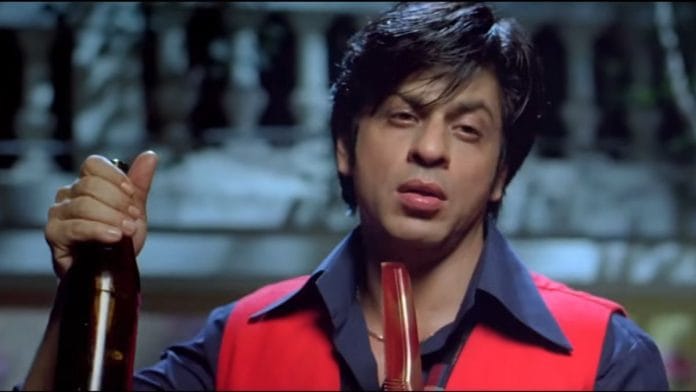


Dialogues such as “Bade bade deshon mein aisi chhoti chhoti baatein hoti rehti hain, “Mogambo khush hua”, and “Kitne aadmi the?” have travelled outside the theatres. They entered everyday conversations, jokes, and mimicry, and somehow became a part of popular Hindi vocabulary. Somewhere between the old era of Bollywood and the streaming era, Shah Rukh Khan became the last of the stars whose dialogues felt larger than the films themselves.
From Darr’s Rahul saying “K-K-K-Kiran” to Om Kapoor’s iconic “Picture abhi baaki hai mere dost”, SRK has repeatedly delivered lines that people could use beyond the context of the film. Even his more recent “Koi dhandha chhota nahi hota” from Raees (2017) is remembered because of the way the dialogue was delivered and how easily it could be repeated in real life.
Look at the last decade, and it becomes difficult to name films or actors whose dialogues have achieved the same status. And this is not only because dialogue-writing has become weaker. Earlier, dialogues were written and delivered with a rhythm that allowed a common person, friends or even comedians to pick them up and use them in completely different situations.
“Main udna chahta hoon, daudna chahta hoon, girna chahta hoon… bas rukna nahi chahta hoon”. This Ranbir Kapoor dialogue from the 2013 film Yeh Jawaani Hai Deewani became the kind of line middle-class boys could relate to when they felt stuck in life. Then there was Jab We Met’s “Main apni favourite hoon”.
These lines carry nostalgia and a certain innocence. They can be spoken almost anywhere, while trying to sound cool on the first day of college, during a family conversation, while giving advice to a friend or simply while joking around. They are multi-purpose, which is perhaps why they survived.
Now compare these to what Animal (2023) offered us. Can you immediately remember a dialogue from the film that people casually use in everyday conversation? And can someone say them at a family gathering?
With “Mard ko dard nahi hota” from Mard (1985) and other dialogues from Deewaar, Zanjeer and Don, Amitabh Bachchan had the authority to turn a line into a statement. His dialogues were often larger than the character itself, because his voice, pauses and screen presence gave them a life of their own. Sunny Deol’s “Tareekh pe tareekh” and “Dhai kilo ka haath” became synonymous with his larger-than-life persona.
And then there is Amrish Puri’s “Mogambo khush hua.”
These were not necessarily dialogues that people could use in every everyday situation. They were so explosive, so distinctive and so deeply associated with the actors who delivered them that they became permanently lodged in pop culture.
Even Paresh Rawal’s Baburao from Hera Pheri (2000) created a different kind of dialogue legacy. “Babu Rao ka style hai” may not be a conventional dialogue in the traditional sense, but these lines became memes before memes had even become the language of the internet.
Also read: What is MIRZAPVR? INOX gets a countrywide makeover for the Mirzapur movie
Keeping the tradition alive
The older generation gave us dialogues we remembered for decades. Shah Rukh Khan gave us dialogues we could actually speak.
But it would be unfair to say that SRK was literally the last actor to deliver memorable Bollywood dialogues. Lines like “Baap ka, dada ka, bhai ka, sabka badla lega re tera Faizal” by Nawazuddin Siddiqui in Gangs of Wasseypur 2 and “How’s the josh?” by Vicky Kaushal in Uri: The Surgical Strike are still remembered. But they have a different kind of afterlife, one that comes with an expiry date.
You cannot randomly say “Baap ka, dada ka…” unless you are recreating the scene. But when your salary gets credited, you can say “Kabhi kabhi kuch jeetne ke liye kuch haarna padta hai”, without explaining the reference.
That is the difference between a memorable dialogue and a timeless one.
Perhaps that is why Shah Rukh Khan feels like the last of that generation of dialogue-driven superstars. His list is almost endless: “Rahul, naam toh suna hoga” (Dil To Pagal Hai), “Pyaar dosti hai” (Kuch Kuch Hota Hai), “Sattar minute” (Chak De! India), “Picture abhi baaki hai mere dost” (Om Shanti Om), “Don ko pakadna mushkil hi nahi, namumkin hai” (Don), “Keh diya na, bas keh diya” (Kabhi Khushi Kabhie Gham) and “Don’t underestimate the power of a common man” (Chennai Express). From romance and comedy to action and motivation, every phase of his career produced lines that audiences carried with them. His dialogue list is so long that you don’t remember just one SRK dialogue, you remember a whole vocabulary of them.
SRK stands somewhere between the two eras, carrying the tradition of Bachchan, Amrish Puri, and Sunny Deol into the age of the internet.
Views are personal.
(Edited by Aamaan Alam Khan)