




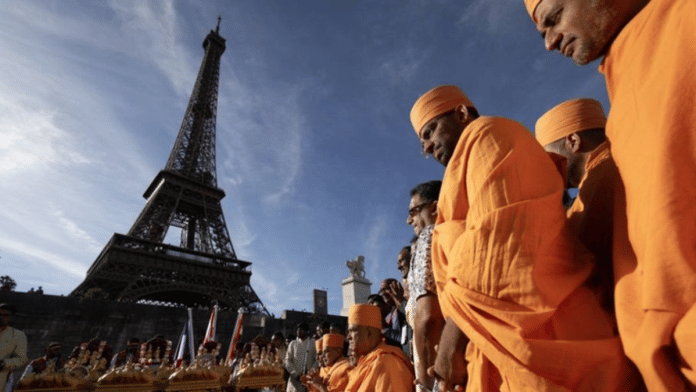



One doesn’t think about a global debate on gender when one talks about the Eiffel Tower. Yet this week, one of the world’s most famous landmarks became the backdrop for an uncomfortable question about the existence of women in public spaces—a question that keeps rising again and again, like acid reflux.
If women are so respected (in our culture, society and religion), why are they always being asked to be removed from sight?
The controversy began when female staff at the Paris landmark were reportedly asked to step aside for a visit by the Hindu denomination Bochasanwasi Akshar Purushottam Swaminarayan Sanstha (BAPS), whose strict celibacy rules require them to limit interactions with women. This “request” prompted protests from the workers’ union, closure of the monument for a day; it even united French politicians in their outrage and resulted in an apology from the group.
Just days earlier, halfway across the world, Kerala’s Grand Mufti Aboobacker Musliyar stirred a debate by suggesting that women should stay inside their homes. The cleric even compared women to gold that should be kept inside a box “safely.”
At first glance, these incidents appear unrelated. One concerns Hindu monks observing religious discipline; the other involves a Muslim cleric speaking about women’s place in society. But scratch the surface even slightly, and you’ll unearth a very familiar idea: Women are precious, sacred even and hence must be hidden.
Also Read: What Grand Mufti Kanthapuram needs to know about Islam before ordering Muslim women inside
Not the dark ages. Just archaic thinking
Across religions and cultures, women have often occupied a strange and contradictory position. They are revered as mothers, celebrated as life-givers, even worshipped as goddesses. Yet, they are also regulated, restricted, and often removed from public spaces in ways men rarely are.
The language used, however, is always positive to sugarcoat the bigotry. Women must be protected. Women must be respected. Women must be honoured. But protection and control have a habit of sounding alarmingly similar.
Consider this: Why must women be hidden from the sight of men observing celibacy? Is the celibacy in question so fragile that it will cause distraction from the mere presence or sight of women? And why must women accommodate a request that doesn’t serve them in any way, but just reduces them to their gender? If men are so unable to control their urges, perhaps they are the ones that must be protected and controlled.
Consider the “gold-in-a-box” analogy. Gold is valuable, yes. But it is also an object. It doesn’t make decisions. It does not move freely. It belongs to whoever owns the box.
The problem with this ideology is that it reduces women to symbols. A woman is no longer a citizen, a colleague, or an individual. She becomes a vessel for honour, temptation, purity and family prestige. She becomes an idea. And ideas are easier to control than living, breathing people.
What’s particularly striking is that these restrictions reveal more about male anxieties than female behaviour.
The logic is familiar. Women must cover themselves because men might get tempted. Women must stay away because men may get distracted. Women must stay hidden because men may lose focus on their spiritual duties. But all this says less about women and more about men.
Religious traditions frequently celebrate extraordinary feats of discipline. Men dedicate themselves to acts of worship, fasting, and some even renounce their wealth and worldly desires. Yet, the mere presence of a woman remains a challenge so overwhelming that entire systems must be built around avoiding her.
The contradiction is too on the nose. If women are required to disappear for men to remain focused, is that really a commentary on women or a startlingly low assessment of men’s self-control?
For centuries, societies have treated women and their bodies as a problem to be managed. Menstruation has been labelled “impure.” Childbirth has been framed as weakness rather than power. Women’s movement has been monitored in the name of safety. Their visibility debated in the name of morality. The reasons differ, the outcome rarely.
Women have always, always, always been asked to shrink themselves to accommodate male discomfort.
The tragedy, though, is that these ideas emerge wrapped in the language of reverence. But reverence is not the same as equality. How can someone be put on a pedestal and be thrown in the shadows at the same time? Why can women not be normal human beings? Reminder: we never asked to be worshipped.
And perhaps that is the real issue. A woman is not a temptation to be avoided, or a treasure to be locked away. She is simply a person moving through the world. Maybe it’s time to just let her be.
Views are personal.
(Edited by Insha Jalil Waziri)