




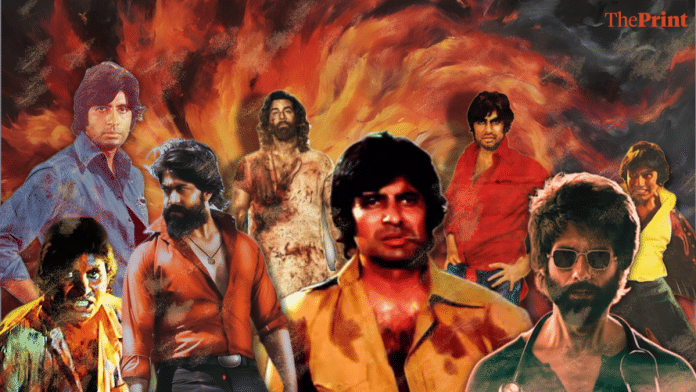

India has lost its Angry Young Man. The new heroes are perhaps angrier, although mostly played by older actors pretending to be young, but they are increasingly becoming a lost cause. They neither contribute to Bollywood’s cinematic legacy nor fight for a larger social purpose. Rather than exploring issues like class divide, caste discrimination, unemployment, corruption, or systemic injustice, their anger is often reduced to personal revenge and wounded masculinity.
When the iconic writing duo Salim-Javed created the Angry Young Man archetype, embodied by Amitabh Bachchan, they gave Hindi cinema a hero whose rage came from social injustice. In films like Deewaar (1975), Zanjeer (1973), and Trishul (1978), Bachchan’s characters were culturally disillusioned, working-class men who constantly stood up against an unfair system. Their anger was rarely driven by personal insult alone. They fought not just for themselves, but for everyone around them.
Compare that with today’s “much angrier” heroes: Shahid Kapoor’s Kabir Singh (2019), Salman Khan in Dabangg (20190), Ranbir Kapoor’s Animal (2023), Allu Arjun’s Pushpa (2021), Yash in KGF (2018) and in the upcoming film Toxic, among others. While these films may have been commercially successful, most of their protagonists are fighting for personal gain rather than a larger cause. Mainstream cinema today rarely takes a socio-political stance. In Kabir Singh, the protagonist slaps his lover, displays obsessive and abusive behaviour, and the film struggles to question any larger social issue. His anger serves only his own desires.
Many argue that not every film needs to address social issues, and that is true. But then we should stop calling cinema a mirror of society. Cinema may be fiction, but it is still created by humans and consumed by society. Take Animal, for instance. Ranbir Kapoor’s character carries a gun into a school, shoots people to avenge his sister, and the film also normalises his affair despite him being married. These traits may define him as an anti-hero, but they also raise an important question: What exactly makes a hero? Ironically, Animal became memorable not for celebrating masculinity, but because it sparked a debate about toxic masculinity and what a hero should not be.
Meet the original anti-heroes: Jai and Veeru
Let’s go back to 1975 and Sholay. Written by Salim–Javed and directed by Ramesh Sippy, the film follows Jai, played by Bachchan, and Veeru, played by Dharmendra, both petty thieves with tragic pasts, yet their motivations are far more selfless than many modern protagonists, whose biggest conflict is often parental neglect despite growing up in privilege. Hired by Thakur Baldev Singh, a man whose hands were brutally cut off by the ruthless dacoit Gabbar Singh, Jai and Veeru initially accept the job for money. But once they witness the suffering of the village, they choose to stay and fight because protecting innocent lives is more important than greed.
Supporters of films like Animal, Kabir Singh or Toxic often argue that filmmakers have the freedom to tell any story they want. They absolutely do. But that raises another question: What inspired filmmakers in earlier decades to repeatedly make films rooted in social realities? They worked with smaller budgets, fewer resources and limited technology. Safety standards were poor, Bachchan nearly lost his life while shooting Coolie (1983). Yet many of those films still found space to discuss class inequality, corruption, labour struggles and the everyday problems of ordinary Indians. Their heroes were angry because society had failed, not because their ego had been bruised.
Perhaps the Angry Young Man has not disappeared. Perhaps he has simply stopped looking outside and has become consumed by himself. His anger no longer challenges the system; it only feeds it.
Also Read: ‘Toxic’ is living up to its name. ‘Ladies & Ladies’ teaser fails women
Who is the villain here?
Maybe this isn’t even the fault of today’s Angry Young Man. The villains have changed too. Instead of giving the hero a reason to be angry, they seem more invested in sorting out his mental health — a disapproving father, a rival in a love triangle, a feuding family member, a lover with a drinking problem. That’s about as far as the antagonist goes.
The villains of classic Hindi cinema, however, had an identity of their own. Even if you had never watched the films, you knew their names. Gabbar Singh from Sholay, Mogambo from Mr India (1987), Shakaal from Shaan (1980), the list is endless. They are remembered not merely because they were evil, but because they represented a larger social fear. Their actions affected ordinary people, thereby giving the hero a reason to fight for something bigger.
That is what made the Angry Young Man believable. He wasn’t angry because his girlfriend left him or because his father loved his brother more. He was angry because society had failed him and everyone around him. He was the voice of the working class, standing up against men with wealth, influence and power despite having none himself.
Now think about today’s mainstream films. Who was the real villain in Kabir Singh? Is it Preeti’s father, who refused to let his daughter marry an alcoholic surgeon? Isn’t that exactly how many Indian fathers would react? And in Animal, was Bobby Deol’s character truly the villain? Beyond his silence, physique and brutality, the film offers little ideological conflict between hero and villain. There is no Gabbar, no Mogambo, no Shakaal, only another damaged man.
The Angry Young Man was flawed, but he was morally aware. He belonged to the lowest class of society, where power didn’t even know he existed. Today, however, the hero is often the one sitting with power.
The heroes of yesteryears fought the corrupt, the influential and the morally bankrupt. Today’s hero, on the other hand, is often a police officer himself, like Chulbul Pandey, who even eve-teases the heroine in the film; a rich son whose anger comes from not being heard by his father, like Ranvijay in Animal; or an alcoholic incapable of understanding the word “no,” much like Kabir Singh; or men chasing wealth and power, like Rocky in KGF.
The Angry Young Man is no longer fighting against evil, he has become the evil, and we are praising or condoling him for it because he is simply “misunderstood” or “unloved.”
Views are personal.
(Edited by Insha Jalil Waziri)