




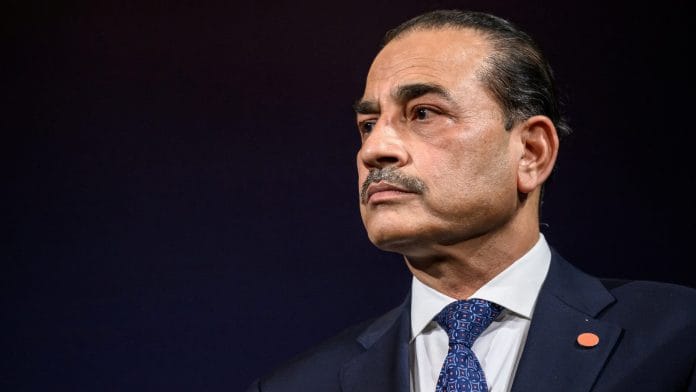

Almost six decades after a Pakistani military officer decided to take sides in an intra-Arab quarrel, his successor in the top office has also intervened in the most economically vital conflict in West Asia. Pakistan Air Force jets reportedly attacked Houthi rebel advances across the Saudi-Yemen border.
Pakistani troops are stationed in Saudi Arabia as part of the recently signed tripartite Mecca Joint Defence Agreement and are also believed to be operating a squadron of JF-17 fighter jets.
Turkey, the third of the Mecca troika, is not known to have troops or equipment in Saudi Arabia.
Without needing to refer to the Pakistan National Assembly, Field Marshal Asim Munir has deployed more than a brigade’s strength of troops, as well as air assets. President of Pakistan may well be the theoretical Supreme Commander of the Armed Forces, but the self-elevated Field Marshal retains full control of the three services following a constitutional amendment in November 2025, when the 27th Constitutional Amendment created the office of Chief of Defence Forces, thus abolishing the nominal post of Joint Chiefs of Staff. Air assets, thus, are also under Munir.
Learning from the best
In launching air strikes on Houthi positions in Yemen, Munir joins the former Chief of Army Staff, General Zia ul-Haq, intervening between warring Arab sides. While the late dictator was a Brigadier when he played a key role in suppressing the Palestinian uprising against the Jordanian monarchy, the current Field Marshal has gone a step further and used Pakistani military assets in a combat role against Riyadh’s recalcitrant neighbours in Yemen. It is of course purely coincidental that both the Pakistan Army officers to perform interventionist roles happen to have Jullundur origins. The similarities, however, end there.
Then a Brigadier Zia ul-Haq was posted as a Military Adviser to Jordan when the infamous Black September massacre occurred in September 1970. It came at the tail end of his three-year tenure, and he departed Jordan with a medal of appreciation, Wisam al-Istiqlal, which ironically translates into ‘Order of Independence’. For it was bestowed on him for duties performed well beyond his advisory role, to the point that he had to carry the sobriquet of ‘Butcher of Palestinians’.
It apparently helped him jump many seniors when he came to be selected Chief of Army Staff later in 1976.
Field Marshal Munir, of course, does not need any such credentials for further elevations, since none are available in Pakistan’s military structure for now. But in this larger regional role, he has taken Pakistan’s military into a territory from which there is no easy way out. The optics of taking sides in an intra-Arab fight, and sectarian at that, are not good for Islamabad, or Rawalpindi, or wherever the new Chief of Defence Forces chooses to work from. Pakistan is home to the second largest Shi’a population in the world, with a large number serving in the armed forces.
Also read: The long shadow of depraved ideologies—from Maoism in Nepal to ISIS
The uncharted territory
There are no known instances of such sectarian tensions boiling over within the Pakistani units, and professionalism has largely prevailed. However, Rawalpindi has had to play tightrope during its long history of deploying troops in Saudi Arabia. At its height of such deployments in the 1980s, during the tenure of Gen Zia ul-Haq, Riyadh expressly asked Pakistan to remove Shia officers and troops from duty on Saudi soil. Pakistan had a reinforced armoured brigade group stationed in Saudi Arabia. While Gen Zia did not immediately reject the demand, his proposal put to the Pakistan Army Corps Commanders was met with resistance.
Several senior officers protested, stating that this may significantly damage the cohesion of the Pakistani armed forces. The reason was that the policy could not be implemented discreetly. They argued that a complete formation with fully cohesive battalions was to be deployed, and removing a particular group of soldiers based on their sect would negatively affect the cohesion of the units.
While that armoured brigade deployment was far from a combat zone, in Tabuk, and miles removed from any operation, the current deployment is in the hottest spot across the West Asian conflict zone. And the sides drawn are expressly sectarian.
This is an unenviable task for a largely mixed military, professionally commanded, although with its own skewed politico-corporate interests. In this regard, the Pakistan military has developed its own peculiar foreign policy, one which was largely focused on India, China, nuclear and terrorism. On these fronts, there was little reason to worry about sectarian tensions, although the blowback from spawning transborder terrorism has affected the Pakistani Shi’a equally. But striking the Houthis, albeit mislabeled as a purely Shi’a issue, complicates matters for the Pakistani armed forces. The madrasa-educated Field Marshal has taken them into uncharted territory, with no easy way out.
Manvendra Singh is a BJP leader, Editor-in-Chief of Defence & Security Alert and Chairman, Soldier Welfare Advisory Committee, Rajasthan. He tweets @ManvendraJasol. Views are personal.
(Edited by Ratan Priya)