






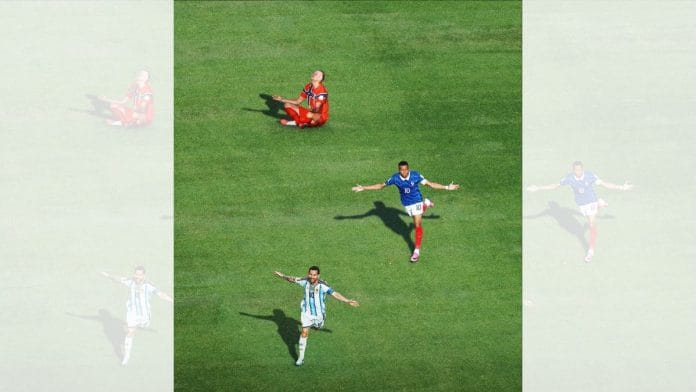


With 24 games, 75 goals, nine draws, seven braces, and three own goals, the first week of the 2026 FIFA World Cup is proof that this tournament may be remembered for chaos and the upsets it has already produced. Tactical choices, team selections and managerial decisions took a back seat.
From three red cards in the first fixture to a magical Lionel Messi hattrick to the controversies surrounding the US as the host, there has already been high-velocity drama, emotions, heartbreaks and pure football.
The expanded 48-team format was criticised prior to the games, with naysayers claiming it would affect the quality of the world’s biggest tournament. However, it has injected unpredictability and closed the gap between football giants and emerging nations.
From Messi and Shakira to heavy scrutiny on players and referees, Matchweek 1 of the 2026 FIFA World Cup was packed with action on and off the pitch. And that’s why it’s ThePrint’s Newsmaker of the Week.
Also read: All-female refereeing trio makes FIFA World Cup history in Czechia-South Africa clash
Messi’s hattrick to Falcao’s tears
It did not even take time for the drama to begin. The first fixture of the World Cup between Mexico and South Africa saw a historic three red cards issued.
It’s a rare sight in the tournament. The entire 2022 Qatar World Cup witnessed only four red cards.
With this, football announced the arrival of the 2026 World Cup and reminded us that the tournament is always unexpected.
Football legend Lionel Messi arrived in his own way. At 38, when most players usually retire from international football, the ‘Little Boy from Rosario, Argentina’ scored his first World Cup hattrick.
He’s captaining the defending champions, Argentina. He won his second Golden Ball award in Qatar in 2022 and remains the only player to win it twice.
His first run in 2026 reminds us that even after achieving almost everything the game has to offer, there are still ways for more glory.
Apart from the players, coaches and fans, the emotions also affected the commentators as well.
Former Colombian star striker Radamel Falcao was moved to tears after his nation routed Uzbekistan 3-1 in its opening fixture. It was Colombia’s way of coming back to the FIFA World Cup after eight years. It reminded Falcao that his team has learned to evolve without him and perform at the tournament. His moment says that football is not only about goals and trophies.
Those same emotions could also be seen somewhere else.
Iraq qualified for the first time in 40 years. Though it had a heart-wrenching first fixture after losing to Norway 4-1, the lone goal from Aymen Hussein shows us what perseverance can do. Al-Qaeda killed his father, and ISIS abducted his brother. He thought of quitting, but his mother forced him to play football. And, now, he has scored the first World Cup goal for Iraq after four decades, making history for his country. This is football!
Sometimes, the game can be cruel. When DR Congo held Portugal for a 1-1 draw, Portuguese legend Cristiano Ronaldo, a five-time Ballon d’Or winner, faced heavy criticism for his performance on the pitch. At 41, Ronaldo, the oldest outfield player in the 2026 FIFA World Cup, made only 25 touches across the 90 minutes. He managed just three shots— none on target—and zero defensive recoveries.
Meanwhile, DR Congo’s performance shows that the smaller nations came to this tournament to fight and stage upsets. Cape Verde, the debutant nation with 5,30,000 population, pulled off the shock of the tournament by holding reigning European champions Spain to a 0-0 draw. While New Zealand, the lowest-ranked team in the 2026 FIFA World Cup, earned a hard-fought point against Iran, Australia thrashed Turkiye 2-0.
The lower-ranked squads proved the critics wrong. Smaller teams have made the tournament more interesting. This is the biggest lesson from Matchweek 1.
Also read: Iran’s FIFA World Cup opener turns political as fans wave banned pre-revolutionary flags
Other side of 2026 FIFA World Cup
From ticket prices and visa issues to protests about visas and flag regulations, the 2026 World Cup has been marred by off-the-pitch concerns. Discussions around the US being the host have often become as prominent as discussions about football.
First, let’s dive into the expense. FIFA promised fans this edition would be the biggest World Cup ever, but it turned out to be the most expensive as well. Tickets for group-stage matches were priced anywhere from $120 to $265, while a seat for the final in New Jersey currently costs between $4,185 and $8,680.
A formal complaint was also filed against FIFA by Football Supporters Europe (FSE) and Euroconsumers regarding the matter.
The transportation costs in certain cities in the US have also increased severalfold. It went up so high that the German national team funded bus transport for 600 of their supporters to travel to their final Group E game against Ecuador in New Jersey.
This came as a response to public backlash over steep price hikes for rail fares.
Second, the visa issue. The 2026 World Cup is facing significant visa and immigration controversies. Delays, high rejection rates, and strict US border policies have impacted players, team staff, referees, journalists, and fans, sparking widespread backlash and criticism.
The Uruguayan team faced severe travel and security disruptions. Their flight from Mexico was barred from entering US airspace, forcing the team to stay in Mexico before being cleared to fly. In Miami, security personnel and sniffer dogs thoroughly inspected players’ personal belongings and luggage outside their team bus right before their opening fixture against Saudi Arabia.
Iraq’s star player Aymen Hussein and the team photographer were detained and questioned by US Customs and Border Protection (CBP) at Chicago O’Hare for seven hours; the photographer was denied entry. While all Iranian players received visas, over a dozen team staffers and federation officials were barred. Due to the restrictions, Iran’s training base is in Mexico and the team must fly in and out of the US on the same day as their matches.
Somali referee Omar Abdulkadir Artan was also denied entry to the US and blocked from officiating at the tournament. The US cited “derogatory information,” especially an alleged “association with suspected members of terror organisations,” for the denial. He was named African Referee of the Year in 2025.
FIFA World Cup 2026 comes at a time when the world is much fractured and uncertain—global isolationism on the rise with multiple active wars. Amid such chaos, football is the global balm. And fans have thronged the US stadiums despite all the administrative hiccups.
Like Spanish coach Pep Guardiola said, “Football is for the fans.”
(Edited by Theres Sudeep)