





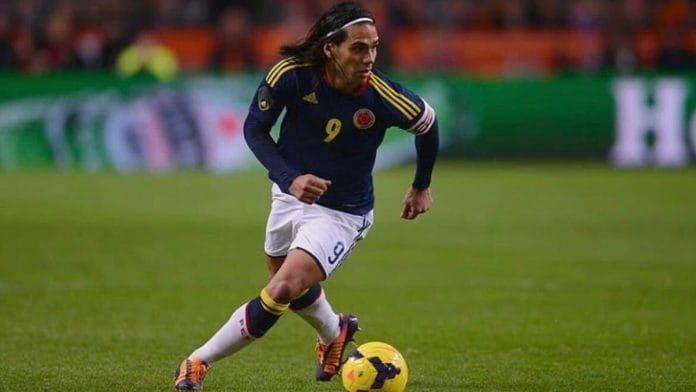


When Colombia defeated Uzbekistan 3-1 in the FIFA World Cup group stage match on Thursday, its former legendary striker Radamel Falcao, who was in the commentary box, was in tears after seeing his nation perform at the world’s biggest football tournament after eight years. He wiped away tears while watching his country begin another World Cup chapter.
That visual took many fans a decade back when Falcao was one of the greatest strikers in football, especially in Europe. Many thought that the tears came out of his love for the country. But it resembled memory, loss, revenge and a World Cup stint which failed for Falcao.
For Colombia, the 2026 World Cup is about participating after almost a decade. But, for Falcao, it’s a reminder of a World Cup moment that might just have belonged to him.
A broken dream
In 2014, when Colombia qualified for the World Cup in Brazil, Falcao played a crucial part in the squad. Before that, Colombia had spent 16 years without playing the World Cup.
With his goalscoring ability for Porto, Atlético Madrid and Monaco, he became one of the most feared strikers in world football. He was even compared to the likes of Lionel Messi and Cristiano Ronaldo. More importantly, he became the symbol of Colombian football. When the national team qualified for the 2014 World Cup, Falcao was at the centre of that moment.
At 27, when he was at the peak of his career, the 2014 World Cup arrived. It looked like as if the tournament was meant for a player like him. And the timing was also perfect. Until the injury came.
In January 2014, Falcao suffered a ligament tear. Suddenly, the dream was about to collapse. Fans were anxious about his return. But football can be cruel.
And, Falcao was ruled out of the tournament.
The 2014 World Cup campaign remains one of the greatest ironies in Colombian football history. The country’s finest World Cup campaign occurred without its biggest star. The star phenomenon shifted to James Rodríguez, who led Colombia to the quarter-finals for the first time.
Rodríguez scored six goals, won the Golden Boot and became one of the stars of the tournament, grabbing headlines across the world. The nation fell in love with a team that showed the world that it’s never over until it’s over.
Also read: Iran player’s gun gesture was just a goal celebration. Stop projecting your politics on it
The lost touch
In 2018, Falcao was determined to be a part of the World Cup squad. For that, he rebuilt his career and rediscovered his first touch. Eventually, he fulfilled his dream of playing in the 2018 World Cup in Russia. He scored against Poland, becoming one of the oldest Colombian players to score at the tournament.
However, things had changed by then. Four years had already passed, and Falcao was 32 by then. He was no longer unstoppable. He didn’t terrorise defenders across Europe any more. The World Cup dream came true, but in a different form.
And, this is the exact reason why his tears in the 2026 FIFA World Cup mean so much for football fans.
The victory over Uzbekistan was just another group-stage win. But for Falcao, the match was proof that Colombia’s place on football’s biggest stage did not end after him or Rodriguez. The team has evolved with new heroes. And new stories are being written.
When Radamel Falcao cried after Colombia’s win over Uzbekistan, he was witnessing a bunch of players with the same passion which he had 12 years ago.
Twelve years after the World Cup, he never got a chance to play, Colombia is back with a bang. And for one of its greatest icons, that means everything. That’s why when Colombia secured the victory, he said, “Shout it! Shout it Colombia! This is madness! What a special moment!”