




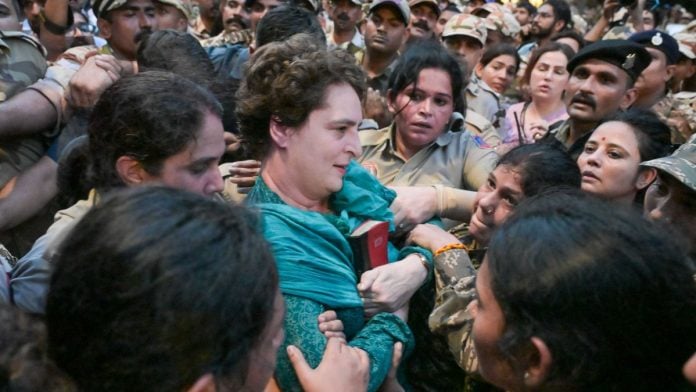

New Delhi: Leader of Opposition Rahul Gandhi climbed over a police barricade and waved the national flag. Congress leader Priyanka Gandhi Vadra raised the Indian Constitution with her hands while being pushed inside a police van. All India Students’ Association (AISA) national president Neha Bora lay down on the road with her arms crossed and refused to be dragged from her spot.
Opposition leaders crouched under a tree near the Akashvani Bhawan premises for hours before being detained. Cousins Uddhav and Raj Thackeray took to the streets in Mumbai with cadres only carrying the tricolor and not the party’s flag or symbol.
All of them had the same demands—that Chief Election Commissioner Gyanesh Kumar must resign and that the Special Intensive Revision (SIR) exercise must be scrapped.
One of the most popular slogans of the current protests—“Gyanesh, it’s done bro!” — is also significant. It is a callback to a particularly low point during the NEET protest, when there was a faint mist of exhaustion in the air, and rumours were abounding that then Education Minister Dharmendra Pradhan was not going to resign. Bollywood star Salman Khan had then urged protestors to return home.
Khan’s post gave the most potent fodder for meme culture surrounding the protests.
“Sonam, it’s done, bro. Don’t extend this,” Khan had said. Two days later, in a development that was a surprise even to the agitating Cockroach Janata Party (CJP) leaders, Pradhan resigned.
The tagline for the current protests takes that uncertain moment from the NEET protest and delivers a message— if protesters could make a Cabinet Minister resign, they can remove CEC Kumar. While the NEET protests involved trial and error, and negotiations with the right to protest, the effort is more structured this time—almost competitive about which political or student leader climbs the most barricades or has the most number of police confrontations. A new coalition is forming—elected representatives, youth organisations and the civil society are all coming together.
And that is why the protest against Gynaesh Kumar is the Newsmaker of the Week.
Khan chacha to Moets
The NEET protests saw most Opposition leaders, activists and civil society figures turning up at Jantar Mantar only in July, days after the CJP announced its extended sit-in at the designated protest site on 20 June. Rahul Gandhi’s most significant protest during the NEET struggle was also on 21 July, a day after more than 50,000 protesters took over the entire New Delhi police district, and the police responded with lathicharge, tear gas, and allegedly pellet guns. Gandhi then protested outside the residence of the Prime Minister, along with his INDIA bloc colleagues.
Gandhi started to shed his “Pappu” image with his popular Bharat Jodo Yatra, and his journey seems to have reached its crescendo with current protests. He has been trying to mainstream his ‘vote chori’ allegations since last year, when he held a press conference alleging that votes were stolen in one segment of Bengaluru Central Constituency during the 2024 Lok Sabha elections.
However, the Indian Express investigation published last month galvanised the broader distrust that had been building against the Election Commission of India. Gandhi now has Opposition MPs walking beside him, with a bolder demand for the CEC’s resignation, scrapping of SIR and an investigation into the alleged voter list manipulation.
For the last few days, Delhi’s hospitality industry and its police machinery have converged due to the protests. The Opposition MPs seem to be on a food pilgrimage with a healthy serving of protests on the side. They’re staying hydrated with a bottle of PepsiCo’s Sting energy drink and well-fed, before storming to the streets in flash protests.
On Tuesday, Rahul and Priyanka Gandhi, along with party workers and about 300 Opposition MPs, were stopped midway during a march to Nirvachan Sadan on Ashoka Road. They then laid siege at Akashvani Bhavan, sitting under a tree for nearly eight hours, before being detained.
On Wednesday, the Opposition leaders boarded three deluxe buses parked outside Sagar Ratna restaurant in Janpath, right after what seemed to be an innocuous lunch. They announced that they would go to Jantar Mantar, and several MPs, including Imran Masood, Deepender Hooda, and Amrinder Singh Raja Warring, waved the tricolor on top of their bus. After a confrontation that saw Priyanka Gandhi lying on the road and several other leaders alleging injuries, they were pushed into police buses.
On Thursday, INDIA bloc MPs, led by Congress President Mallikarjun Kharge and Rahul Gandhi, once again held a lunch meeting— this time at Connaught Place’s Moet’s Restaurant— before marching to Rajghat.
Together, we stand
Meanwhile, student organisations and civil society groups are also leading the protests from the front, hand in hand— literally and figuratively. There is an alacrity in all sections of society, and a will to lead parallel, concerted efforts to get their voices heard and demands met.
On 26 September, around 60 people, including Neha Bora, Yogendra Yadav, social activist Anjali Bhardwaj, Advocate Prashant Bhushan and CPI(M) leader Dipankar Bhattacharya, were detained near Jantar Mantar. On 2 October, hundreds of students and activists were detained once again, while marching towards Jantar Mantar. Right around the same time, thousands gathered in Mumbai’s Shivaji Park on Friday as the Cockroach Janta Party (CJP) protested against CEC Gyanesh Kumar.
On 3 October, AISA’s Neha Bora led a march to Jantar Mantar, alongside Rajya Sabha MP Kapil Sibal, political activist Yogendra Yadav, Supreme Court lawyer Prashant Bhushan and RTI activist Anjali Bhardwaj. On that day too, 160 protestors, including Bhushan, Bhardwaj, and Bora, were detained. On 4 October, demonstrations continued in Delhi, and 500 protestors were detained as they tried to reach Jantar Mantar. In Mumbai, Shiv Sena (UBT) chief Uddhav Thackeray and Maharashtra Navnirman Sena (MNS) chief Raj Thackeray led a march seeking the CEC’s removal. The march also saw the participation of Congress and the Nationalist Congress Party-Sharadchandra Pawar (NCP-SP) leaders.
This time, therefore, there also seems to be a mutual trust and understanding between different quarters on how to take the protest forward.
In fact, in a press conference on Tuesday, Bora made it clear that this “fight to save democracy is not divided by party lines or banners of student organisations”. She was giving a call for a protest at Jantar Mantar on 10 October, alongside several other student and civil society organisations.
She praised the political leaders fighting on the streets too. She said that the rights of the common citizens are being violated, and the true representatives of the people are taking to the streets. “We see the Leader of Opposition and various INDIA bloc parties take to the streets to defend democracy.”
“They prove that in this fight to save democracy, all Opposition parties and the common people of this country—we are all on one side, and the other side only has ECI and BJP,” Neha Bora said.
(Edited by Ratan Priya)