






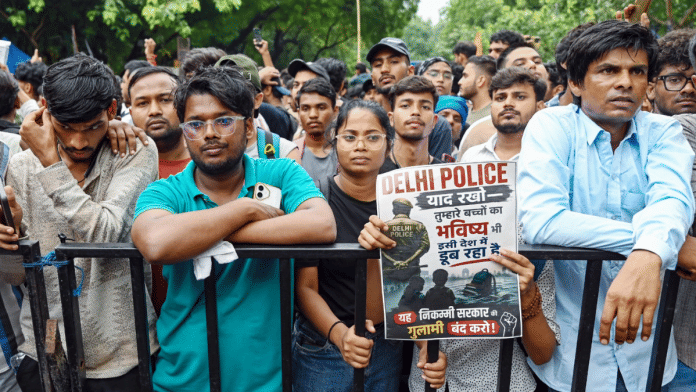


India today has the largest youth population in the world. Around 65 per cent of its people — more than 950 million — are under the age of 35. This is the generation that grew up believing education was the great equaliser. Study hard, compete fairly, and merit will prevail. That promise has shaped the dreams of millions of students and their families.
But what do they see instead? Every few years, another paper leaks. Every few years, students protest. Governments promise reforms, arrests are made, committees are formed, and the news cycle moves on. Then another examination fails, and once again, nobody seems to be held accountable.
If India’s political class still thinks the protests at Jantar Mantar are merely about NEET or the demand for someone’s resignation, it has completely misunderstood what is playing out.
This is not just another protest asking the government to reverse a decision. Students are demanding resignations and accountability, they are asking: who pays the price when institutions fail? Without accountability, promises of reform mean very little. They are no longer willing to accept the familiar response that “aisa hi system chalta hai.”
This generation is not protesting because one examination failed. It is protesting because it believes the system doesn’t want to stop failing. That is a far bigger crisis.
Owning the problem
The BJP should certainly be uncomfortable.
It came to power promising not just a change of government, but a change in governance. Much of its appeal rested on the argument that India’s institutions had become inefficient, complacent, and unaccountable. More than a decade later, it cannot continue to describe recurring examination failures as someone else’s legacy. If institutions have still not changed, then what exactly has?
Perhaps the greatest irony lies in the political symbolism of the present moment. One of the main demands of the protesters is the resignation of Union Education Minister Dharmendra Pradhan. Yet as a young ABVP student leader in the late 1990s, Pradhan himself participated in protests over examination paper leaks in Odisha.
History has a peculiar habit of putting yesterday’s protesters in charge of answering the same questions they once asked. The irony is not about Dharmendra Pradhan as an individual. It is about our institutions. Governments change. Protesters become ministers. Opposition becomes government. Yet nothing really changes.
The protesters are right to demand accountability. That is how democracy is supposed to work. When institutions fail, those responsible must answer for it. The possibility of losing office is what reminds every future minister and public official that there are consequences of failure. Without accountability, there is little reason for institutions to improve.
Governments eventually own the institutions they run.
But in the long run, the Opposition should resist congratulating itself. Supporting students from the Opposition benches is the easy part. They should ask themselves what happens if it returns to power tomorrow. The credibility gap confronting India’s education system did not emerge overnight, nor was it created by one government alone. It has accumulated across political cycles, surviving changes in leadership while exposing weaknesses that appear stubbornly resistant to reform.
If Congress — or any ally of it — returns to power tomorrow, what exactly will change? How will accountability become stronger? And what assurance is there that the next generation of students will not be back on the streets protesting over another examination scandal?
Demanding resignations is part of democracy. Building institutions that no longer produce the same failures is the harder task.
The protests at Jantar Mantar have also drawn support from beyond the protest site itself. Sonam Wangchuk’s hunger strike gave the movement greater visibility, while Indians abroad organised demonstrations in solidarity. From the United Kingdom to Europe and the United States, many expressed support for the students back home.
Their participation was not simply emotional. It reflected something that almost every Indian, whether living in India or overseas, wants to see — a system that is fair, transparent, and trustworthy.
Also read: CJP protest isn’t another Anna movement. It’s something Modi govt doesn’t know how to fight
Public distrust in a democracy
It is not that paper leaks happen only in India. No country has a perfect examination system. Mistakes happen everywhere. The real difference is what happens afterward.
Consider South Korea.
Like India, it is a country where university entrance examinations can shape a student’s entire future. Families spend years preparing for them. The pressure is enormous.
When South Korea uncovered a network involving teachers, examination setters, and private coaching institutes accused of illegally creating and selling examination questions in 2024, the response went far beyond arrests.
The Seoul Metropolitan Office of Education began disciplinary action against 142 teachers in Seoul alone. Many were suspended or dismissed. The government tightened conflict-of-interest rules.
Then came another controversy.
A South Korean college entrance examination in 2025 was criticised after the English paper turned out to be much harder than intended. No paper had leaked. There was no fraud. Yet the head of the Korea Institute for Curriculum and Evaluation resigned because public confidence in the examination had been damaged under his watch.
South Korea is hardly unique. Similar debates over examination failures have led to resignations, dismissals and institutional reforms in countries as different as Algeria, the UK, and Australia.
We may disagree on politics, governments or ideology. But very few Indians would disagree on one thing: systems should be reliable, and institutions should be accountable. One thing people in power should understand is that democracies can survive policy failures. What they struggle to survive is the loss of public faith in the institutions meant to correct those failures.
Our hopes for progress, better governance, and greater prosperity all depend on people believing that the system can still improve. A democracy derives its legitimacy not only from free elections but also from public confidence that its institutions are fair, competent, and capable of correcting their own mistakes. Winning elections gives governments authority. Trust in institutions is what gives a democracy its strength.
Amana Begam Ansari is a columnist, writer, and TV news panellist. She runs a weekly YouTube show called ‘India This Week by Amana and Khalid’. She tweets @Amana_Ansari. Views are personal.
(Edited by Aamaan Alam Khan)