






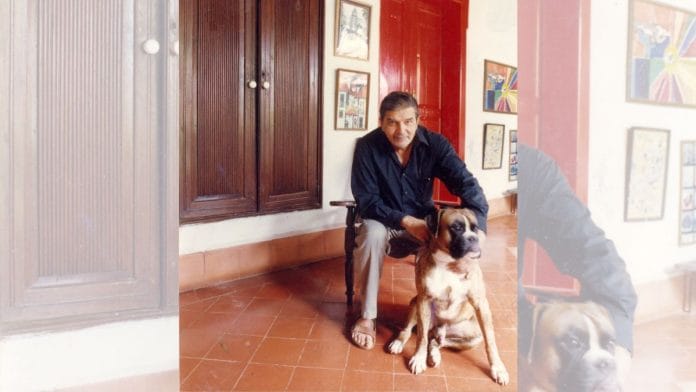


Grey lines dominate the stately frame of cartoonist and painter Mario Miranda’s 1985 depiction of the New York skyline. They grow denser and grimmer the further your eye extends, conjuring an image of corporate America wholly removed from the synth-wave era’s saturated, manic depictions of the city. The composition calls to mind Richard Drew’s Falling Man, the photograph that defined 9/11 – the same vertigo-inducing oppressiveness that fades human scale into insignificance.
But this is Mario Miranda we are talking about, so the frame’s bleakness is broken by a little red tugboat chugging along merrily over the Hudson. Unlike the terror inspired by Drew’s photograph, Miranda gives us that playful pop of colour, indifferent to what looms behind it.
Turn to the Paris piece alongside it, “Bridge of Archeveche, 1984”, and the mood is starker. A solitary figure leans on the Seine embankment, Notre Dame dissolving into the grey middle distance. The stippling remains, but there’s no tugboat to relieve the borderline melancholia. This, too, is Mario Miranda.
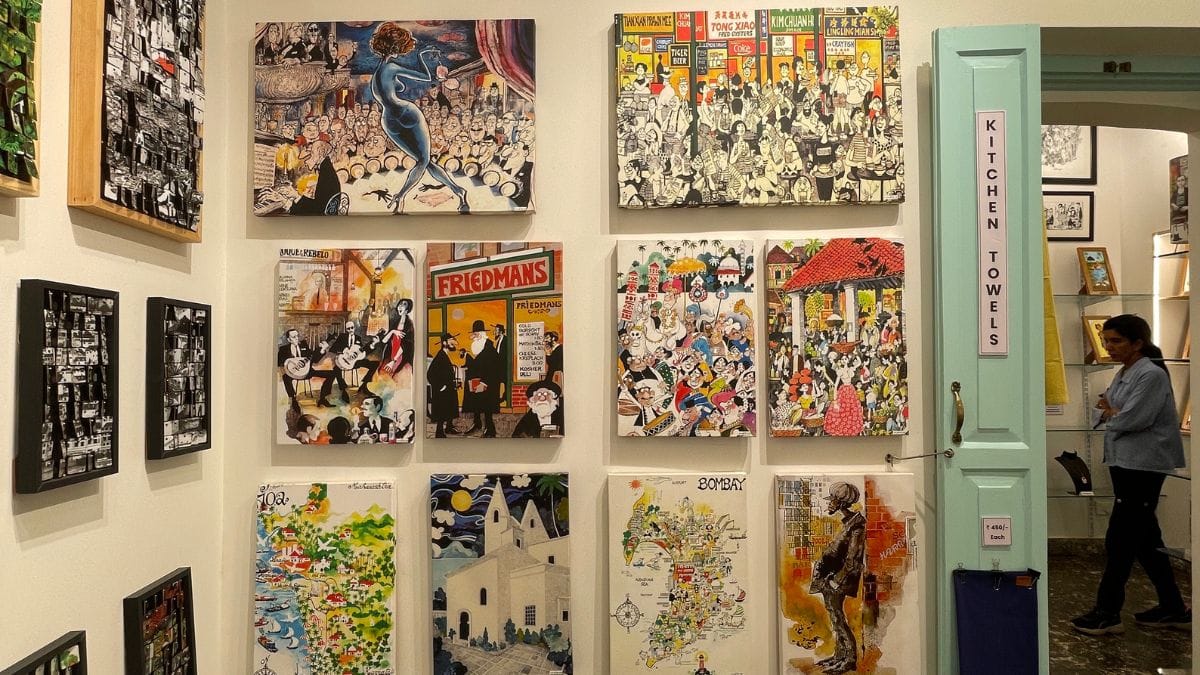
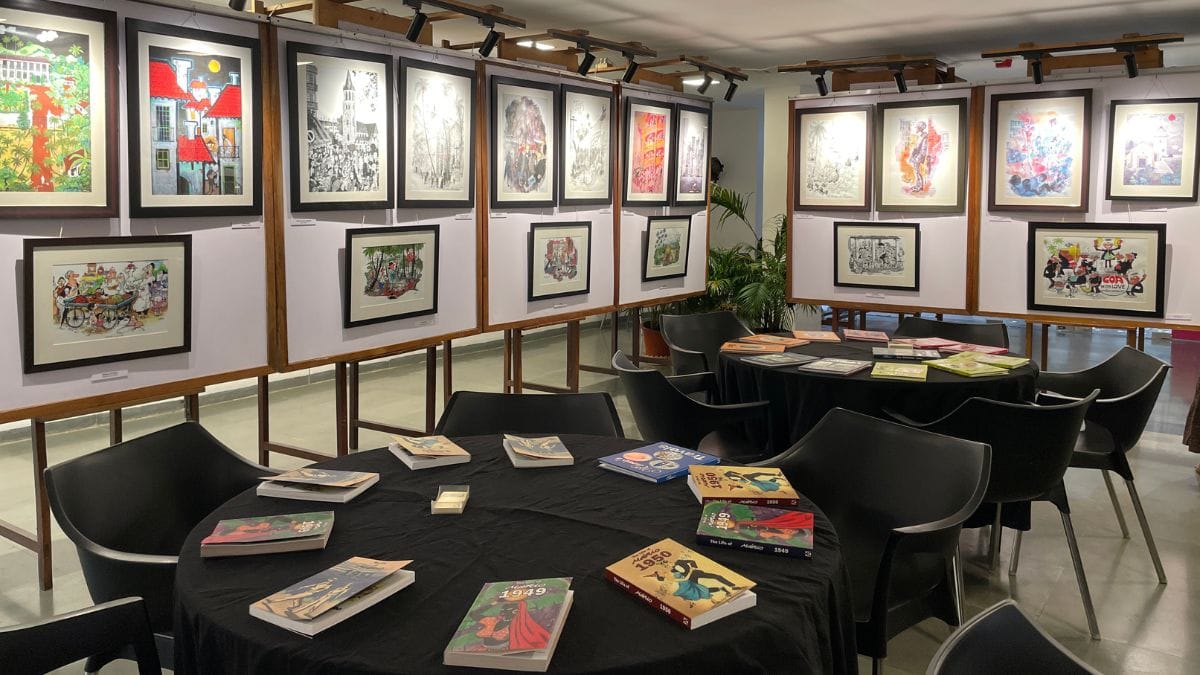
Goa is celebrating the prolific Padma Vibhushan-winning artist’s birth centenary this month. Two exhibitions – one at Panaji’s Kala Academy and another at Clube Tennis de Gaspar Dias in Miramar – flagged off the commemoration. They offered viewers a chance to see, in one full sweep, the range of Miranda’s eye.
Later this week, Sunaparanta Goa Centre for the Arts is hosting Growing Up in Mário’s World—a month-long exhibition of a hundred original works from a private collection. The exhibition begins with a staging of Mario Sossegado De Miranda: Celebrating the Artist, a new play by Isabel Santa Rita Vas, with other shows slated across Goa later this month. And in Fontainhas, a snazzy sixth Mario Gallery has opened in an old house that Miranda himself drew in 1982.
Mario Miranda’s Goa
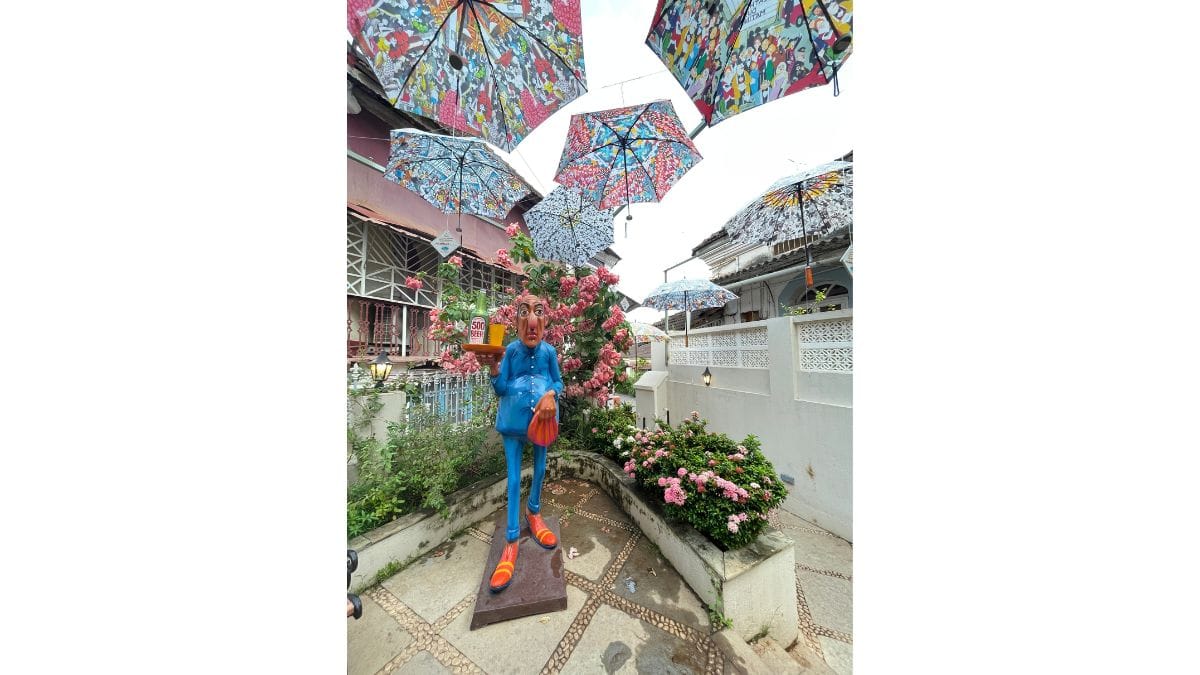
It is difficult to think of another Indian artist so thoroughly beloved, and so woven into the daily texture of the place he came from. Mario Miranda’s murals of happy, exaggerated figures dot Goa – you can see them bhaji-shopping at the Panjim and Mapusa markets, or lingering over a nightcap at the Mayfair Hotel or Park Hyatt’s erstwhile Miranda Bar. He lives on through iconic characters like Ms Nimbu Pani and Bundaldass that he created for some of India’s most prominent publications. And then there is the immediately recognisable style, replicated endlessly with little felicity.
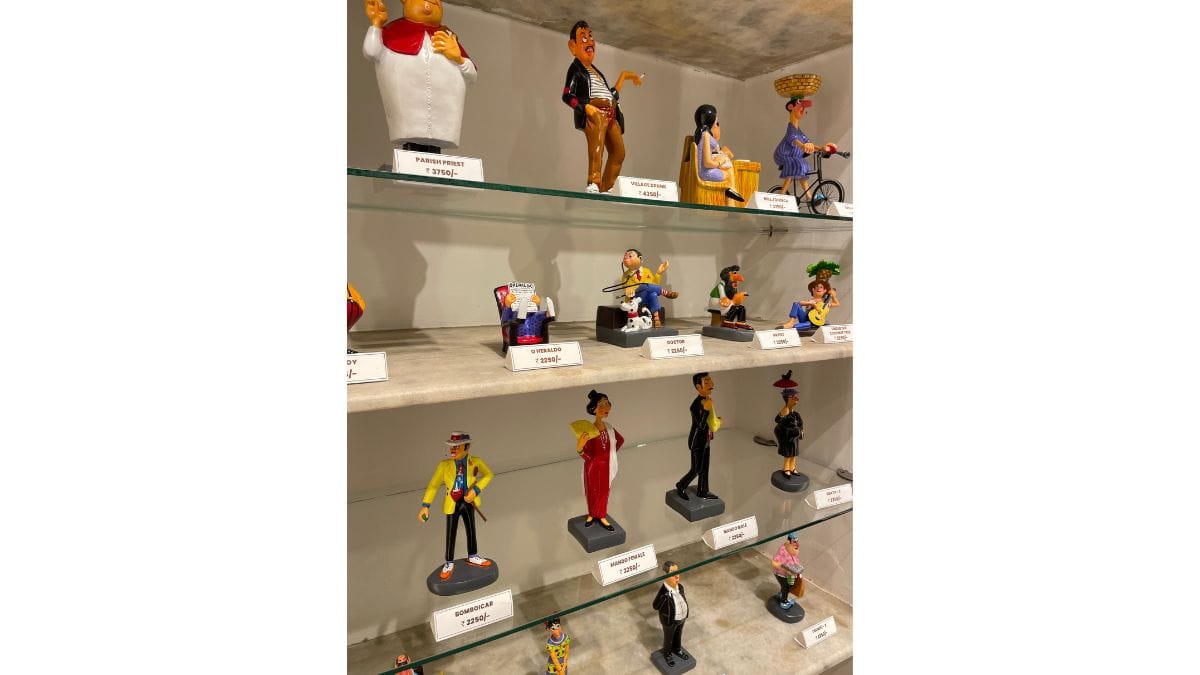
His work hangs in homes across the state in the form of prints, fridge magnets, and other tchotchkes. For a generation of Goans – and for many Indians who had never set foot in the state – Miranda’s Goa was the only Goa there was. It was warm, festive, happily chaotic, often playful to the point of sexism in its depictions of women, but always drawn with affection. He loved Goa, and Goa loved him back. And that love became the lens through which a whole country learned to see its smallest state.
Behind the omnipresent tchotchkes lies another story. Gerard da Cunha, an architect best known for his meticulous documentation of Goa’s vernacular architecture, first encountered Miranda in 1999, when the artist agreed to release da Cunha’s book, Houses of Goa. Some years later, with Miranda’s health declining and his finances precarious, da Cunha found himself in an unexpected new role.
What began as a publishing project – first, a large retrospective volume of Miranda’s work, followed by smaller books on Goa, Bombay, and his travels – grew into something more elaborate. “I had to make a business out of his work. There was only so much we could fit into the books,” da Cunha told me. “Mario would take common themes like the rains or the traffic in Bombay, he would look at ordinary Indians like the bus conductor, and develop them. We realised that merchandise was the key to getting this on the road.”
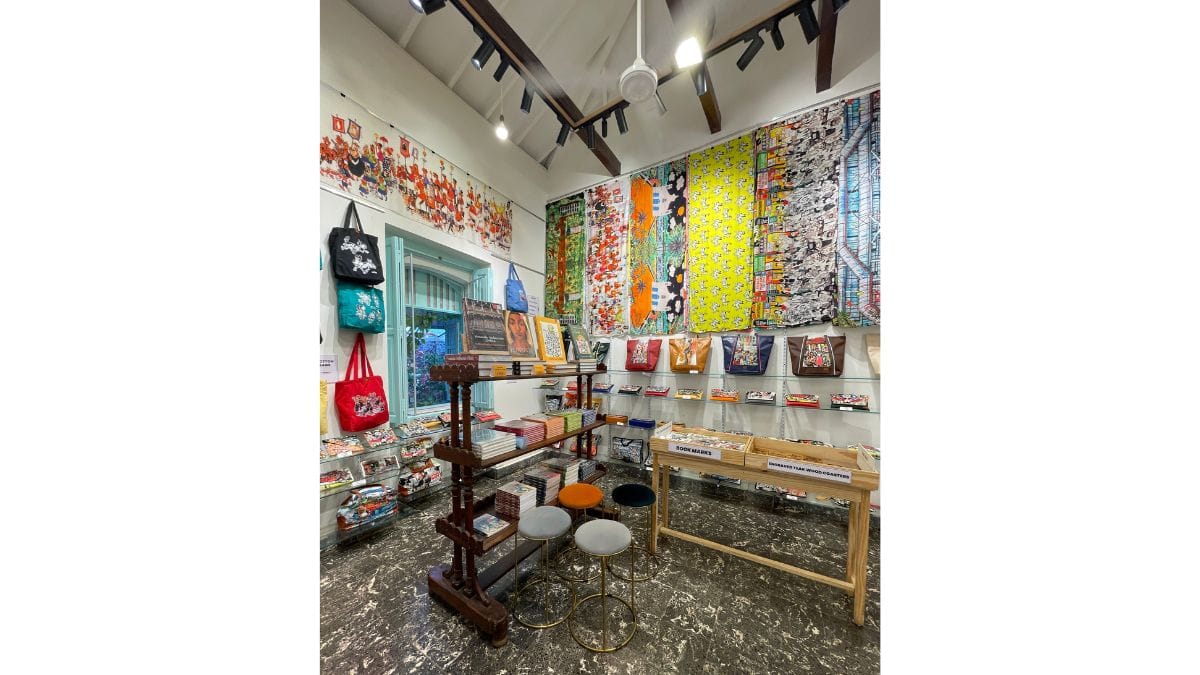
The success of the merchandise has enabled the opening of the centenary Mario Gallery, as well as the start of a freely accessible archive that has kept the artist in continuous public view.
Also read: India is losing out from the glamour around English. Cultivate multilingual workplaces
Dismissed as a cartoonist
Vas is worried that we might forget Miranda despite his ubiquity. “Look at Dr Francisco Luis Gomes,” she mentioned the 19th-century polymath from Goa. “He was an economist, a political writer, philosopher, and an MP in Portugal. But all that people remember about him is the statue of him in Campal.” That’s not a fate Vas wants for Miranda, so she wrote a celebration of the artist’s relationship with his work, delivered in the form of a fantasy.
During her research, Vas recalled reading that someone once asked Miranda if he was happy being an artist. “He said ‘Yes, very, but I might have liked to be a musician, because of the applause,’” Vas said. “That idea stayed with me. He really wanted to connect and have a community, but an artist’s life can be very lonely.”
Some of the applause that Miranda craved, but didn’t get to see in his lifetime, might have been from the art establishment. The “cartoonist” label attached to Miranda is a word that, in the hierarchy of Indian art, places you outside the gallery system, beneath serious curatorial consideration.
This absurd diminishment of Miranda’s spectacular range becomes apparent when you look at his work: The drawings from Europe, the sombre depictions of Goa, the illustrations he made for writers Dom Moraes and Manohar Malgonkar, and the visual diaries from his earliest years. In a 2008 essay titled The Art of Mario Miranda, critic Ranjit Hoskote wrote, “Editorial artists are regarded with some dismissiveness as being narrowly purpose-driven; it is believed that they are tainted by having their work embedded, as lightweight relief, within a popular medium with its compulsions towards entertainment and advertisement… [But] he represents the lineage of the gadfly-provocateur and the witness to caprice and unreason, whose standard-bearers include Goya, Hogarth and Daumier.”
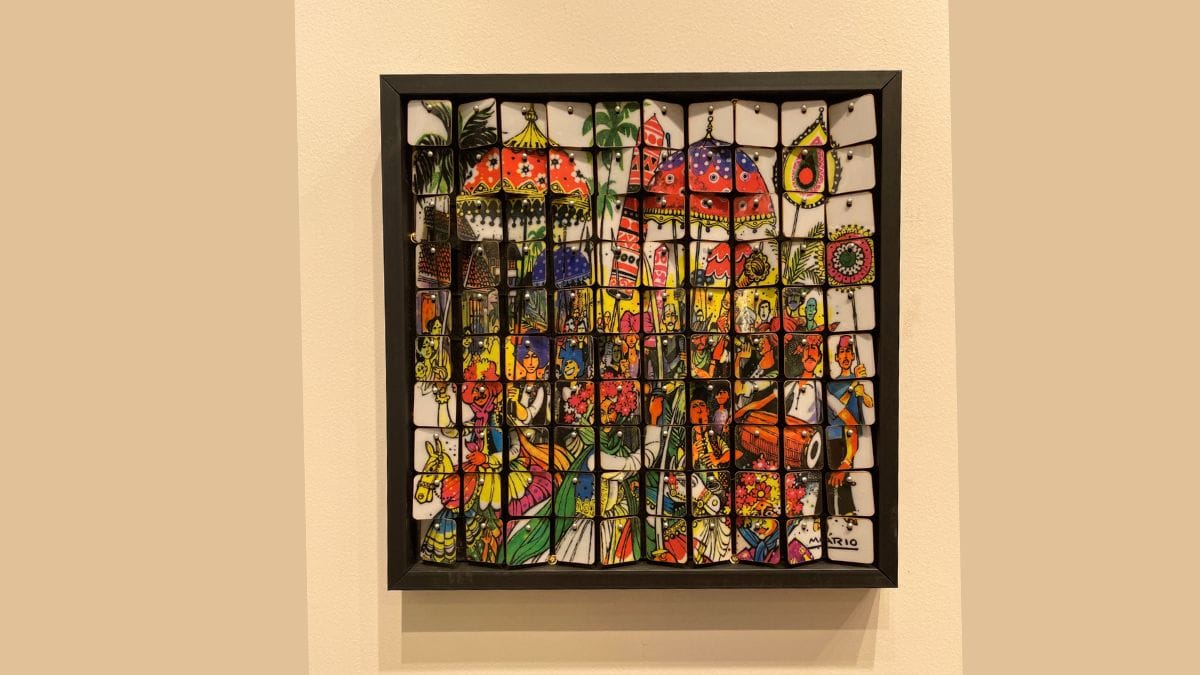
Subodh Kerkar, who holds the Mario Miranda Chair for Arts at Goa University and founded the Museum of Goa, does not accept the verdict. “Goa has gifted the world three visual artists,” he said. “FN Souza, VS Gaitonde, and Mario Miranda.” While Souza and Gaitonde are in the canon, Miranda is only now beginning to be properly seen.
“For a Goan of my generation, Mario was a constant presence,” said Vivek Menezes, writer, photographer and co-founder of Goa Arts and Literature Festival. “In fact, sometime in the 1990s, I feel like Mario’s memories of Goa blurred into mine – I don’t know where my memories end and where his begin.”
Menezes, who has written extensively on Miranda, believes that the overt focus on his Goa work is a disservice to the artist’s legacy. “The more I understand Indian modernism, the more I realise how hugely impactful his work was to an understanding of contemporary visual culture in India. He can’t be pigeonholed as a cartoonist.”
The larger conundrum is also that this lack of formal recognition goes hand in hand with a very successful merchandise business. “Yet, the commercial success has not translated to any commensurate stature as an artist,” said Menezes.
Part of the answer might lie at the Sunaparanta exhibition. The hundred original works in Growing Up in Mário’s World are a deliberate corrective to the Miranda of the merchandise. Shaun Lobo, who assembled this collection from works first acquired by his late father Ronnie, a close friend of Miranda, described them as “a reflection of his career”. These include the earliest pieces from Paris, made during his Calouste Gulbenkian Foundation Scholarship in Europe, mid-career works documenting Bombay’s extraordinary transformation, and the murals and book illustrations of his later years. “Most of them showcase Mario explicitly as a modernist,” said Menezes. “They make the argument that his work deserves to hang at the NGMA, alongside Jamini Roy and Abanindranath Tagore.” An artistic reckoning, he said, is coming.
Miranda did not live to see any of this. He died in 2011, still craving the applause. But 15 years on, his work is finally making a case for itself.
This article is part of the Goa Life series, which explores the new and the old of Goan culture.
Karanjeet Kaur is a journalist, former editor of Arré, and a partner at TWO Design. She tweets @Kaju_Katri. Views are personal.