




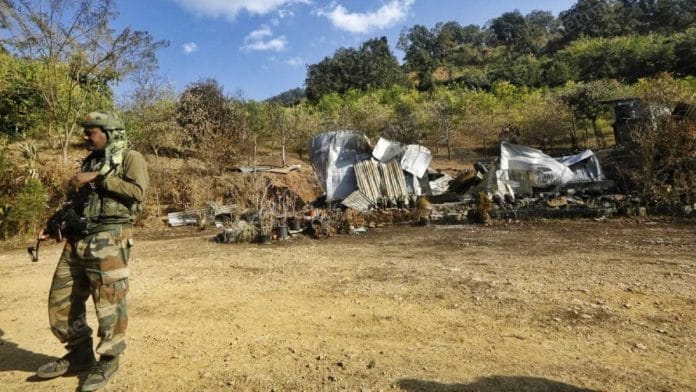

If some social media accounts are to be believed, the ongoing Naga-Kuki clashes in Manipur were triggered by a brawl between some youths of a particular community, who were drunk and threw stones at the houses/properties of the other community. Within a couple of days, entire communities had forgotten their peaceful coexistence and become sworn enemies—an enmity which has claimed many lives and shows no signs of abating.
Earlier, the tribal unity had taken to the streets in solidarity to protest against a High Court order that they perceived would have harmed their interests vis-à-vis the Meiteis. The results were disastrous, sowing seeds of hatred and uprooting thousands on both sides of the divide.
In India’s Northeast, a young man’s arrest for a crime—theft, assault, even something as serious as rape or murder—undergoes a narrative transformation. It no longer remains “a crime committed” by an individual, in a personal or individual capacity. The story becomes “our boy is being targeted”, followed by ‘community-based’ calls for justice or condemnation. Elders and NGOs/CSOs convene. The village council issues a statement. Social media erupts with appeals to “stand with our own”. An individual act gets coloured as an attack by one community or against the other. Emotions are fanned as if an entire community is cast as the victim/aggressor. The accused becomes a target of collective persecution. Condemnation based on a strong moral fabric is creditworthy; ‘communitisation’, perhaps not.
This pattern—communities in the Northeast closing ranks instinctively around their own, regardless of individual culpability—is one of the most under-examined obstacles to justice, development, and inter-community peace and maintenance of public order in the region.
It does not confine or contain conflict; it does the opposite—conflagrates it.
A dispute between two individuals metastasises into a dispute between two villages. A crime against one person becomes a grievance nursed by entire communities for generations. What should have been an individual infraction of law becomes a matter of collective honour—and once honour enters the equation, resolution becomes exponentially harder, because no community can be seen to “lose”.
Closer to home, in Nagaland, my karmabhoomi (field of action), the land demarcation is unsubstantiated and unrecorded in land records. Village domains and jurisdictions are loosely defined, so cases of land and property rights often become bones of contention. A small village named Lamhai Namdi and its control became a subject of dispute among both communities, digging in deep and trying to buttress their claims by bringing in other ‘tribes’ to hedge their bets. Violence erupted, with communities drawing upon both overground civilian and underground resources to preserve their domain. Some lives were lost before an uneasy calm returned, and has stayed.
Instances such as these are not uncommon and have dotted the maps of most northeastern states. Entire communities and regions dwell on a precipice that can give way without any forewarnings. For the rest of the country, these incidents and names don’t even register. For the Northeast, these are alarm bells.
Understanding why this happens and persists even as the region modernises requires going back to how authority, identity, and justice were structured in these hills, before the modern state institutions arrived.
Justice before the State
For most of their history, the hill and tribal societies of the Northeast did not experience ‘the State’ as the primary guarantor of order. Long before colonial administration, security, justice, and identity were organised around the clan, the village, and the tribe—not around a distant, centralised authority. Customary law, administered by village councils, chiefs, gaon buras, dobashis, and clan elders, governed nearly every dispute: land, marriage, inheritance, property offences, and even homicide.
Punishments were often collective—fines, restitution, or retribution were owed by and to entire lineages, not merely to individuals. Wrongs done by one member of a clan could be avenged upon any member of the offending clan; feuds between two clans could persist for generations. Their origins were sometimes forgotten, but never the obligation to uphold them.
These systems were not irrational.
Historically, most tribal communities were isolated. The primary support systems were ‘within’: clans, villages, hill-ranges, and tribes. In the absence of institutions for investigating, adjudicating, and enforcing judgments across limited jurisdictions and inaccessible terrain, collective responsibility within was the only mechanism of societal discipline and cohesion.
If an individual could commit a wrong or digress from the local norms and simply walk away with no consequence to his kin, there was no deterrent—his own group had no incentive to restrain him. By making the group liable for the acts of its members, customary systems created internal pressure: elders disciplined their own not out of altruism, but because the clan’s collective security, survival, and reputation depended on it. Collective responsibility was the region’s oldest law-and-order mechanism.
Rather than dissolving this pattern, British rule entrenched it. Using the “Excluded” and “Partially Excluded Areas” framework, the Inner Line system, and through the Rules for Administration Police and Justice, the British deliberately kept much of the hill Northeast outside the ambit of regular civil and criminal administration, ruling instead through customary and tribal authorities. Their interest was optimal distancing and governance at minimal cost. For the better part of a century, generations grew up with the lived experience that ‘real’ authority, justice, and protection were derived from one’s own community.
State actions after Independence only reinforced the pattern. Decades of turmoil and instances of disproportionate or indiscriminate action by security forces against entire villages or communities in the 1950s and 1960s deepened a pre-existing instinct to close ranks and protect one’s own. Some of those bitter memories have lingered in the region as entrenched hatred through generations.
Sometimes, anxieties over land alienation, demographic change, and the fear of being administratively or numerically overwhelmed strengthened the historically entrenched mindset for communal solidarity as a survival strategy.
Solidarity as a survival strategy is often missed as mere parochialism: it was not born of backwardness. It was an adaptive response to centuries of perceived weak, distant, or hostile external order. Decades later, a mechanism forged for survival in a Stateless or semi-Stateless domain has outlived the conditions that justified it and has become, in a modern era, actively corrosive.
Also read: The Gyanesh Kumar controversy & Modi govt: When things go wrong the crises keep coming
Why the old codes no longer fit
Modern rule-of-law states rest on a non-negotiable principle: guilt and innocence are individual, not collective. The architecture of criminal justice exists to protect the individual from being punished for what a group is presumed to have done. Equally, it ensures that an individual wrongdoer doesn’t escape accountability by hiding behind a group.
When a community reflexively defends an accused member purely because he is a member—completely disregarding the facts—the principle gets inverted. Community membership becomes a shield against accountability rather than a source of it.
The costs of this inversion are severe and cumulative.
It destroys the possibility of impartial fact-finding. Witnesses within the community are pressured into silence or false testimony. Investigators are treated as hostile outsiders rather than neutral fact-finders. Victims who belong to the same community as the accused are often silenced—expected to prioritise communal “unity” over their claims to justice. A survivor, for instance, may face far greater pressure to withdraw a complaint if pursuing it is conjectured as “airing the community’s dirty linen” or handing ammunition to ‘others’.
Individual disputes get converted into communal ones, and communal ones into permanent fault lines. Once a conflict acquires a communal or ethnic label, it stops being a legal problem with a legal solution and becomes an identity contest with no natural endpoint.
Collectiveness empowers the loudest and most extreme voices. Once mobilisation begins, rarely do saner moderates control the pace and temperature of events—ceding to the aggressive or politically motivated actors, including those with a direct interest in escalation, who capture the narrative. Genuine community welfare falters at this altar.
Solidarity imposes enormous, disproportionate collective costs on people who did nothing wrong. Collective actions such as blockades, bandhs, and fund collections (often forced) to ‘defend themselves’, paralyse free speech and expression, movement, trade, education, healthcare access, and livelihoods in large geographical areas—a form of collective self-inflicted punishment by the community.
Once a conflict is coded as inter-community, it enters collective memory—sometimes in oral tradition, increasingly today in digital form, permanently searchable and re-triggerable. None of this is unique to the Northeast, of course—clan and ethnic solidarity overriding individual accountability is a human, not a regional, phenomenon, visible from feuding lineages in many parts of the world. Manipur is the proof—in a region navigating fragile inter-ethnic coexistence, and a developing relationship with formal state institutions, the bets on getting these wrong are unusually high.
Also read: No, there won’t be a G2. It’s a phantom monster
Disincentivising the reflex
Community solidarity cannot be condemned and consigned to the dustbin. The same social bonds that produce this defensive reflex also produce extraordinary resilience, mutual aid, and cultural continuity that the Northeast can’t and shouldn’t discard. The goal must be narrower and more precise: to disentangle legitimate community welfare and advocacy from automatic shielding of wrongdoing, and to make the formal justice system credible enough that communities no longer feel they must choose between trusting it and protecting their own.
Some prescriptions to move forward are:
- Making the state visibly fair and fast, not just formally impartial.
- Formalising and clarifying the role of customary institutions.
- Protecting witnesses and complainants from communal pressure, especially intra-community victims.
- Investing in cross-community dialogue mechanisms before flashpoints occur, not after.
- The State must avoid its own version of collective punishment.
- The government must focus on civic and legal education through schools, churches, and student unions, helping young citizens imbibe the distinction between standing up for one’s community and shielding wrongdoings within and by it.
The instinct to protect one’s own is ancient. But a modern constitutional democracy and lasting peace between the many communities of the Northeast cannot be built on a foundation where guilt is negotiable by ancestry and justice is a contest of collective will.
Let us endeavour not to erase the bonds of community, but to ensure that those bonds no longer stand between individuals and the consequences of their own actions.
Rupin Sharma serves as the DGP of Nagaland. His X handle is @rupin1992, and he is on Instagram @rupin.sharma.1. Views are personal.
(Edited by Prasanna Bachchhav)