




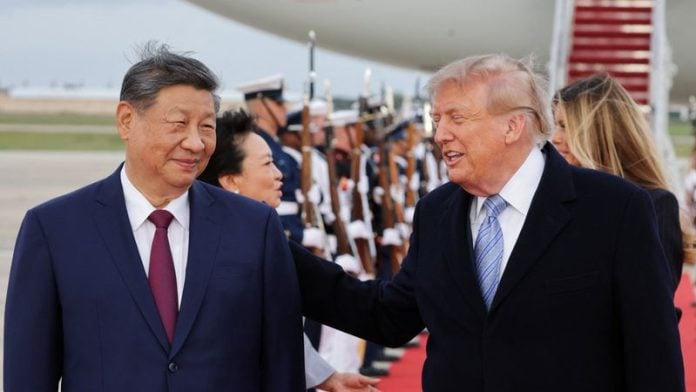

The summit between US President Donald Trump and Chinese President Xi Jinping has aroused anxieties about the development of a G2, where the two superpowers bargain and carve up the world, hurting the interests of others such as India. Clearly, no such bargain has been reached this time, but the unease hasn’t abated. The fact remains that the anxiety is entirely misplaced. There will be no G2, either now or in the future.
It is important to think about what we mean when we say G2. Of course, the two great powers would want to cooperate in order to promote some common interests. And of course, there will be some coordination, some areas where they reach agreement on narrow issues. The US and the Soviet Union did reach arms control and other agreements. The US and China can be expected to reach such agreements too, eventually.
But early bipolar competition will likely be intense, partly because neither side is fully aware of how much it can push and what the other side’s vital interests are, but also because China is a rising and immature power that is eager to assert its privileges. It is also, for these reasons, likely to be far more suspicious of others (especially the US) and far more easily offended by perceived slights. So, the likelihood that the two sides will reach some broad political agreement is highly unlikely, especially in these early days.
Abandonment anxiety
Mutual suspicions between the two great powers are heightened in a bipolar order, which will also prevent unwanted outcomes such as spheres of influence. Indeed, to the extent that any such spheres have existed in the past, they have been because the opposing side hasn’t had the power and reach to challenge it. They’ve not usually been the result of some political arrangement.
In short, bipolar competition is likely to be intense and all-encompassing, both in terms of the issues they cover and the locales where such competition takes place. Moreover, such competition will also be zero-sum. Any gains for either of the powers will automatically mean a loss for the other, which means both will do what they can to avoid such outcomes.
Think back, for example, to the last Cold War period. Though there was good reason for both sides to find some modus vivendi for their intense competition, they never really managed to achieve it. At the very end, when Soviet leaders such as Mikhail Gorbachev were looking into the abyss and realised that Moscow simply did not have the wherewithal to continue the competition, they did start to find ways to moderate the Cold War. This was the result of the Soviets themselves recognising that they were too weak to continue the fight, which they should have recognised much earlier considering that their economy, in its best years, was never more than half that of the US economy. What is surprising is not that they were seeking an exit by the late 1980s, but that it took them so long to reach that conclusion.
The situation with the US and China is very different. Their economies are roughly comparable in size, which means that neither side has much incentive to give up at this point. And they are unlikely to reach the point of exhaustion anytime soon.
Nevertheless, for weaker countries such as India, dealing with the bipolar contest between the US and China is not easy, especially because India borders and is in an active dispute with one of them. Of the many dangers they face is that the polar great power they are partnering with for security is no longer willing to provide it. This is the essence of the G2 anxiety in India, that the US will abandon any security commitments to New Delhi.
Such abandonment is not unusual in international politics. It can happen for a couple of reasons: that the great power one depends upon may no longer be capable of providing such protection, or even if it can, domestic political conditions may no longer accept such burdens. The former is less likely, because this is the result of a great power declining. But such developments rarely happen overnight. We can see material decline taking place well in time and will usually have time to consider alternatives.
Changes in domestic political conditions are more unexpected. They can happen in both democracies and autocracies and can be unexpected, leaving security partners in the lurch. In fairness, this can happen to both the strong and the weak, and it is never pleasant, even if it is understandable. Think of the Soviet Union abandoning India in 1962 or Egypt switching partners from Moscow to Washington in the early 1970s.
Also read: Why the Trump-Xi summit just produced a truce, not a breakthrough
What’s driving the hunt for G2
Let us also be clear that part of the reason some in India are constantly looking for signs of a G2 forming is that they are looking for a means of undermining any security partnership with the US. The logic is that if there is indeed a G2, then the US would be an unreliable partner.
Such efforts at undermining the security partnership with the US are unlikely to succeed for two reasons. First, they have not been successful in the past decade or more, despite the enormous effort undertaken toward the venture. Indeed, the concerted nature of such effort cannot but raise some suspicion as to whether at least some segments of such opinion are being promoted by other powers who would rather not see any significant effort to strengthen Indian security against China. Hopefully, at least some of those who profess such opinions are genuinely concerned, though their efforts only undermine their own underlying objective of strengthening Indian security.
Second, the reasons such efforts do not succeed are also relevant. The reality is that those who adopt such positions are not very practical. They are loath to examine India’s actual options, given its relative capabilities. While railing about partnerships as being dependence on others, they have little answer to how India can manage balancing China by itself, given India’s material weakness.
Ideally, India should not need partners to secure itself. But what the country faces is not an ideal situation. Suggesting that it should grow strong to avoid the need for partners is unobjectionable but unhelpful. If wishes were horses, India would have an economy that is five times its current size, and it would be churning out fifth-generation fighters like China is. Sadly, in the real world, the Indian economy is a quarter or less than the Chinese economy, and the chance of an Indian fifth-generation fighter aircraft arriving in the next five years is zero. Refusing to recognise these realities is infantile.
What India needs to worry about is the overwhelming power and threat at its border, which can seriously reduce its freedom and autonomy. Shadow-fighting mythical monsters such as the G2 will only divert its attention from this real danger at its doorstep.
Rajesh Rajagopalan is a professor of International Politics at Jawaharlal Nehru University, New Delhi. He tweets @RRajagopalanJNU. Views are personal.
(Edited by Prasanna Bachchhav)