




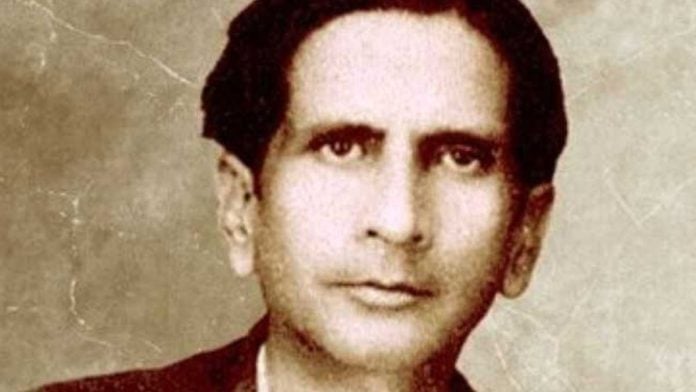

Majaz Lakhnavi did not have to wait for death to become a legend. He achieved the title when he was still a student at the Aligarh Muslim University. As a poet of all poets, he wrote the anthem dedicated to his alma mater way back in 1936, titled ‘Nazr-e-Aligarh’, which is still sung by students to this day. It is popularly called Aligarh Tarana.
This is how famous cultural podcaster Pervaiz Alam described the Majaz mystique: “For the Algarians who shared his times and those who followed later, Majaz was no less than God. This was so because he lived a life of intense poetry and love and his death followed the same passion.”
Lakhnavi’s glory during his university days was such that female students, whom he taught as a scholar from behind a curtain in keeping with the Muslim purdah tradition, slept with his picture beneath their pillows. They also held lotteries in his name to decide who he belonged to.
The more orthodox young ones said that after marriage they would name their son ‘Majaz’. Such was his fan following!
The legend of Aligarh
Lakhnavi was born in Rudauli village in Ayodhya district in the United Provinces of Agra and Oudh, British India, which is now Uttar Pradesh. His family was of medium landowners, not overtly rich, but they carried the much-celebrated Ganga-Jamuni tehzeeb, the shared culture of northern India known for Hindu-Muslim togetherness. This spirit survived several generations.
His younger brother Ansar Harvani was a freedom fighter, a student leader and an associate of Subhash Chandra Bose. Post-Independence, Ansari was a member of Parliament for three terms. Lakhnavi was the elder brother to writer Safia, who was married to poet Jan Nisar Akhtar. They were parents of writer Javed Akhtar and poet and psychoanalyst Salman Akhtar. Lakhnavi’s nephew, son of Ansar Harvani, is singer Nasser Harvani. Freedom struggle, literature, and arts were very much a deep concern of the extended family.
The poetic legacy of Majaz Lakhnavi remains a matter of pride for us, but it is tinted forever by the sorrow of his tragic death at the peak of his fame. He died when he was just 44, on a cold winter’s night.
Majaz was the precious child of his parents who had lost two baby boys before his birth, and his doting mother tended to overprotect him. He grew up as a night bird, as he liked to do his reading and writing late. That’s why his sisters named him ‘Jaggan Bhaiya’. He completed school in Agra in 1929 because his father in government service was posted there. He enrolled in St. John’s Intermediate College there, nurturing the dream of becoming an engineer. That was not to be; poetry awaited him with open arms.
Also read: Amrita Pritam was a lifelong romantic. Faiz felt her poems in his soul
He started dabbling in it in his college days in Agra and took it to great heights when he joined Aligarh Muslim University. It was in Aligarh where he came in the contact of senior poets and writers like Faiz Ahmed Faiz, Fani Badayuni, Makhdoom Mohiuddin, Sahir Ludhianvi and Ismat Chughtai. Lakhnavi’s first collection titled ‘Ahang’ (melody) was published in 1938 with a preface by none other than Faiz.
“The new generation embraced his poetry and felt it throb in their hearts,” said Chughtai. This very first collection included some of his most famous ghazals, including ‘Ai gham-e-dil kya karoon‘ (Oh my sorrowful heart, what should I do). This was later sung by Talat Mahmood in the film Thokar (1953).
From Aligarh, Lakhnavi moved to New Delhi and worked as a broadcaster at All India Radio. He was also one of the editors of the Urdu journal Aawaz. His Delhi days were cut short by a heartbreak from which he never recovered and drowned himself in alcohol. It was a hopeless love for a beautiful and cultured elite society woman who was already married. While she returned his passion, she was not willing to leave her comfortable home to be with him.
“The problem with the best of our poets is that they will not be satisfied by marrying a woman of their class and so also Majaz,” Ismat Chughtai told me.
Lakhnavi died on 5 December 1955. He had gone on a drinking spree with his friends at a tavern in Lucknow, wearing just a white chikankari kurta. While the others returned home, he fell asleep on the rooftop and was found dead the next morning.
It was a tragedy mourned to this day by his family, friends, and admirers. The government of India issued a commemorative postage stamp in his memory. One of the greatest poets who wrote about romance and revolution, Lakhnavi is also referred to as the John Keats of Urdu poetry. His legacy is celebrated by his nephews Javed Akhtar and Salman Akhtar, who spent their childhood in their maternal grandparents’ home with Mamu Majaz after the death of their mother.
Lakhnavi would not only tutor them in poetry but play cricket with them, as recounted by Javed Akhtar. In recent times, Salman Akhtar has organised functions in Delhi and London in tribute to the legacy of the poet. Lakhnavi’s nephew Nasser Harvani sang his verses ‘Kamal-e-ishq hai’ and others. The poet has passed on, but his poetry lives on.
Nirupama Dutt is an author, poet and journalist. Views are personal.
(Edited by Ratan Priya)