






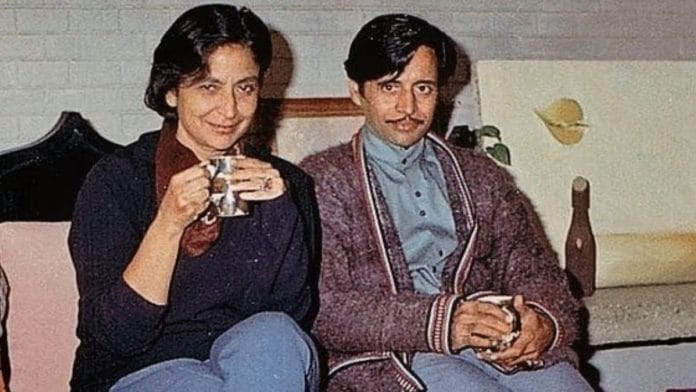

She was born to love, create, and conquer with rare courage, defying all taboos of her time. Celebrated as the high priestess of love, Amrita Pritam was born to a school teacher, Raj Kaur, and Kartar Singh Hitkari, a poet and scholar deeply rooted in spirituality. He nurtured Pritam in rhyme and meter, sowing the seeds of poetry in her early days. It is a different matter that his willful daughter chose the romantic instead of the religious, and went on to become a poet who would follow, above all else, her own heart and dreams.
She was born in Gujranwala in West Punjab, now in Pakistan. The place was “famous for its blood-red Malta fruit and the birthplace of a girl called Amrita”, her lover and painter Imroz (Inderjeet Singh) would joke. Her family moved from the town to Lahore as her father pursued his literary and spiritual pursuits. Her mother passed away when she was not yet 11. It was a lonely childhood for the only child, but Pritam lit it up with her vivid imagination. She invented a playmate, giving him the romantic name ‘Rajan’, and began to voice her thoughts of love and longing with pen and paper. This was the beginning of her poetic pursuit.
Pritam’s journey was a rare one from the personal to the political. Long before the words ‘women’s liberation’ reached India, the artist had freed herself from many obligations of patriarchy.
A passionate, fruitless romance
Pritam has many firsts to her credit. Well before Partition, Pritam was a cherished Punjabi broadcaster on Radio Lahore. She would ride her tonga herself from her marital home in Anarkali to the radio station. She even dared to fall in love while being in an unhappy marriage, and her platonic, unfulfilled romance with Urdu poet Sahir Ludhianvi is today the subject of many a yearning sigh. Even in his later days, Ludhianvi—his mama’s darling—would tell her over a glass of wine, “Ammi, you know, she could have been your daughter-in-law.” That was not to be. After Partition, even though she was a mother to a daughter and son, Pritam distanced herself from her loveless marriage and travelled from Delhi to Mumbai in the hope of meeting Ludhianvi—only to return disheartened.
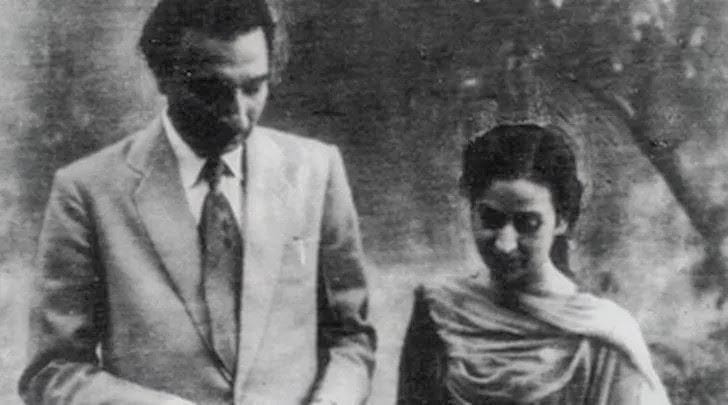
Yet, the magic of this encounter of two great poets is recounted even now. Many recount the intensity of their attraction in pre-Partition Lahore. Pritam lived with her husband above his hosiery shop, and Ludhianvi would come to a paan shop below and smoke cigarette after cigarette until he saw her opening the window of her living room. Catching a glimpse, he would stub his cigarette and retreat. It was perhaps this narrative that inspired a popular Bollywood song: ‘Niche paan ki dukan, upar gori ka makan…‘
Pritam wrote in her autobiography that later, he would come to visit her and they would talk as he smoked. She even confessed that she would pick up the cigarette butts after he left and take a few whiffs. It was the beginning of a lifelong tobacco addiction.
While much was made of her romance with Ludhianvi, there are many, including lyricist Javed Akhtar, who dismiss it.
“Great talents not only invent their present, but their past also to add to their charisma,” Akhtar said.
Of course, Pritam was broken when this intense passion did not fruitify, but she found a great admirer in Imroz. They lived together for 40 years without the need to marry, for the bond was so strong.
Also read: Shiv Kumar Batalvi had many female admirers. He was only looking for ‘A Girl Named Love’
‘Today, I implore Waris Shah’
Pritam’s contribution to literature was immense: she authored over 100 books of poetry, fiction, biographies, and essays. She wrote in Punjabi, and took the language to unparalleled heights. She was the first woman writer to win the Sahitya Akademi award way back in 1957, when the likes of this scribbler had not even learned the alphabet. This was followed by many awards and accolades. She was the first Punjabi writer to win the highest Indian literary honour, the Jnanpith Award, in 1980.
Many other honours followed her at home and abroad, but her greatest contribution was the Partition poem that described the tragedy inflicted on women, both Muslim and Hindu. She called out not to politicians or rioters but Waris Shah, the great Punjabi Sufi poet of the 18th century, who had penned the tragic legend of ‘Heer’. The poem went straight to the hearts of the displaced in the vast, merciless, bloody migration of 1947.
The famous Urdu poet Faiz Ahmad Faiz was to recall later that he got the poem in the prison in Pakistan, where he was detained for his Leftist commitment, and the words entered his very soul for the pain they encased. Faiz said that after he was released, he found that the poem had touched everyone and they kept it in their pockets. Such was the weight of Pritam’s words that her refrain had reached bleeding hearts from the elite to the banana sellers in the streets.
Yet, on this side of the border, Sikhs were angered that her words were dedicated to a Muslim poet and not a Sikh Guru. The communists felt she should have written in the name of the Russian leader Lenin. The importance of Pritam lay in the fact that she had chosen to call out to a poet loved equally by the Hindus and the Muslims:
“Today I implore Waris Shah
to speak up from his grave
and turn over a page of the Book of Love.”
Nirupama Dutt is an author, poet and journalist. Views are personal.
(Edited by Prasanna Bachchhav)