






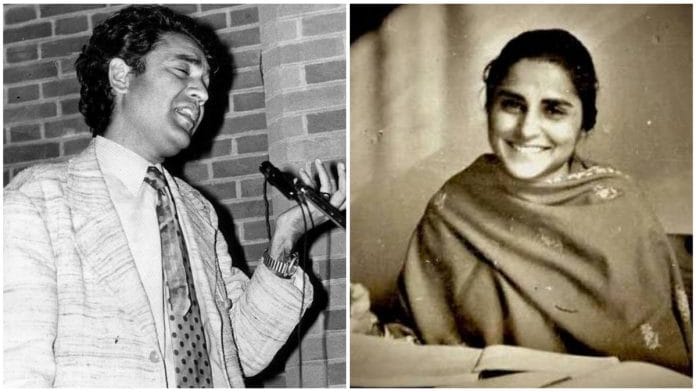


Poets come and go, leaving their legacy in human hearts. But there are some who strike a chord so deep that they are destined to become legends for all time. The Punjabi lyrical poet Shiv Kumar Batalvi was one of the few whose verses were to remain evergreen in Punjabi souls from one generation to another. His 90th birth anniversary on 23 July still finds him on top of the charts as the man who was looking for “a girl named love”—Ik Kudi Jihda Naam Mohabbat.
He was born in Barapind, Narowal, in the Sialkot district of united Punjab and migrated with his family to Batala when Punjab was split into two in the great divide of 1947. The 11-year-old boy never lost the pain of parting from his home and hearth, leaving the greens of his village and the friends he would never meet again. This was a major melancholy that was to be found in his verses — of being cut off from all that made his life in the village. Life, of course, went on, and he started to channel his losses and pain into poems, owning his new habitat by adding the title of ‘Batalvi’.
The only time I saw him in person was as a four-year-old child in the young city of Chandigarh, accompanying my mother and older cousins to a mushaira in Nehru Park. I recall a fair, lanky young man who came on stage to sing his verses into the mike, and the listeners went into raptures. He rose to great fame and moved to Chandigarh, where the State Bank of India was to give him an honorary job where all he was required to do was sign the register and dedicate himself to his verses. This had never happened before or after him to any poet.
Batalvi’s popularity rose and with it female admirers. It is said that girls in the Panjab University hostels would keep his pictures under their pillows. As far as the fanfare of girls and addiction to liquor went, he had no forerunner among Indian poets except the famous Urdu poet Majaz Lakhnavi of Aligarh Muslim University. Of the latter, it is said that girls would draw lots in the hostels to decide who Majaz belonged to. Such are the privileges only of great poets!
Also Read: Punjabi Dalit fiction is reaching an English audience at last. The book is called Gangrene
The girl named love
Deep, passionate love visited Batalvi in Preet Nagar (City of Love), a literary commune established by Gurbaksh Singh Preetlari, editor of Preetlari (the most coveted literary magazine of Punjab, which is still alive). It was Anusuya Singh, the beautiful daughter of the founder. But some things are not destined, and she migrated abroad. Batalvi was to marry the lovely Aruna of Pathankot in an arranged marriage, but Anusuya, or Anu, remained the girl named love.
In the late seventies, as young journos, a friend and I, smitten by the poetry of Batalvi, decided to write a book on the legend of the poet, which led to a friendship with his wife. It was in the family album that I saw for the first time a picture of a pretty girl, and Aruna told me with half a smile, ‘She is Anu, Shiv’s friend.’ Years later, Anu, who is no more, was to confess to a niece that Shiv was not marriage material, but that she used to gaze at a star in the foreign skies and remember him.
Also Read: Bringing Ghalib to Gen Z—Amitabh Baghel is reviving the Urdu poetry culture
‘My songs will remain’
Batalvi’s poetry was to touch great heights. He was to become the youngest recipient of the Sahitya Akademi Award in 1967, and among his admirers was the queen of Punjabi poetry, Amrita Pritam, who always admired his great talent and legacy.
However, in Punjab in those days, it was the rule of Left-inspired revolutionary poetry, and Batalvi was often belittled for his romantic verses. Yet he retained readers and listeners, for he sang his lyrics in his sonorous voice. The Akademi award was given to his epic verse play Loona, based on the Punjabi kissa of Puran Bhagat, in which he reversed the entire sympathy for Loona, the woman unjustly married to an old man and seeking her right to love someone her age. This angered patriarchal Punjab, but over time Batalvi was the winner by hitting out at a social order that did not allow a woman to love a man her own age.
Alcohol was to be his companion through his life, and his trip to London worsened his situation, with admirers offering him more and more. There, he sang ‘A Girl Named Love’ on the BBC in the hope, it is said, that Anusuya, who lived abroad, would hear it.
Poets are dreamers, and rarely do words reach where they are intended to. When Batalvi returned from England, his health had declined, and he passed away from cirrhosis of the liver in May 1973, survived by his wife Aruna, son Meherban, and daughter Puja. His was indeed a journey from life to legend. The prophecy in one of his poems was: ‘Main nahi ravanga, mere geet rehange’ (I will not be there, but my songs will remain). So true.
Nirupama Dutt is an author, poet and journalist. Views are personal.
(Edited by Asavari Singh)