







Nainital: When Amitabh Singh Baghel heard a ghazal, for the first time, as a kid, the verses stayed with him. It left him with some questions — who weaved these words together so magically? And what do they mean?
“Brimming with curiosity, I went to my cousins who understood Urdu, and they deciphered the two lines by Mirza Ghalib — Go Hath Mein Jumbish Nahin Aankhon Me To Dam Hai, Rehne Do Abhi Sagar-O-Meena Mire Aage ( let the cup and flask of wine remain in front of me though my hands are motionless, my eyes as yet can see),” said Baghel, now a literary curator and founder-chairperson of Lekhni Foundation, a non-profit literary and cultural organisation.
That marked the beginning of Baghel’s journey with Urdu. Since then, he has made a point to appreciate Urdu literature and poetry and make it accessible to a larger audience.
In line with this vision, he launched the Aaghaz Poetry movement in 2019. The platform brought together people from across the globe — Hong Kong, Singapore, Europe, and parts of the US — with a shared interest in Urdu poetry.
“Aaghaz Poetry movement seeks to generate interest in poetry. I started by discussing and explaining Urdu poetry to groups from different parts of the world in English over Zoom calls. We also discuss some English and Spanish poetry, but primarily it’s Urdu,” said Baghel, adding that he keeps organising sessions both online and offline.
For Baghel, while English poetry, too, evokes emotions, it fails to forge a deep connection with the reader as Urdu poetry does.
“This is because Urdu has words for degrees of emotions. The craft of Urdu poetry, especially the ghazal form, makes it mandatory to make a connection between Misra-e-Ula (first line) and Misra-e-Sani (second line),” said Baghel.
With Gen Z embracing poetry to express love, loss, and pain, Urdu poets such as Jaun Elia, Mirza Ghalib, and Faiz Ahmad Faiz have found a new audience. In Elia’s case, Baghel said, he didn’t enjoy much fame during his lifetime, “but through his works, he managed to connect with the lovers of Urdu poetry, especially the youth”.
Like poet Josh Malihabadi, who was conferred the Padma Bhushan by the Indian government in 1954, Jaun Elia also migrated from India to Pakistan. But while Malihabadi was sought-after in both Pakistan and India, Elia didn’t gain recognition on either side of the border.
Another poet that Baghel often likes to quote is Mirza Ghalib, a name that has become synonymous with Urdu poetry. What sets Ghalib apart from others, according to Baghel, is the fact that he has only one diwan (collection of poetry) of Urdu that contains about 235 ghazals.
“With these ghazals, he has managed to connect with people at large, which is a great achievement for any poet,” said Baghel, adding that the ghazals have a verse for every emotion and situation a person experiences.
Also read: Rebel Ranis retells Sita, Draupadi’s stories with modern twist—dowry deaths to workforce
Taking people back to books
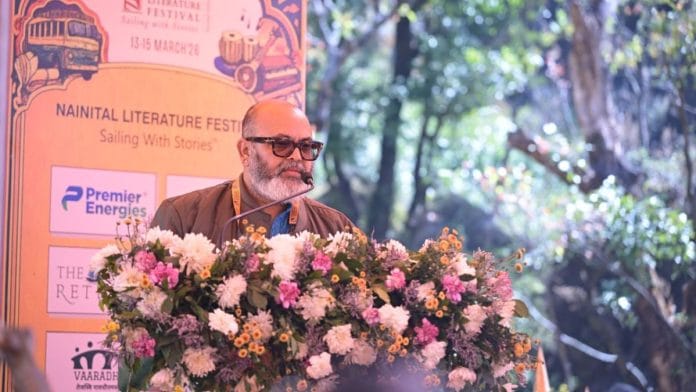
Baghel is a strong advocate of community engagement and argues that literature festivals are the best way to do it. He founded the Koshal Literature Festival in Lucknow in 2022, and went on to curate two more in 2025—the Nainital Literature Festival in April and the Jindal Literature Festival in November. The second edition of the Nainital Literature Festival, a ticket-free event, concluded on 15 March. Over three days in the serene hill town, it saw authors, filmmakers, poets, and influencers talk about their craft, launch books, and chat with guests.
“Building a literature festival from scratch and directing it involves a lot of work; it’s not like a desk job where you have a log-in and log-out time. But the reason I continue to invest so much time in it is that literature drives me,” said Baghel.
He is also confident that literature festivals can help bring people closer to books at a time when there is a decline in reading for pleasure.
“When we bring in authors who talk about their work from the stage, the audience there gets instantly inspired to buy their books,” said Baghel.
Baghel is now preparing for the release of his new book this year — a collection of Urdu nazms penned by different poets from across time periods. He has also compiled Noon Meem Rashid’s nazms in Devanagari script in a book, Zindagi Se Darte Ho, which hit the shelves in 2025.
(Edited by Ratan Priya)
Another ploy to influence the youth. If the influx of Western culture and the English language caste system were not enough, now we have attempts to revive Urdu imperialism.
Meanwhile Bharatiya languages remain neglected as always, the infinitely rich literature of Bharata unread, and thus the minds of the next generation of the nation chronically underdeveloped.
Bharatiyas must never forget that the so-called language of tehjib (by implication: other languages are not cultured/civilised) has invaded not just the everyday vocabulary and pronunciation of many Bharatiya languages but also the cultural idiom of expression (from supposedly benign phrases like uparwala to slurs like the omnipresent kufr metaphor), in the end diluting sanskriti (sometimes turning it into unambiguous vikriti e.g. aurat for women!) while doubling as a vehicle for poisoning the everyday language and literature with irrational (e.g. 7 skies), regressive (e.g. parda) and foreign (e.g. deen, iman) ideas.
Even today, the most popular in Urdu literature (which I call subliterature) is dominated by one genre, and that is the ilk of Jannat ke Pattay, Mushaf, Peer e Kamil, Alif, Rab se Jurnay ka Safar (I’ve read all these titles and know firsthand) – proselytism thinly disguised as literature.