






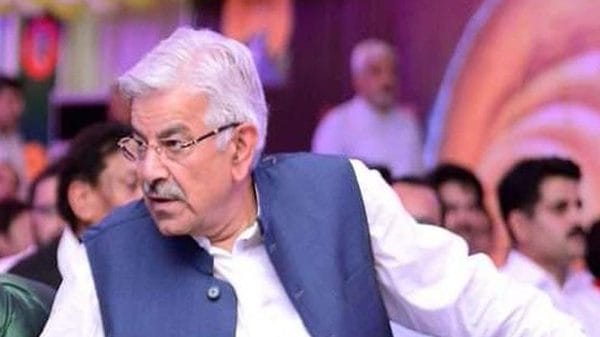


Pakistan’s Defence Minister Khawaja Asif said in a recent interview that Pakistani students should be taught factual history and that many people in the country are becoming alienated from their historical roots. Asif argued that many Pakistanis claim their ancestors came from Saudi Arabia or Iran. He said this mindset was deliberately cultivated through textbooks, describing the academics who wrote them as “criminals”. Elaborating on his point, Asif said that he and former Prime Minister Nawaz Sharif had openly acknowledged that their ancestors were Hindus. He also remarked that studying Ashoka, Chandragupta Maurya, Buddhism, Jainism and Greeks—a clear reference to pre-Islamic history and non-Muslim historical figures—in school doesn’t make him “any less Pakistani”.
The immediate context for his candid views was the restoration of older names of streets and localities in Lahore, but also a broader discussion on the geopolitical developments. Recently, US President Donald Trump urged several Muslim-majority countries, including Pakistan, to join the Abraham Accords and recognise Israel. Asif has said that he does not believe Islamabad should become part of any agreement that “clashes with our fundamental ideologies.”
Is that why the textbooks taught in Pakistan were designed to mould future generations into a specific mindset: because they were at odds with the country’s “fundamental ideology”? This is evident from Asif’s explanation that during America’s wars and Pakistan’s role in global politics, society’s perceptions were changed, and history was presented accordingly.
The defence minister argued that instead of teaching factual and analytical history, school textbooks promoted a limited and politicised understanding of the past. He specifically mentioned KK Aziz’s book The Murder of History, which criticises distortions in Pakistani history textbooks. He also argued that historical figures such as Mahmud of Ghazni should be studied analytically rather than celebrated uncritically, noting that historical events must be understood in their full context.
Also read: Donald Trump’s Abraham Accords ultimatum has put Pakistan in a strategic trap
Nation-state and Pakistan’s search for identity
The bottom line of what the defence minister pointed out is that the Abraham Accords are for Arab countries and Pakistan is not one of them. The message is a clear no to signing the Abraham Accords, recognising Israel, or becoming part of West Asian politics and society. By acknowledging Hindu ancestors, Asif was emphasising that Pakistani identity is rooted in the history of the Indus region and South Asia, not exclusively in the West Asia.
His comments are part of a long-standing debate in Pakistan as to whether national identity should be based primarily on Islam or also on the broader historical and cultural heritage of the region. They also relate to wider debates about nationhood, identity and historical memory.
The advent of nation-states in the 19th and 20th centuries greatly changed how people identified, understood and interpreted national identity. Many modern identity crises can be traced to the conflict between older forms of belonging — such as worship, clan, tribe, ancestry or lineage — and newer ideas that a nation should possess a single, structured, and unified identity. Almost all the nation-states of West Asia, including the Arab states, Israel and Iran, have, over time, developed independent socio-political and national identities.
The emergence of nation-states in present-day Central and Eastern Europe began after World War-I and the disintegration of the Ottoman Empire and the collapse of the Austro-Hungarian Empire which was officially dismantled at the end of the war under the Treaty of Saint-Germain-en-Laye and the Treaty of Trianon. These treaties dissolved the Habsburg monarchy and carved the former imperial territories into new independent nations such as Czechoslovakia and the Kingdom of Serbs, Croats and Slovenes (later Yugoslavia). The emergence of the erstwhile Union of Soviet Socialist Republics (USSR) showed the difficulty of keeping diverse socio-political people under one umbrella, eventually culminating in its collapse in 1991 after nearly seven decades.
Any artificially cobbled political entity is likely to disintegrate as soon as its constituent groups recognise identities that differ starkly from the one forcefully imposed upon them, as seen in the case of the Soviet Union. Pakistan is no exception.
Also read: ‘We the people of Pakistan, irrespective of religion, are the true Indians’
Can Pakistan wish its historical ties away?
Pakistan was created as a homeland for Muslims of the former British Indian Empire. However, Muslims in South Asia were (and are) highly diverse in language, ethnicity, culture, and regional traditions. After independence, a central question of identity emerged in Pakistan: Is Pakistan primarily an Islamic state, a nation-state based on citizenship regardless of religion, or a federation of diverse ethnic groups united by a shared history?
Several major ethnic and linguistic communities, including Punjabis, Sindhis, Pashtuns, Baloch, Saraikis, Muhajirs and others, have strong tribal, local and historically ancient identities that predate the national religious identity. While Islam provides a common religious identity, regional and linguistic identities like Baloch, Sindhi and Pashtun remain strong. The non-compatibility between Urdu and Bengali contributed to the creation of Bangladesh in 1971.
During her election rallies, former Pakistan Prime Minister Benazir Bhutto used to raise the slogan, “Chaaron soobon ki zanjeer, Benazir Benazir” (Benazir is the link between the four provinces of Pakistan, that is Punjab, Sindh, Khyber Pakhtunkhwa and Baluchistan). The distinct languages spoken in these regions and their centuries-old historical roots set them apart from a purely religious identity of Islam. Recently, in an attempt to recognise elements of its pre-Islamisation heritage after nearly 80 years of Partition, Lahore restored older Hindu, Sikh, Jain and colonial names of certain streets and localities.
From this perspective, Asif’s remarks were not simply about genealogy. His statement was less about personal ancestry and more about the historical and cultural basis of Pakistani nationhood. His statements were part of a broader argument that Pakistan should be comfortable acknowledging its pre-Islamic past while remaining a Muslim-majority nation and that doing so need not diminish its contemporary national identity.
After the division of Germany in 1949, East Germany spent four decades trying to define an identity separate from West Germany, ultimately in vain, as the Berlin Wall fell in 1989 and reunification followed in 1990. Pakistan too may take its own time to resolve its identity crisis, again in vain, before deciding to, in this case, bring down the fence.
Seshadri Chari is the former editor of ‘Organiser’. He tweets @seshadrichari. Views are personal.
(Edited by Prashant Dixit)
How is ancestry, Hindu or otherwise, relevant to forging a more businesslike relationship between India and Pakistan. There are contemporary issues that will have to be addressed. At least for the limited, focused purpose go managing a tense relationship, lowering the possibility of conflict very substantially. 2. Some recent remarks by top US and EU diplomats make it clear that Pakistan is not globally isolated. The West sees value in engaging with it seriously.